



Interiors
How to Decorate Around a Colorful Rug in the Living Room
Pull three colors, repeat each twice, set the sofa a step off.
By Zarbish · · 11 min read
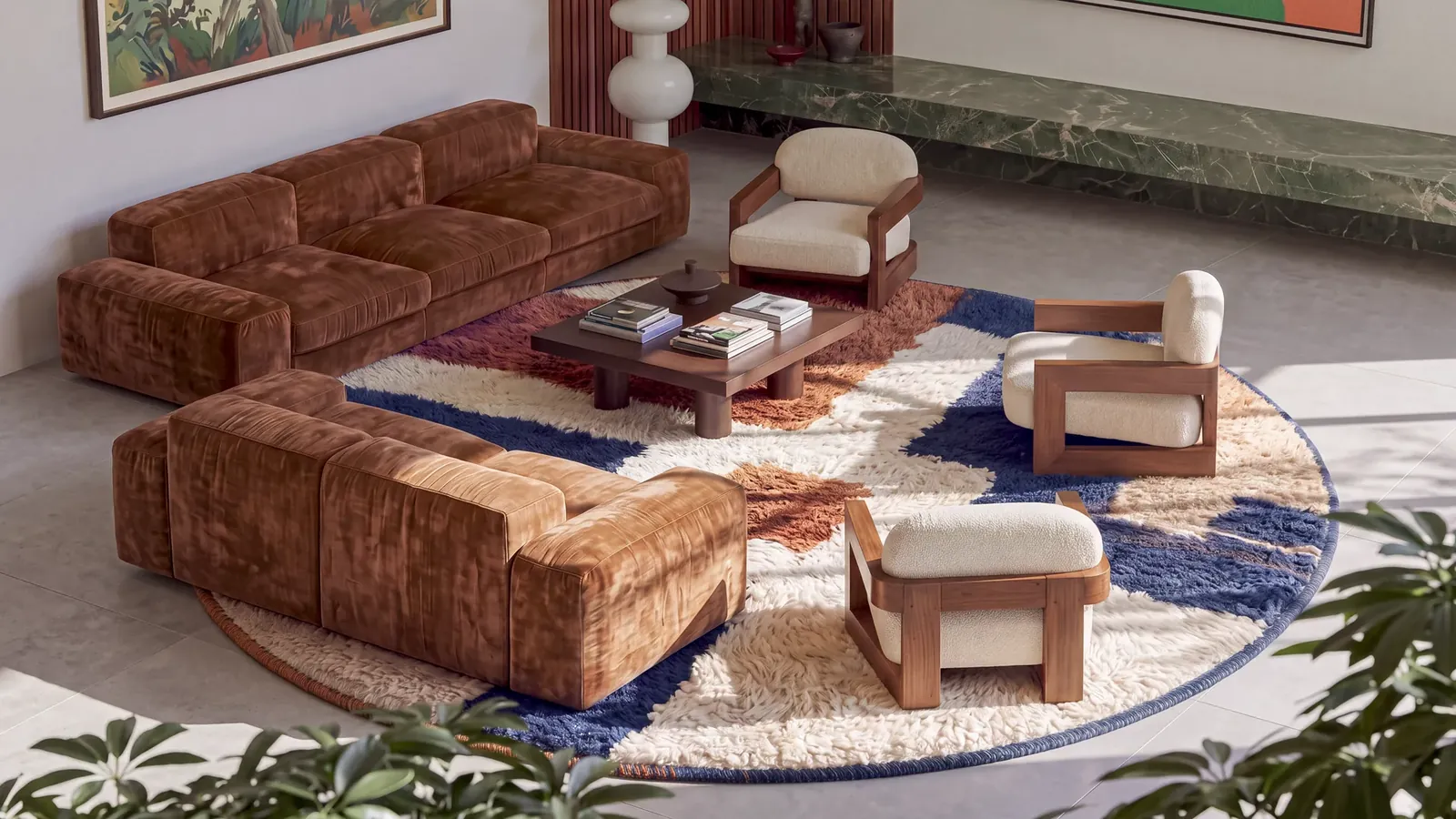
To decorate around a colorful rug in a living room, take three colors from the rug, one dominant and two accents, and repeat each at least twice in the room, in different materials. Keep walls, curtains and floor quiet. A sofa can carry color if the rug already holds it, a clear step lighter or darker.
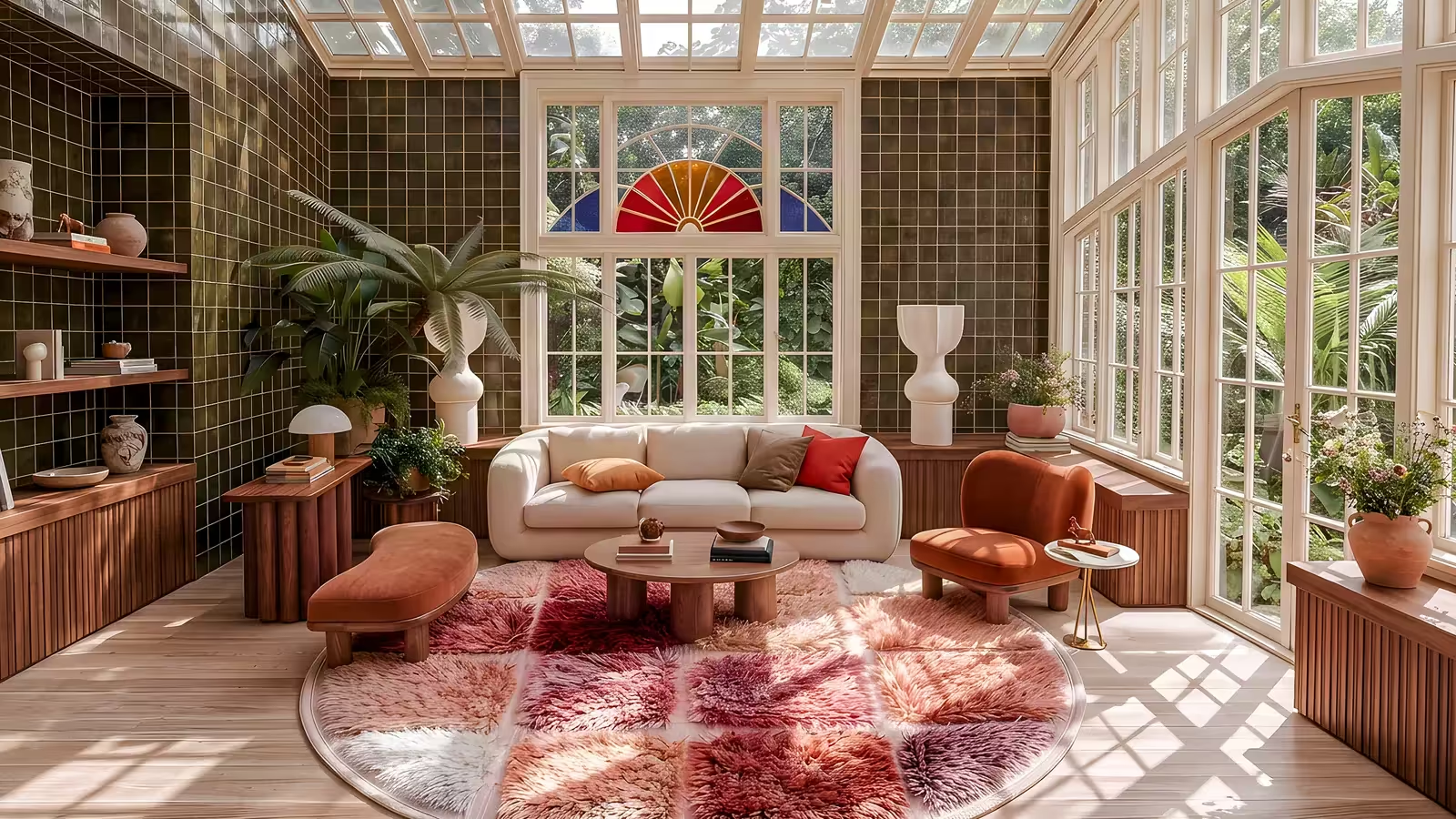
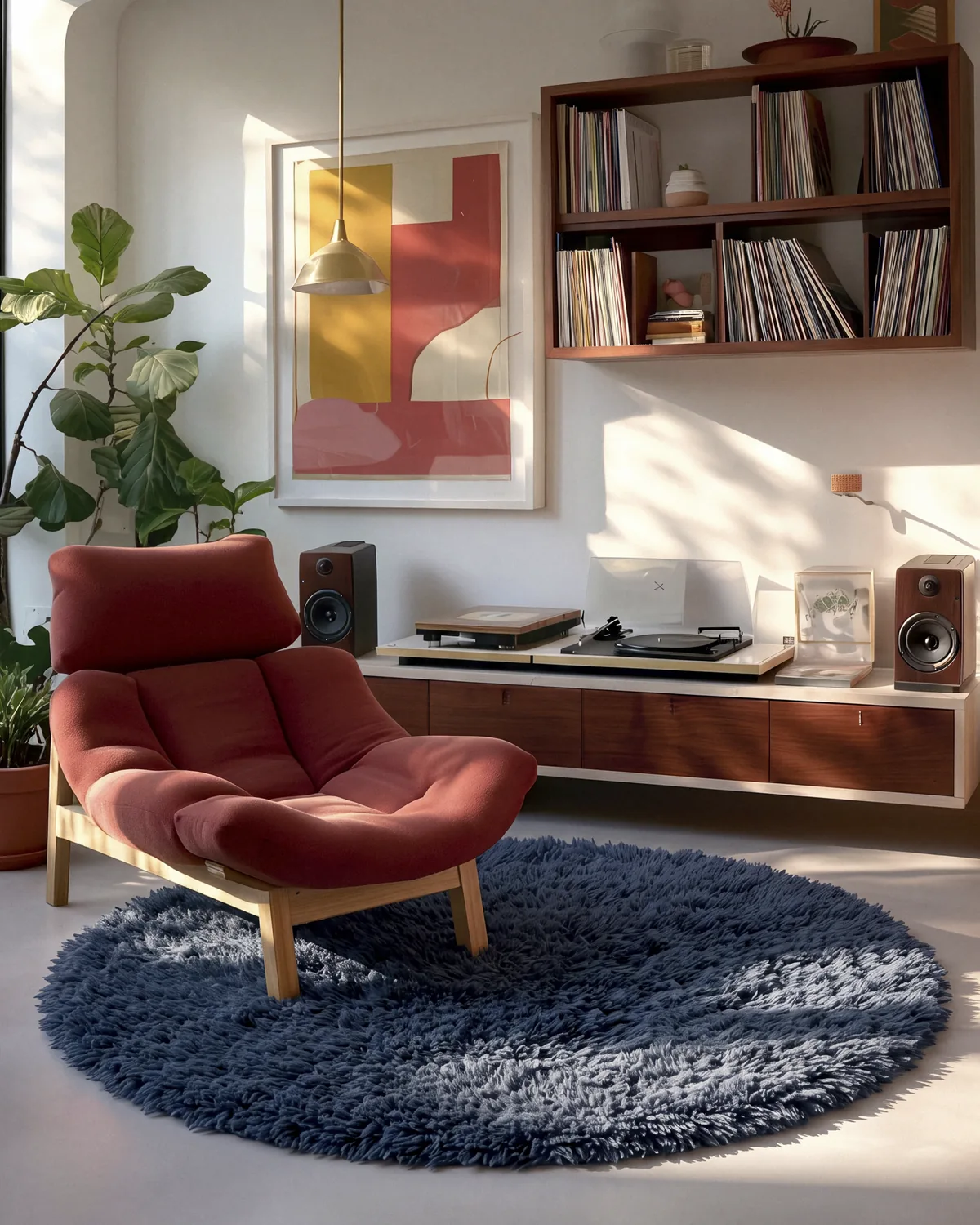
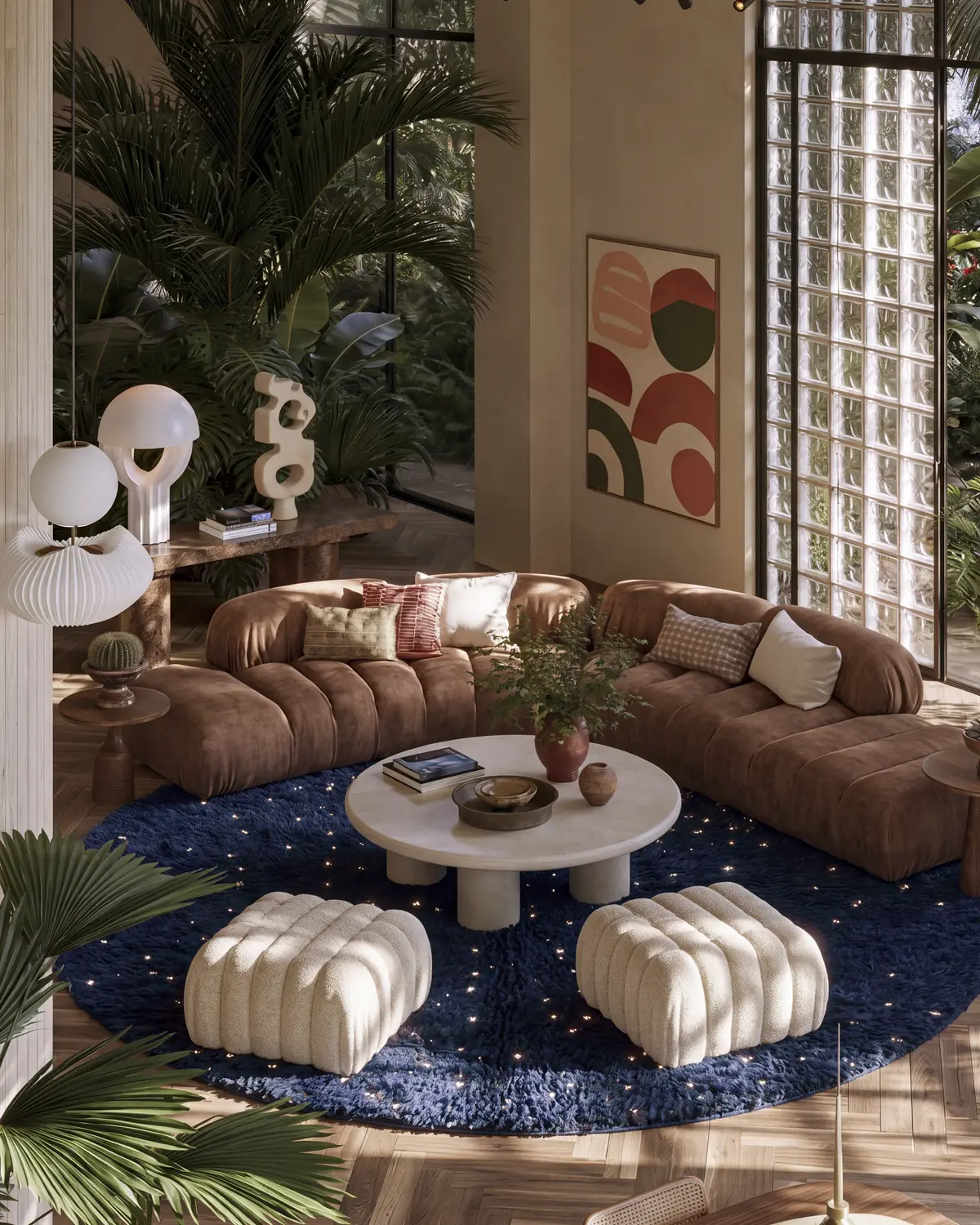
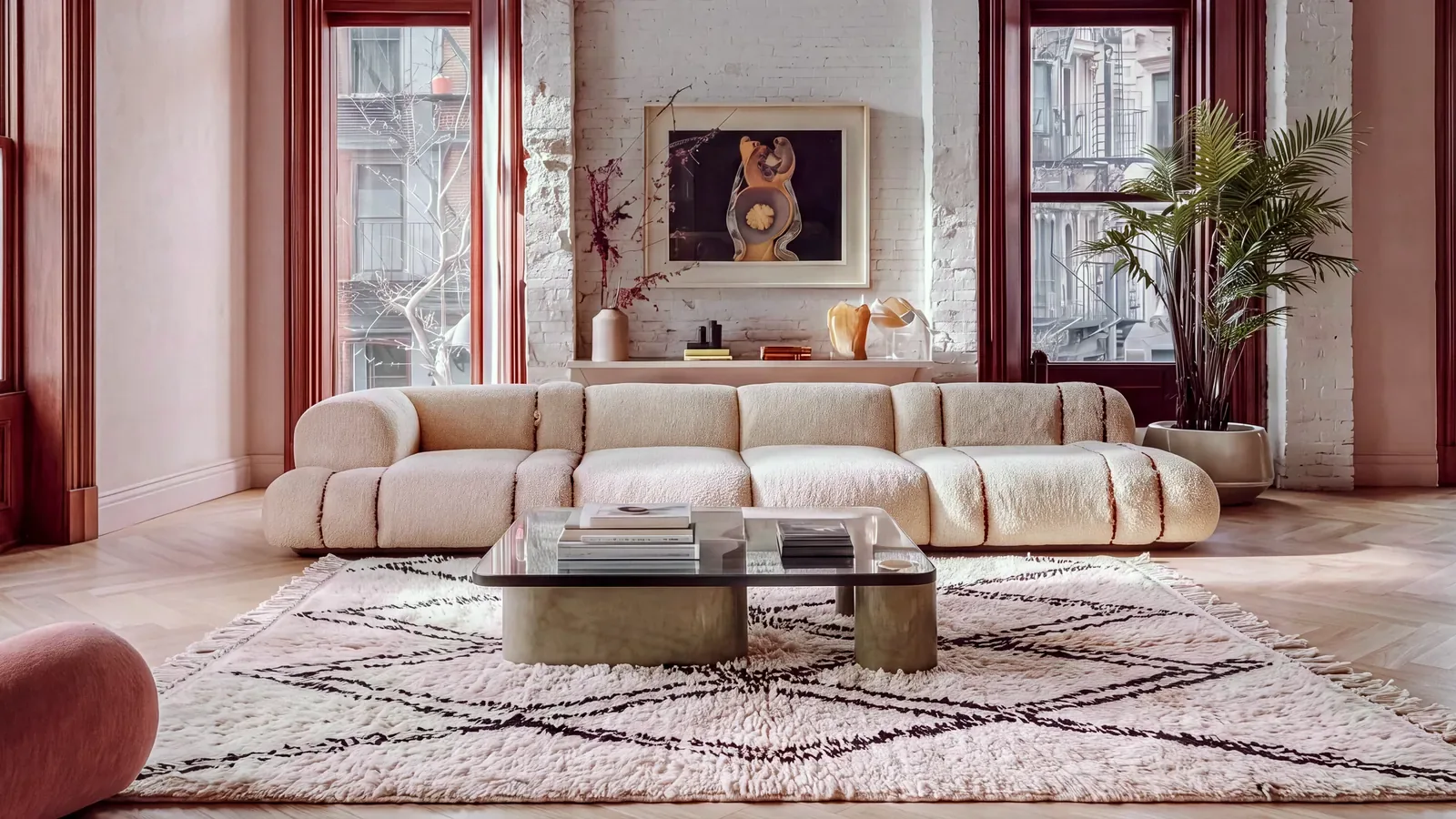
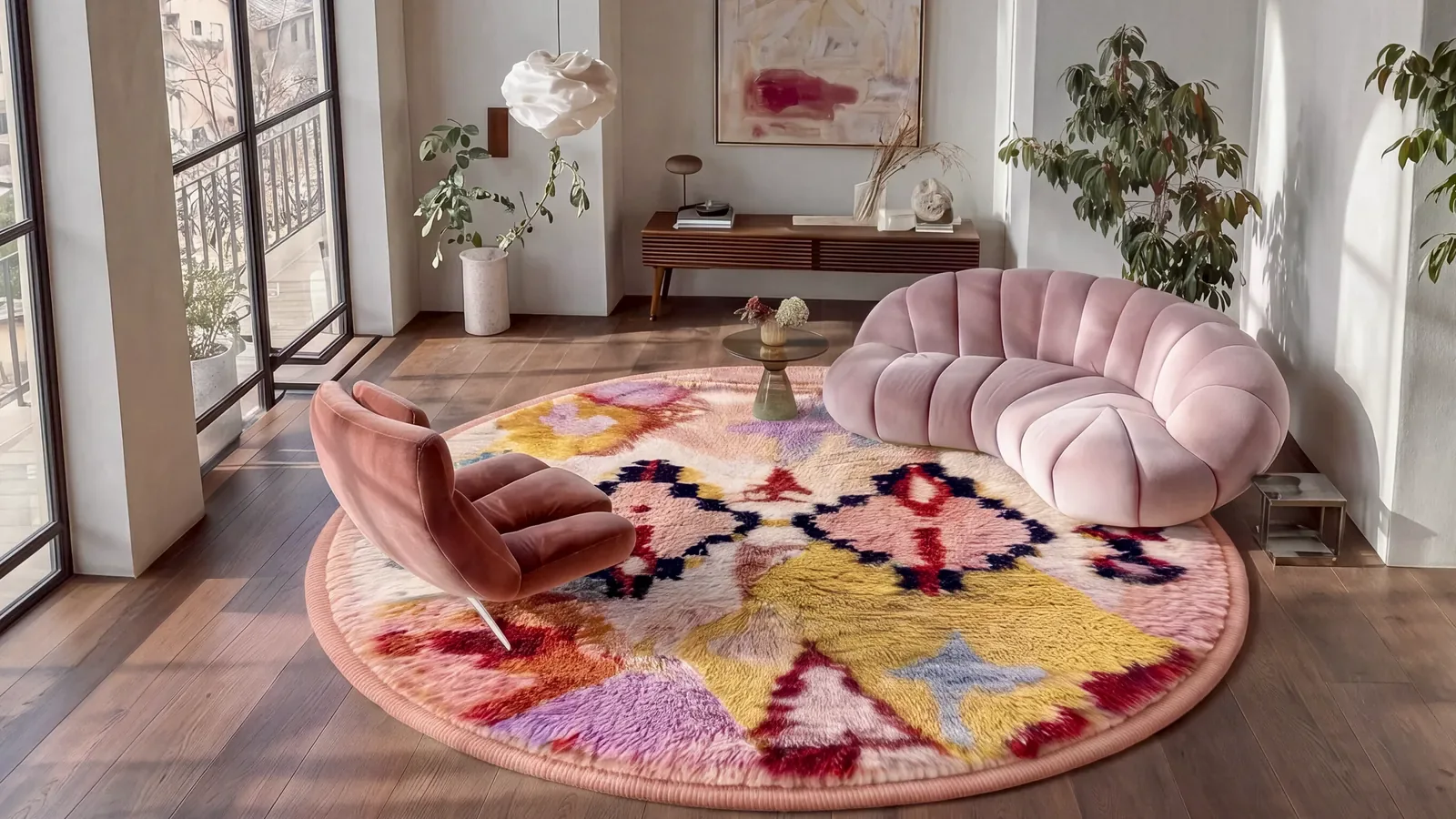
The method takes three steps and one decision about the sofa, and the four living rooms pictured here each test it against a different rug, with the round at the top as the simplest case. Still choosing the rug? Start from what you will not change: the sofa, the wood and the light.
Key takeaways
- To decorate around a colorful rug, take three colors from it, one dominant and two accents, and repeat each at least twice in the room in different materials.
- Ivory, cream and sand inside a rug are its ground, not one of the three colors, so a rug with five colors still gives three picks.
- A sofa can carry color when the rug already holds that color and the sofa sits a clear step lighter or darker; the rug's main color at the same strength flattens both.
- Walls, curtains and the floor around the rug stay quiet, the 60 in the 60-30-10 rule, so the rug remains the loudest surface in the room.
- Wool color moves with the light: test cushions and paint against the rug in daylight and again by lamplight before committing.
Step 1: pull three colors from the rug
The palette for a room around a colorful rug is already decided, by the rug. Name its dominant color, then two accents, and stop at three. A fourth color placed around the room is where rooms start to argue with themselves.
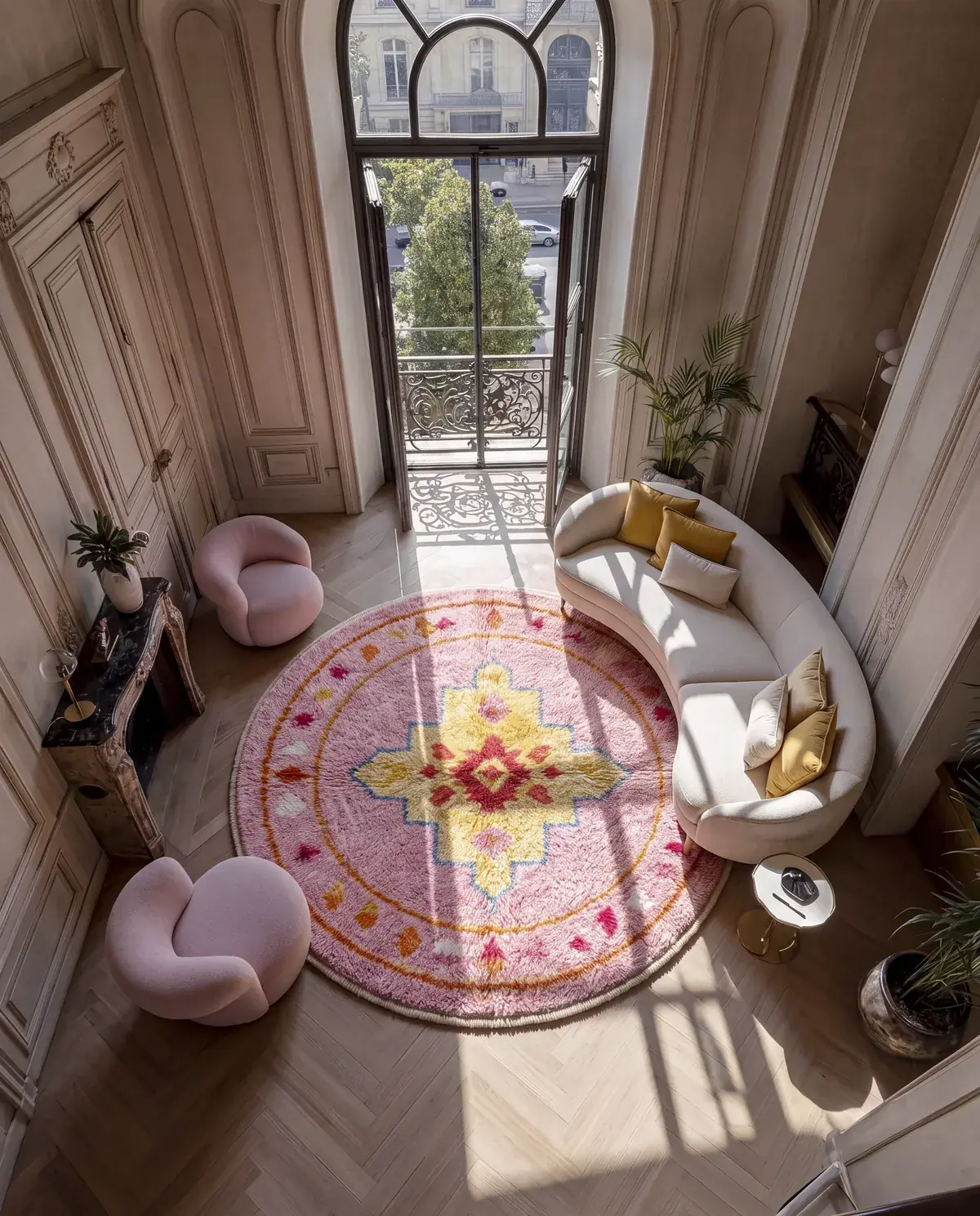
Count ivory, cream and sand as the rug's ground, not as picks. They sit easily with every other color in the room and need no repeating. That is how a rug with five colors in its wool still gives you three.
| Rug | Colors in the wool | Dominant | Accent | Accent |
|---|---|---|---|---|
| Warda, Bloom | Pink, mustard, teal, red, orange, ivory | Pink field | Mustard medallion | Teal outline |
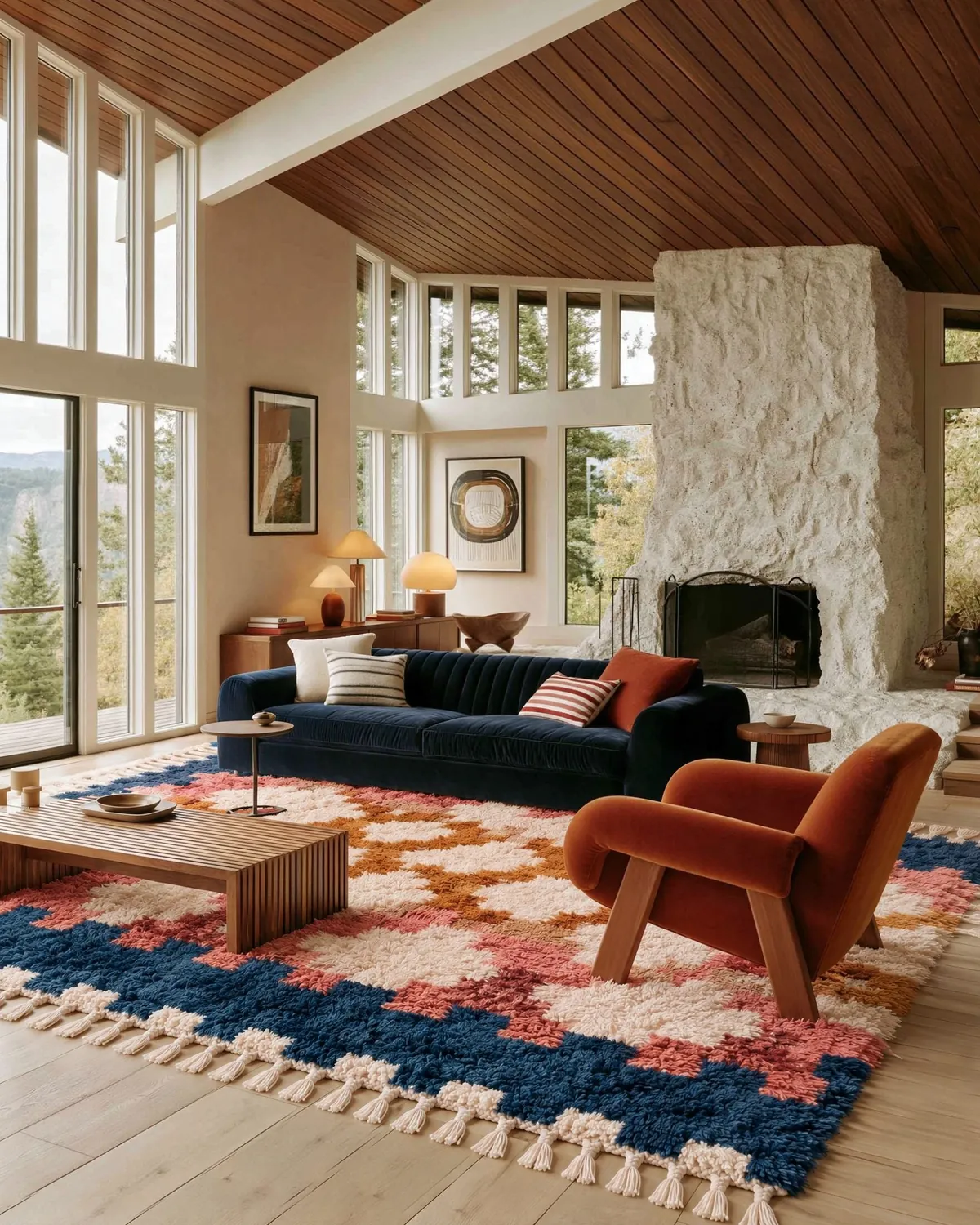
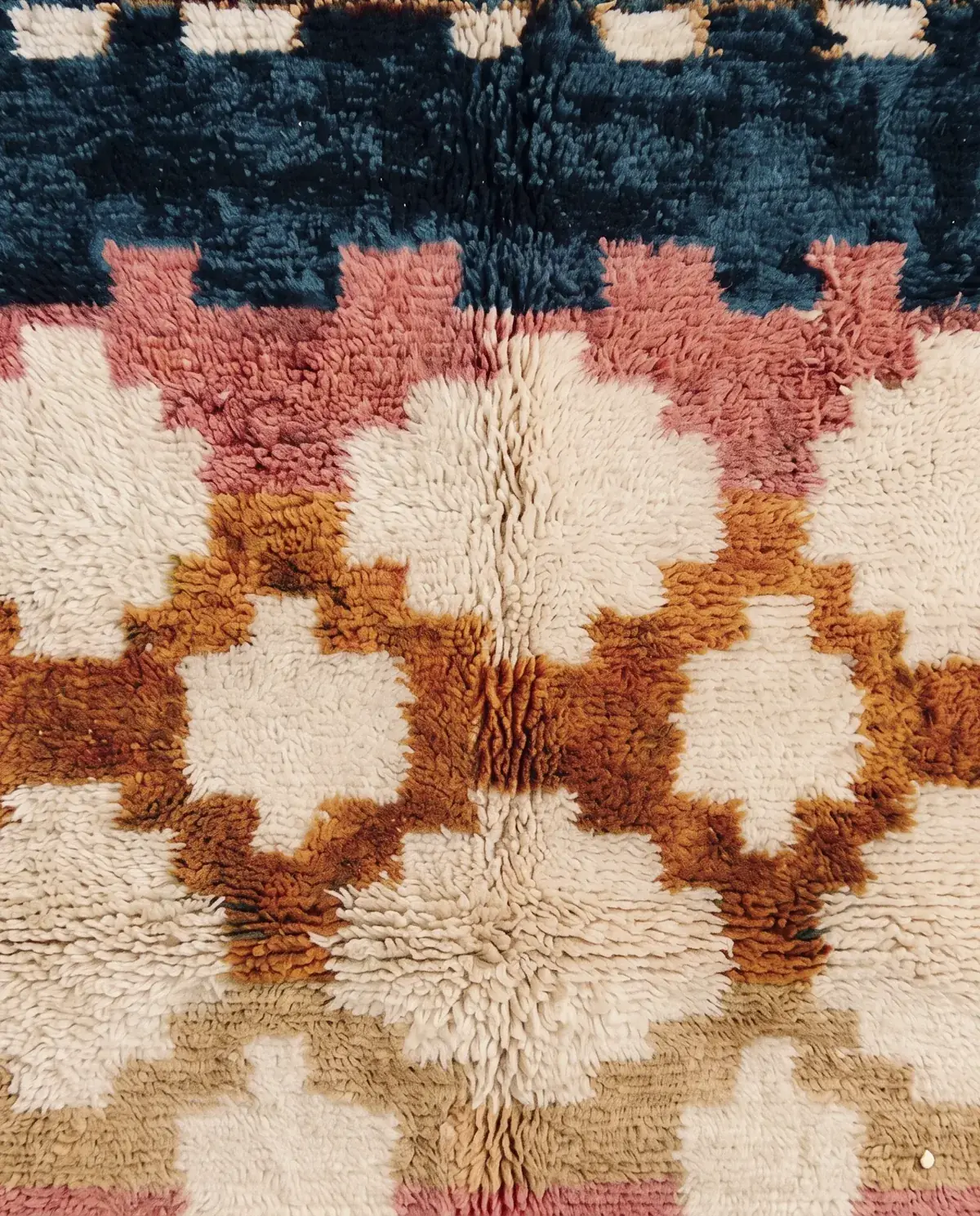
| Riad, Mozaik | Rose, burnt orange, blue, sand, ivory | Rose lattice | Burnt orange lattice | Blue end bands |
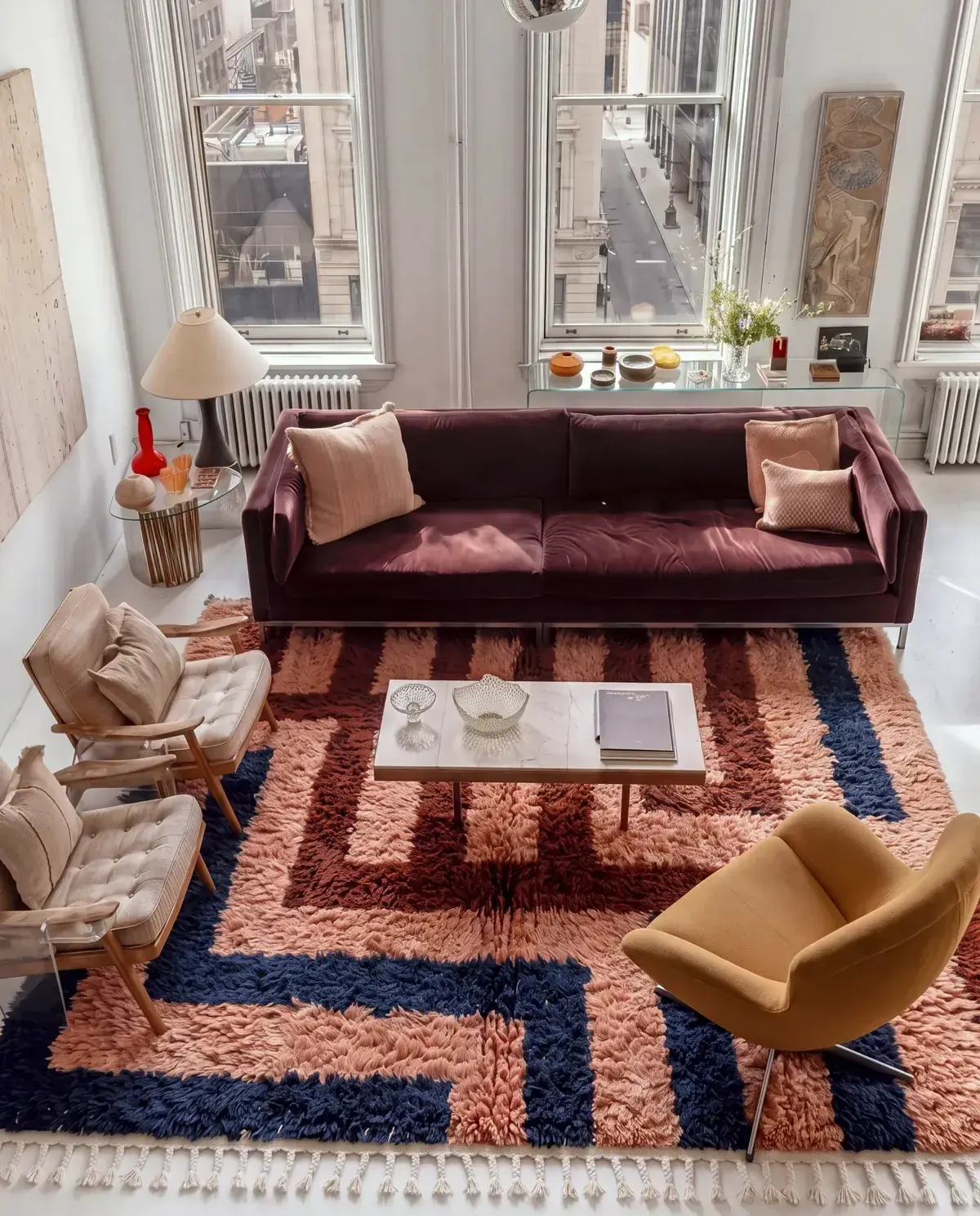
| Mataha, Dama | Peach, rust, navy, ivory | Peach field | Rust bands | Navy corner |
| Darja, Dama, round | Navy, burnt orange, ivory | Navy blocks | Burnt orange blocks | Take it from the room |
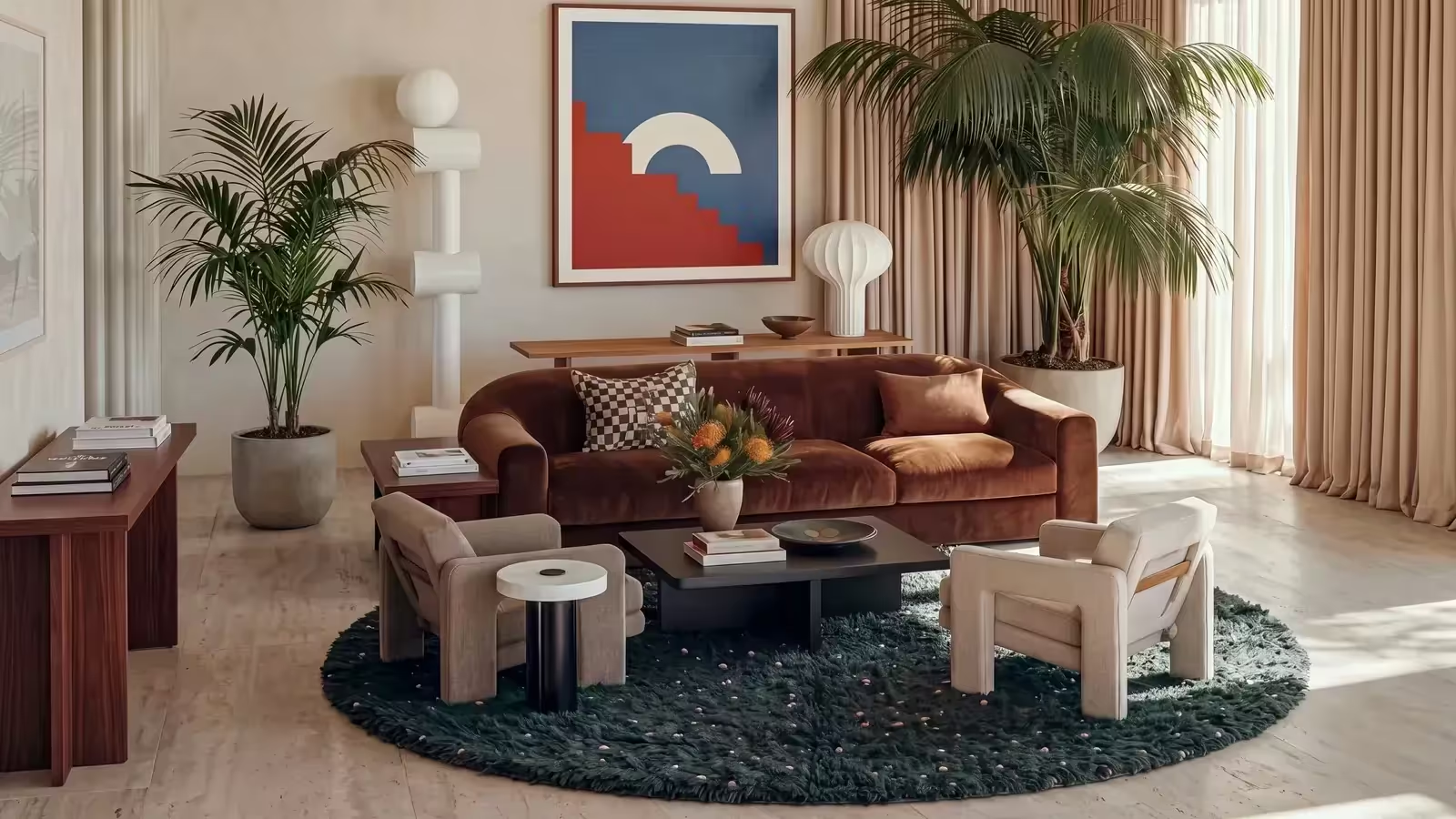
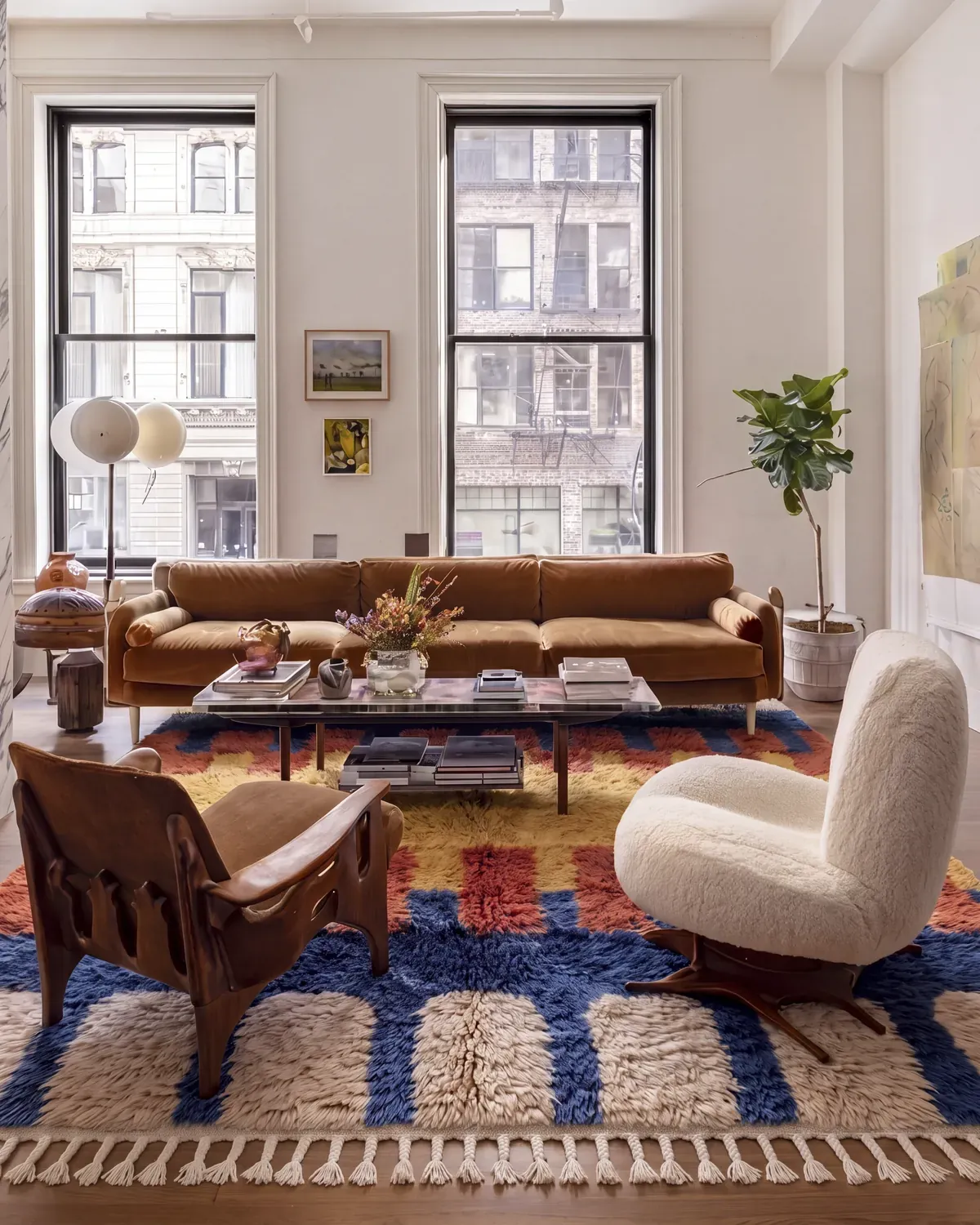
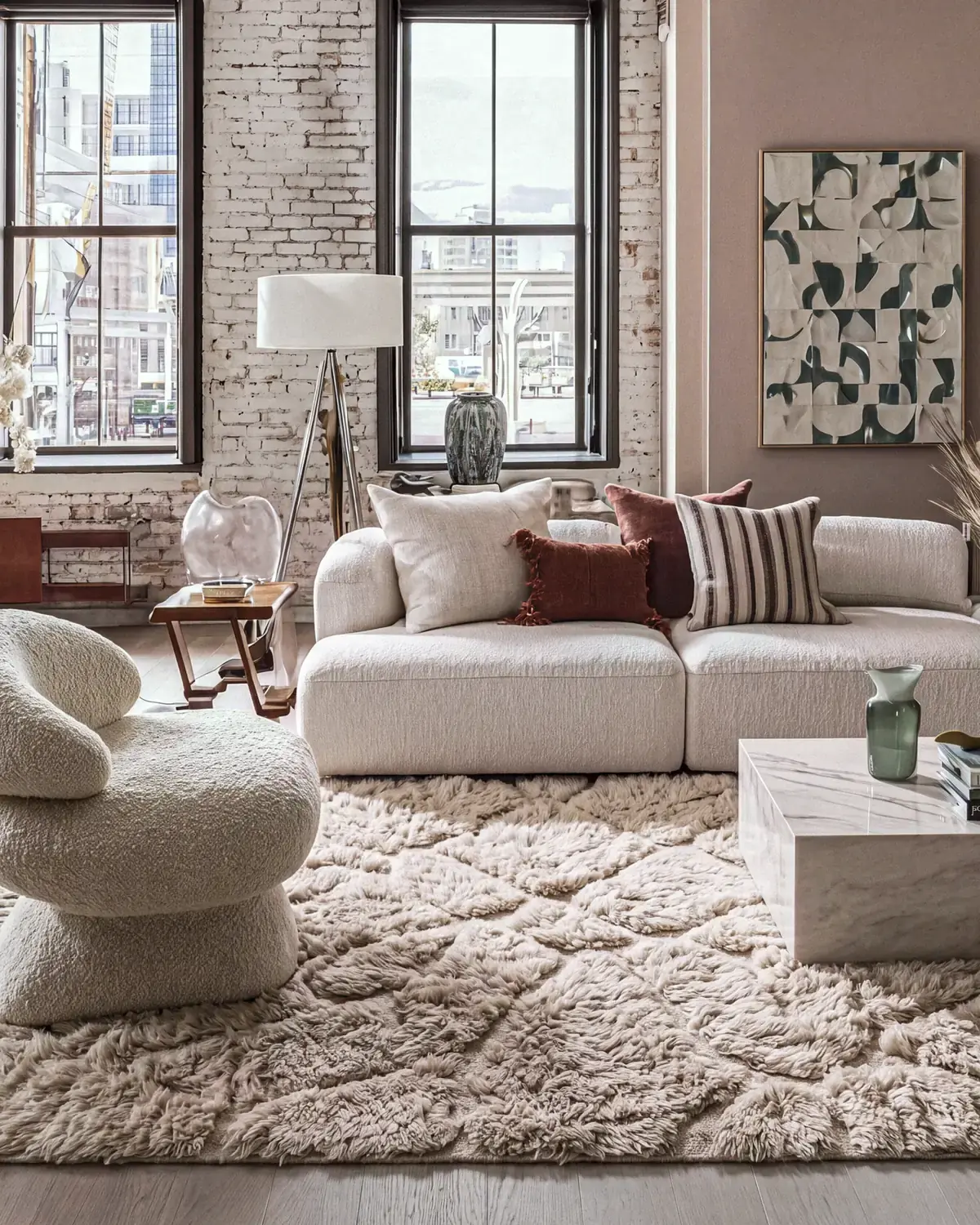
Darja is the useful case. Its wool holds two colors on an ivory ground, so a third pick from the rug would be inventing it. Take the third from what the room already owns: oak, plaster, brass, linen. In the living room at the top of this page it is the wood of the table, which the orange warms against. Riad is the opposite case: five colors, so the sand and the ivory stay in the rug as its ground, and the three that move out into the room are rose, burnt orange and blue.

Step 2: repeat each color twice
Repeat each of the rug's three colors at least twice in the room, because one appearance of a color reads as an accident and two read as a decision. Never use the same material twice for one color, so the repeats look collected rather than bought as a set:
- Dominant, twice: a cushion in the same tone and one larger object further from the rug, a throw over the arm of a chair or a print on the far wall, so the eye travels across the room.
- First accent, twice: the smallest things in the room, a lamp base and a book spine, a ceramic and a frame. Accents work better at object scale than at furniture scale.
- Second accent, twice: one at eye level and one at floor level, a print on the wall and a stool or a basket, so the color exists above the rug as well as beside it.
The living room at the top of this page shows the move at its simplest. Darja's burnt orange comes back in the two rust velvet sofas, and its navy only in the rug; one navy cushion would give it the partner it wants. The ivory needs nothing: the two pale armchairs are the rug's ground, standing up.
The rule that saves the most money: nothing large in the rug's main color at the same strength. A painted wall or a pair of curtains in that color is too big to change and too big to agree with a patterned floor. The sofa is the one large piece that can carry color, and it has rules of its own.
Step 3: keep the big surfaces quiet
Around a colorful rug, the walls, the curtains and the floor around the rug stay quiet: plaster, warm white, linen, wood, stone. They read as material rather than as color, and that is what lets the rug lead. One dark object, a lamp, a frame, the legs of a chair, gives the eye somewhere to rest between the rug and the neutrals.
Match the quiet surfaces to the rug's undertone. Warm rugs, pink, rust, peach and orange, sit best with warm whites, oak and terracotta. Rugs that lean cool, blue, teal and forest green, take cooler whites and gray more easily. A cool gray wall behind a peach rug makes both look tired; the same wall behind a blue and ivory rug looks deliberate. The color pages gather rugs by hue, rugs in pink and rugs in blue among them.
Does the 60-30-10 rule work with a colorful rug?
Yes, with the rug counted in the 30. The 60-30-10 rule splits a room into about 60 percent main color, 30 percent secondary and 10 percent accent. Around a colorful rug, the 60 is the quiet shell: walls, curtains, floor and most of the upholstery. The rug and its dominant color make up the 30. The two accents from Step 2 are the 10. The numbers guide the eye; nobody needs to measure them.
What color sofa goes with a colorful rug?
A sofa in the rug's ground color, ivory, oat or cream, is the safe answer for any colorful rug. A sofa in a color the rug already holds works too, as long as it sits a clear step lighter or darker than that color does in the wool. What fails is the rug's main color at the same strength: the two largest soft surfaces in the room merge, and the floor stops reading as a floor.
Two of the three living rooms in this post have a colored sofa, and each one follows that rule:
| Your sofa | What to do | In our rooms |
|---|---|---|
| Ivory, cream or oat | Any colorful rug works; put the accents on cushions | Warda: cream sofa, mustard cushions |
| A pale tint of the rug's main color | Keep it a clear step paler than the rug | Warda: two pink chairs a step paler than the field |
| A deep color the rug holds | Choose a rug that holds it as an accent, not as the field | Riad: navy velvet beside the blue end band |
| Deeper than anything in the rug | Let it frame the rug from above; repeat the rug's field on its cushions | Mataha: plum velvet with peach cushions |
| A color the rug does not hold | Change the rug, or move the sofa's color into the 10 with a throw | Not pictured |
Should a rug be lighter or darker than the couch?
Either, as long as there is a clear step between them. In the Mataha room the sofa is darker than anything in the rug; in the Warda room the chairs are paler than the rug's field. Both work because neither matches. A rug and a couch at the same depth of color read as one block, and the seating loses its edge. The same test on a gray, brown or green couch is worked through in what color rug goes with your couch.
What rug goes with a blue couch?
A rug that holds blue as an accent, never as the field, on an ivory, rose or warm ground. Riad is the worked case: its blue appears as the two end bands, so the navy velvet sofa beside it reads as the band continued, and the rose and burnt orange lattice carries the rest of the floor. The same logic holds for a green or a plum sofa: find the rug that holds that color in its border or motif. If the green is in the rug rather than the sofa, sage green against olive green sets out which suits which room. A green rug does the same job with more warmth, and rugs in green run from sage to forest.
Three living rooms, one method
Each room below starts from a different rug and lands on the same method: three colors pulled, each repeated, the big surfaces kept quiet.
A pink rug with one medallion
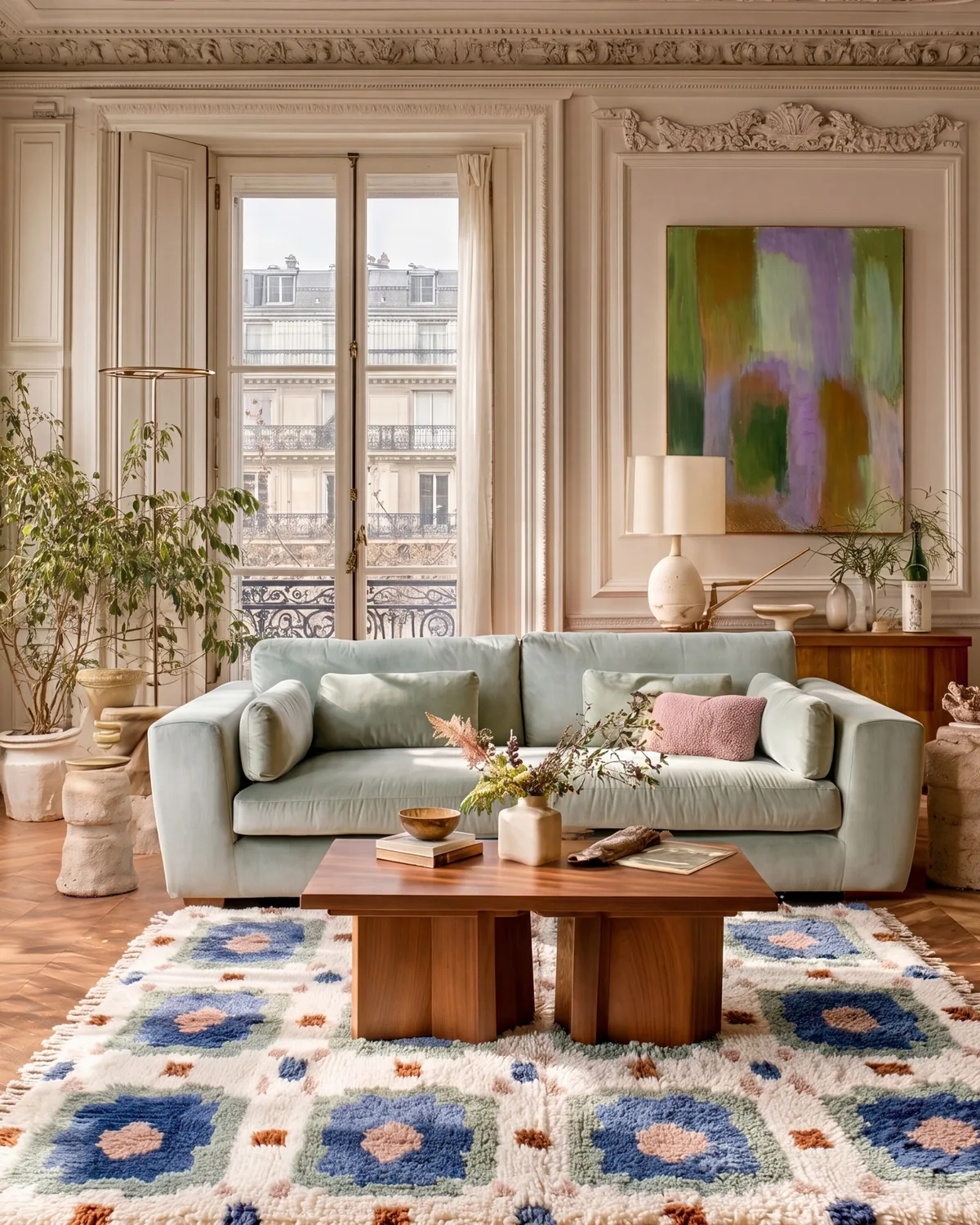
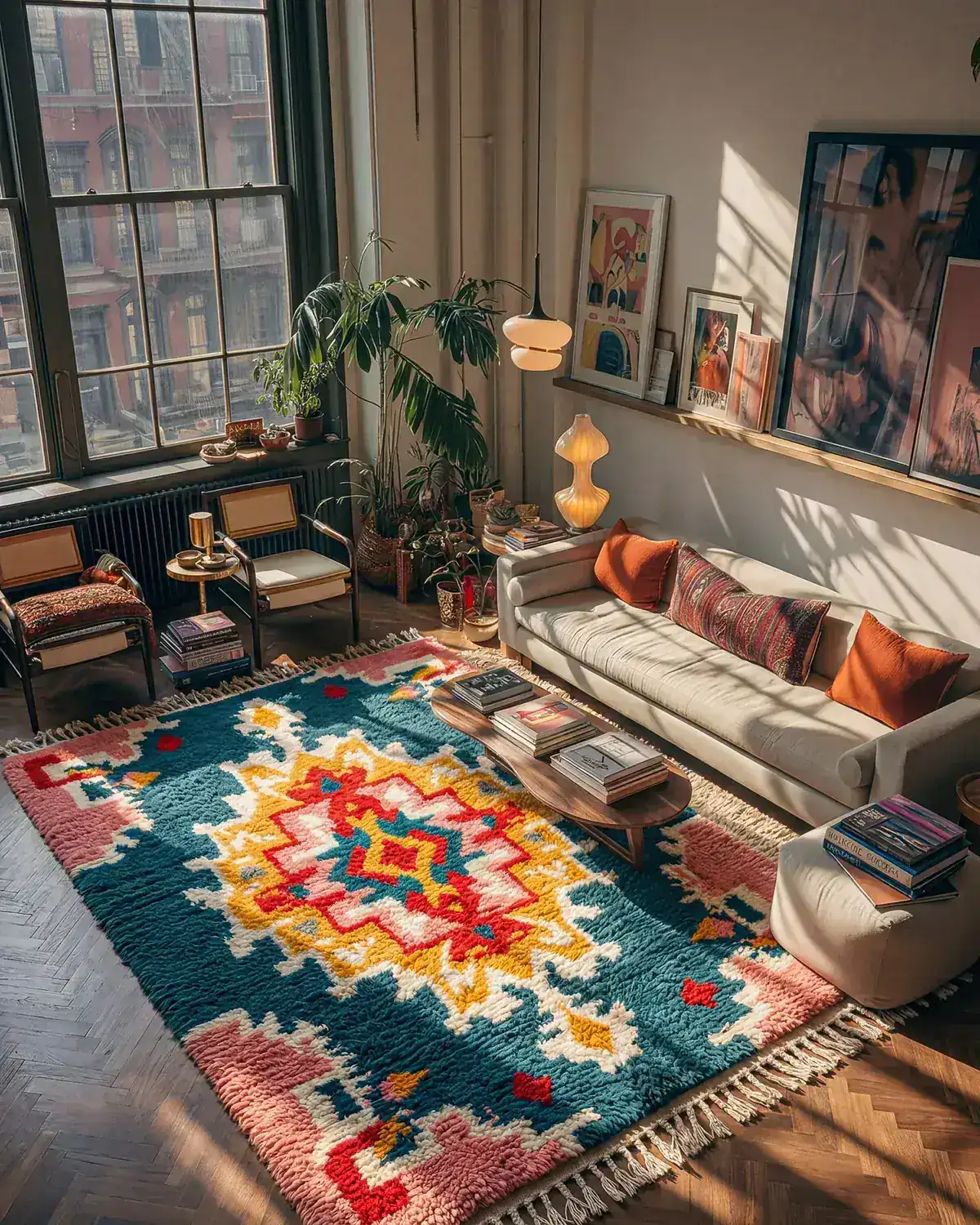
Warda is named for the Arabic word for rose, and it behaves like one: a single mustard medallion outlined in teal, a small red cluster at its center, set alone on a soft pink field. In a living room, that one motif gives the floor a center, a job that usually takes an all-over pattern. The room pictured above follows the method closely, with the design in the round: two pink bouclé chairs a step paler than the rug, a cream sofa with mustard cushions that answer the medallion, and a marble console for the dark note. The plants supply a green the rug leaves out. Pink stays soft through the morning and the teal outline sharpens once the lamps come on. The rest of the Bloom collection works the same way, color led, pattern restrained. For pink rugs in particular, our guide to what colors go with a pink rug goes shade by shade.
A pink and blue floral rug
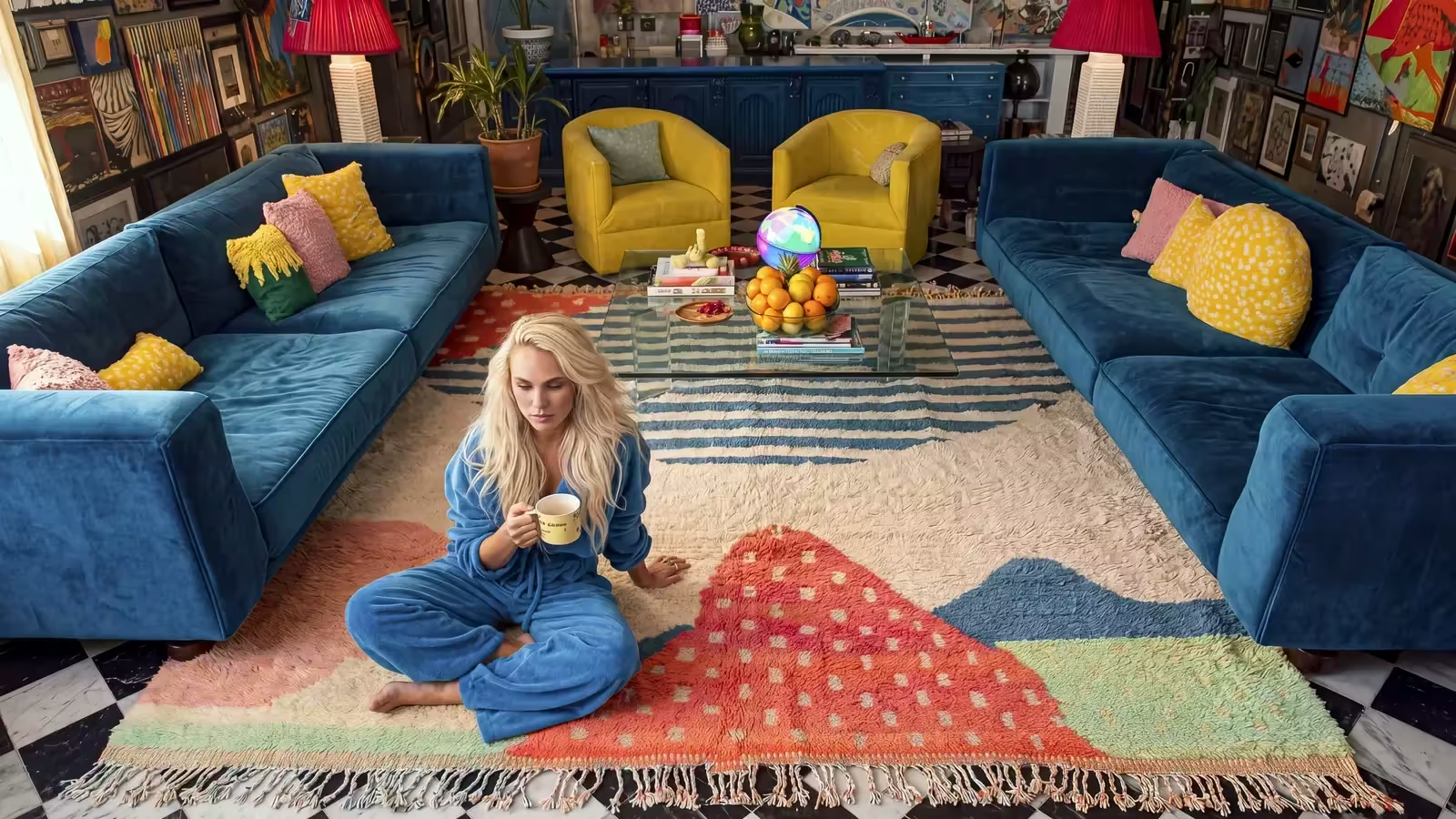
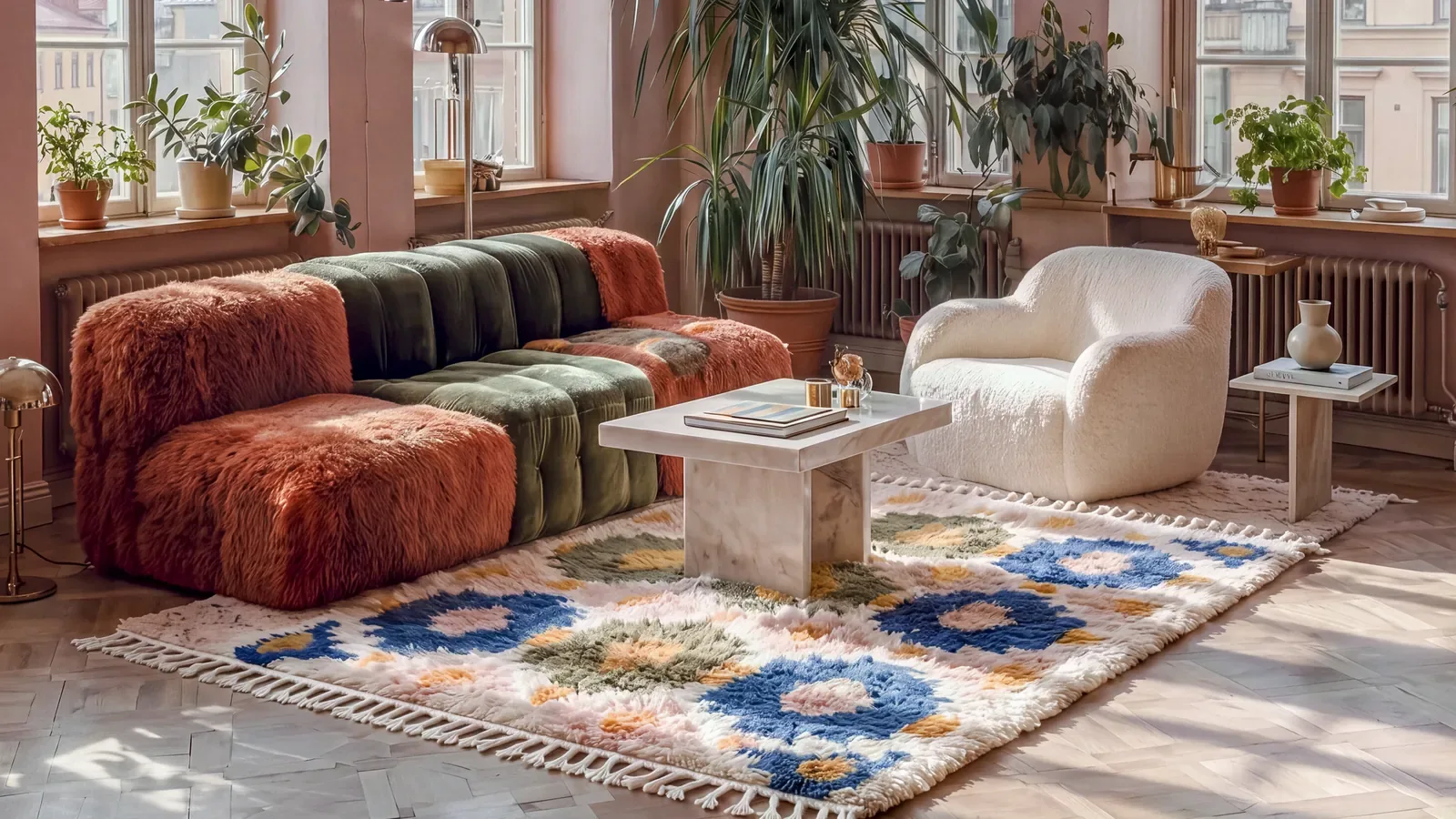
Riad is named for the garden house built around a courtyard. Its horizontal bands of ivory stepped florets are linked by a lattice that shifts from rose pink to burnt orange to sand, and a deep blue band closes each end, like a garden inside its own walls. A floral rug is the busiest surface a room can hold, so everything around it stays solid: in the living room pictured, under a wood ceiling, a navy velvet sofa repeats the end band, ivory cushions pick up the florets, a rust velvet armchair and a terracotta cushion carry the burnt orange, and a white stone fireplace and the wood do the rest. Rose and burnt orange brighten through the day and the blue bands deepen by evening, so the navy sofa and the rug read as one dark line after the lamps come on. Mozaik is the collection for a room that wants a patterned surface rather than a single motif.
A peach and rust grid rug
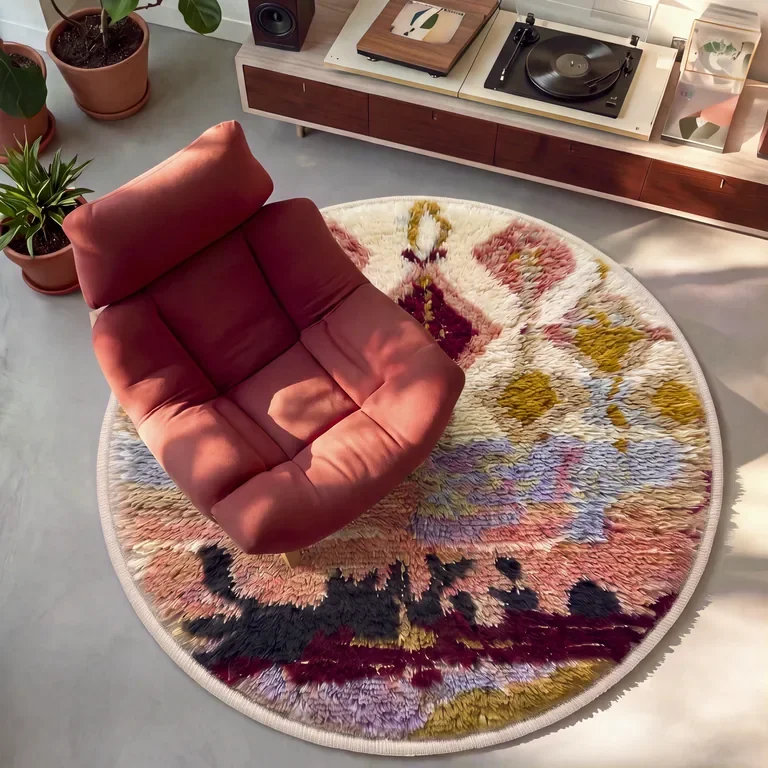
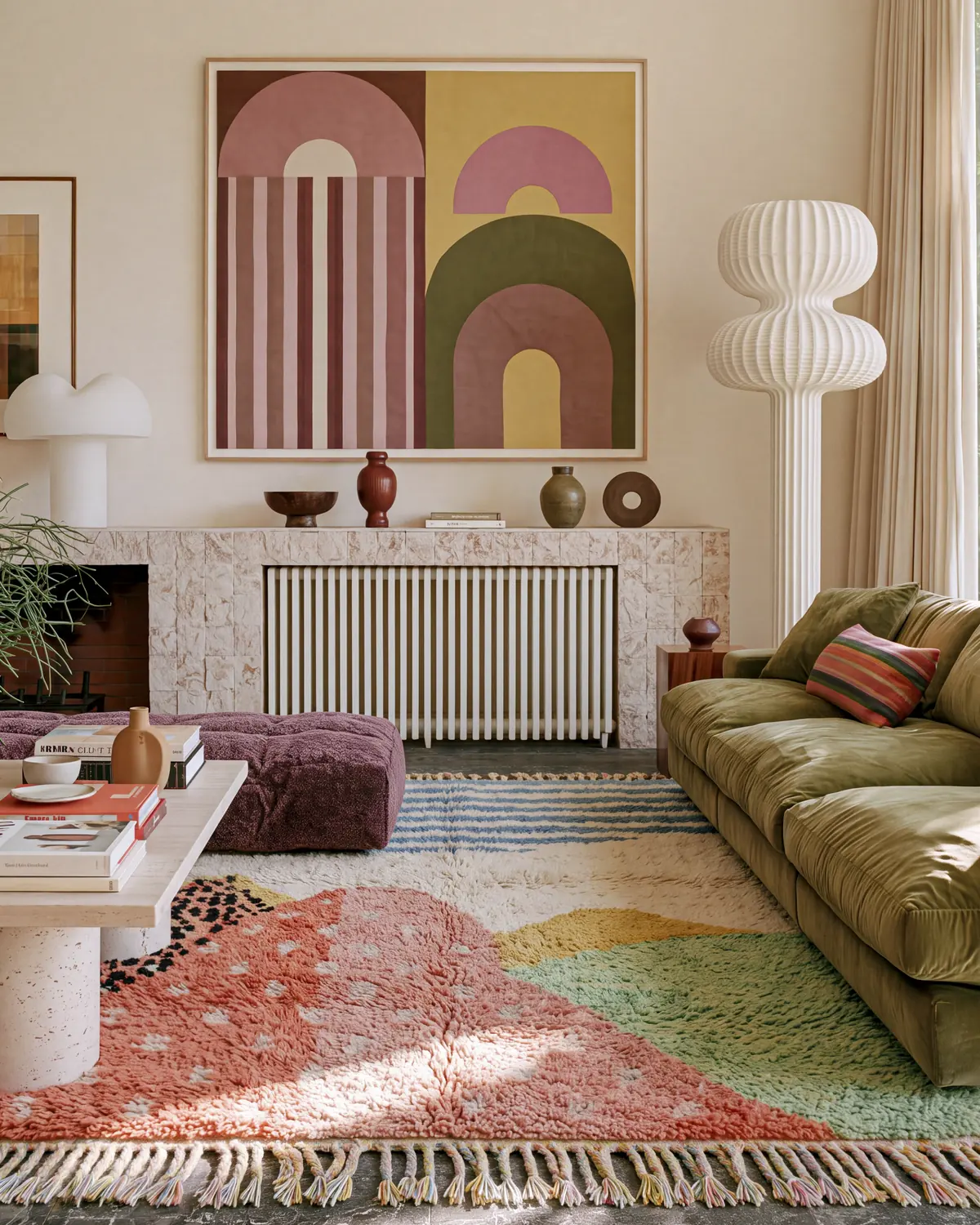
Mataha is named for the Arabic word for maze: wide rust bands cut the peach field into rows of short bars, like a ladder, and navy bands turn through right angles at one corner. Under a coffee table those bands give the seating a spine. The room pictured takes a plum velvet sofa, a step deeper than the rust, with peach cushions that carry the field up onto it; two pale wood armchairs and one mustard chair share the rug without competing, and the walls stay white. Peach catches soft light at sunrise and deepens toward rust by evening, so a navy accent that looks heavy at noon usually looks right after dark. Dama is where the grid designs live.
How to choose a colorful rug for your living room
Choose a colorful rug by what the room already has, not by the rug alone. The rug will be the largest pattern in the room, so the sofa, the wood, the light and the traffic decide which colors it can take.
- Start from the sofa. A neutral sofa takes any palette. A colored sofa needs a rug that holds its color as an accent, as in the table above.
- Read the wood. Oak, walnut and teak run warm, and pink, rust, peach and orange rugs agree with them. Pale or gray-washed floors suit rugs that lean cool: blue, teal, forest green.
- Check the light. A room facing north cools every color, so warm pinks and oranges hold up better there than icy blues. Rooms facing south and west warm the rug further through the afternoon.
- Think about traffic. An all-over pattern hides crumbs, paw prints and wear better than a solid field; what holds up under dogs and cats is in pet-friendly wool rugs.
- Small room? Choose a light ground with the color in the motif. A saturated field brings the floor closer; a light one keeps it open.
Where to look: Bloom carries the most color, the Boujaad lineage in freehand marks. Mozaik sets color in tiles and florals, and Dama works it into grids and checks. Whole rooms built around that color are in colorful living room ideas.
Size comes next. Most living rooms take an 245x305 cm rug, and long sofas and sectionals a 275x365 cm; the method for your own sofa and room is in what size rug for a living room.
Why rug colors change through the day
Rug colors change through the day because wool is not a flat surface, and color on it moves. The pile catches light from one direction and shades from the other, which is why the same peach reads bright at noon and deep at dusk. That movement is the wool, not the dye: our natural dyes are fixed so the color does not transfer or shift with use, and the wash in our workshop checks every color against the final design before the rug ships.
The practical version: choose cushions, throws and paint samples against the rug in daylight, look again after the lamps come on, and keep whatever works at both hours. Where the color in a Boujaad rug comes from in the first place is its own subject: where Boujaad color comes from.
Next: colors that go with a pink rug, or the Bloom collection.