






Runner rugs
Hallway Runner Size: Width, Length and Runner Ideas by Room
Width, length and pile for hallway, kitchen and bedside.
By Zarbish · · Updated · 12 min read
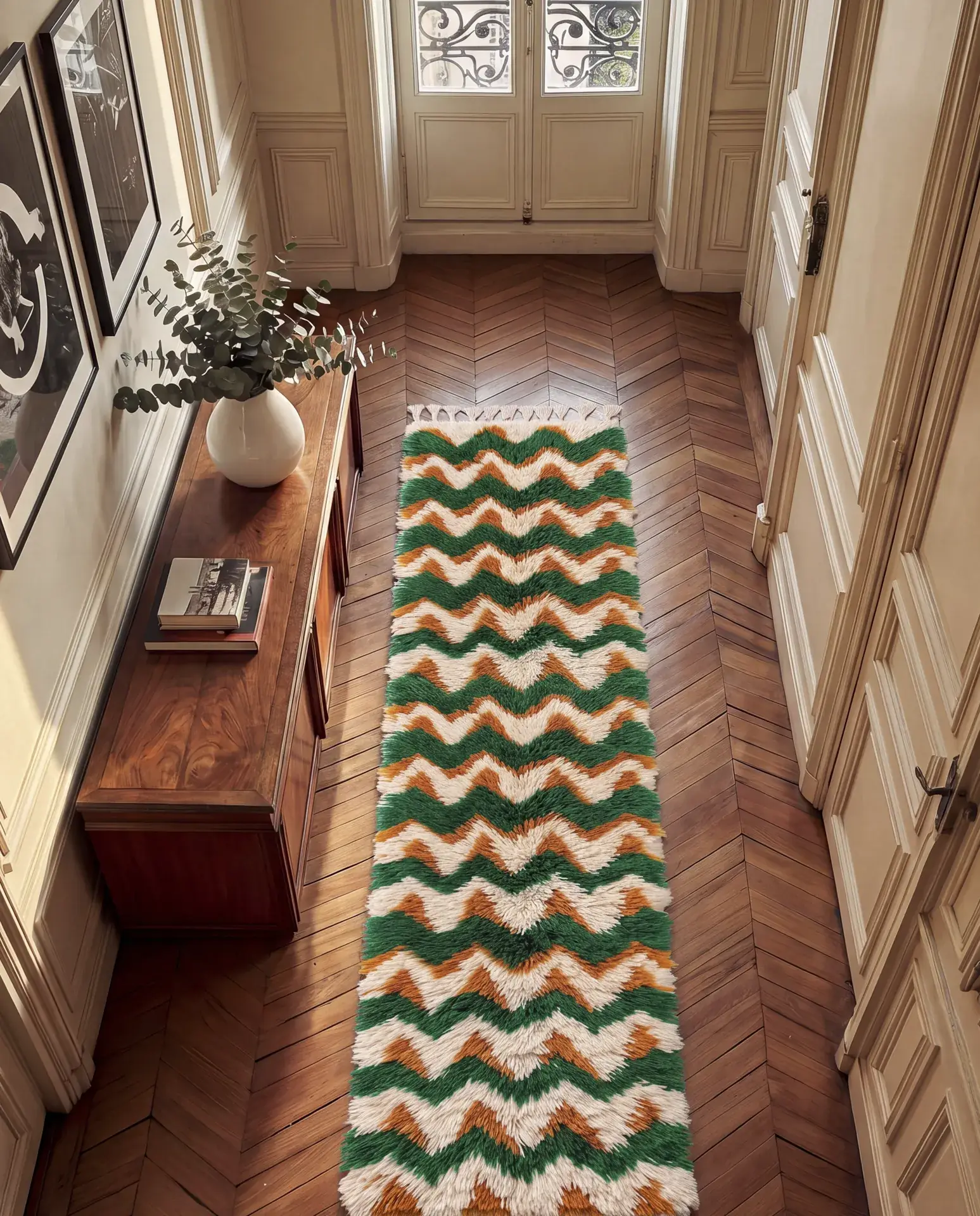
A hallway runner should be 60 to 90 cm wide, leaving 8 to 15 cm of floor on each side, and 30 to 60 cm shorter than the hallway, so floor shows at both ends and doors clear it. Choose short pile, 1 cm, or medium, 2 cm.
The same rules, adjusted, put a runner along a kitchen counter, beside a bed, across its foot and down an entry. What changes from room to room is mostly the pile: short where doors and stools move, deep where bare feet land.
Key takeaways
- A hallway runner is 60 to 90 cm wide: take the hallway's narrowest width and subtract 15 to 30 cm, so 8 to 15 cm of floor shows on each side.
- A hallway runner is 30 to 60 cm shorter than the hallway, so a 305 cm hallway takes a 245 cm runner, and it stops before any door that swings over it.
- Short pile, 1 cm, or medium, 2 cm, suits hallways, stairs, kitchens and entries, where doors swing and traffic is heaviest; shag, 3 cm, belongs only in quiet places, such as beside a bed.
- A kitchen runner runs parallel to the counters or the island, about as long as the island and never past it, 8 to 15 cm clear of the cabinets.
How wide should a hallway runner be?
A hallway runner should be 15 to 30 cm narrower than the hallway at its narrowest point, which leaves 8 to 15 cm of floor on each side. Measure where the hallway pinches, at a door frame, a radiator or a console, not in its widest stretch.
| Hallway width, at its narrowest | Runner width | Floor on each side |
|---|---|---|
| Under 75 cm | Narrower than 60 cm | at least 8 cm |
| 75 to 90 cm | 60 cm | 8 to 15 cm |
| 90 to 105 cm | 80 cm | 8 to 15 cm |
| 105 to 120 cm | 90 cm | 8 to 15 cm |
| Over 120 cm | 90 cm, or wider | 15 cm or more |
The strip of floor is what makes a runner look chosen. Floor on both sides frames the runner and keeps the hallway reading as wide as it is. Wool that reaches the skirting makes the passage look narrower and catches on door stops and baseboards. In a narrow hallway, lean toward 8 cm so there is still wool to walk on; in a wide one, 15 cm looks deliberate. The short picks for common hallways are in hallway and kitchen sizes.
How long should a hallway runner be?
A hallway runner should be 30 to 60 cm shorter than the hallway, leaving 15 to 30 cm of floor at each end, and it should stop before any door that swings over the floor. A 305 cm hallway takes a 245 cm runner. Measure it this way:
- Measure the width at the narrowest point and subtract 15 to 30 cm. Choose the runner width at or under the result, from the table above.
- Measure the length, wall to wall or threshold to threshold, and subtract 30 to 60 cm.
- Mark every door that opens over the hallway floor. Stop the runner before its swing, or check that the gap under the door clears short pile and a thin pad.
- Choose the standard length at or just under your number: 185, 245, 305 or 365 cm.
- Tape the outline on the floor and walk it for a day, doors, bags and all.
A worked example. A hallway 100 cm wide at the door frames and 395 cm long, with a bedroom door swinging into it 60 cm from the far end. Width: 40 in minus 15 to 30 cm gives 70 to 85 cm, so the 80 cm runner, with 13 cm of floor each side. Length: the door swing ends the usable run at 335 cm, and leaving floor at each end gives about 305 cm. The runner is 80 cm x 80x305 cm.
Longer hallways and corners:
- Over about 425 cm. Use two runners of the same design with 15 to 30 cm of floor between them, ideally where a door or an alcove breaks the wall.
- An L-shaped hallway. Lay one runner per straight run, with floor showing at the turn, rather than one runner bent around the corner.
- A console or a bench. It stands fully on the runner or fully off it, never with two legs on the wool.
Do hallway runners make a hallway look bigger?
A runner with floor showing on all four sides makes a hallway look longer and more finished, because it sets a line down the passage and frames it. A runner that is too wide does the opposite. Pattern that runs lengthwise, like a border along both edges, stretches the hallway further; bands running across it make a long, tunnel-like hallway feel shorter.
Pile, pad and doors
Short pile, 1 cm, or medium, 2 cm, is what we recommend for a hallway, because a hallway takes more footsteps than any other floor in the house and needs cleaning more often. Short clears a tight door and lets a suitcase roll over it; medium gives a little more wool underfoot where doors allow. Keep shag for quiet rooms. On a hard floor, lay a rug pad under it (do I need a rug pad).
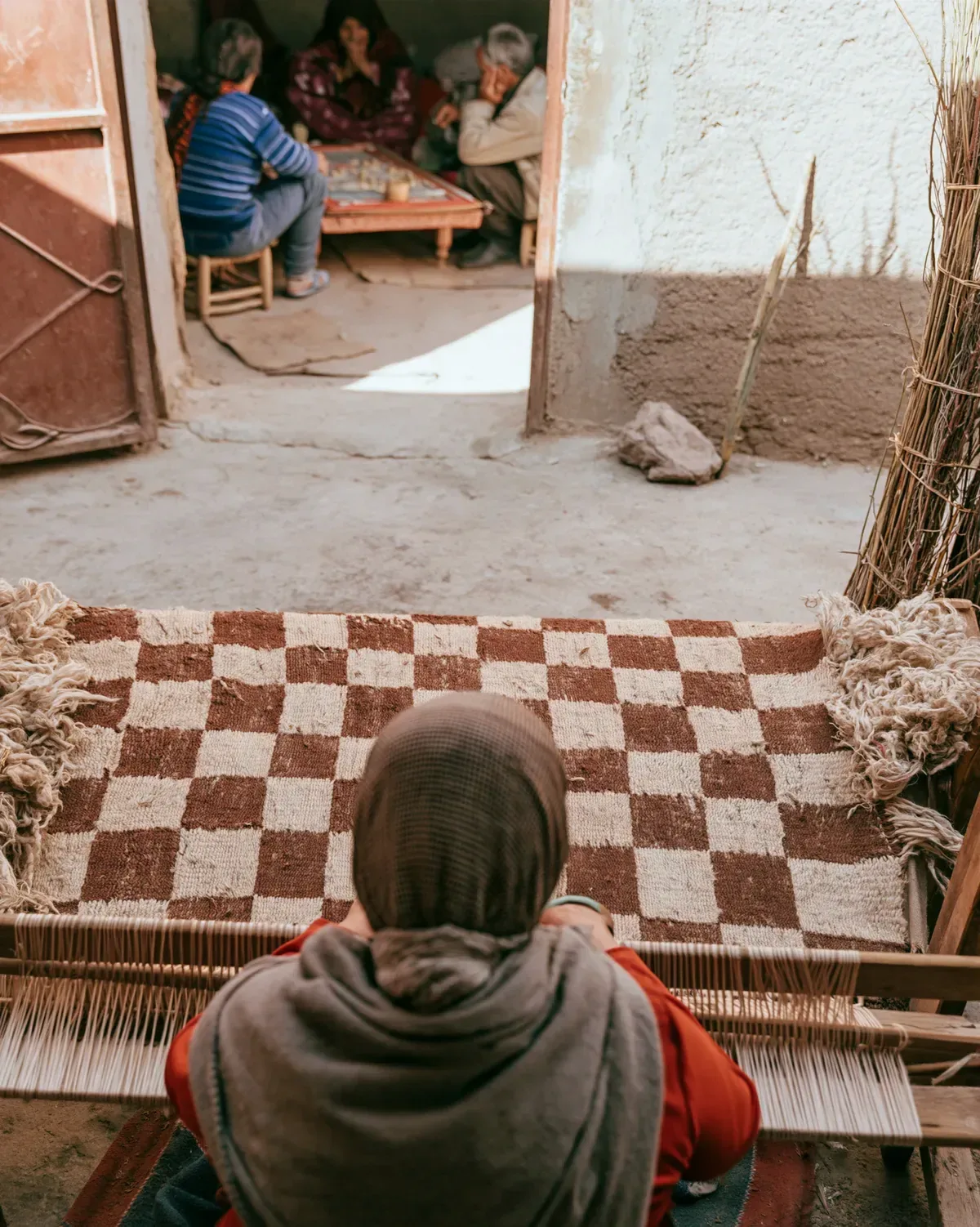
One thing that only shows at the loom. On a narrow runner the finished edge is a much larger share of what you see. The weavers close both long edges by hand, and on a runner those edges sit exactly where a foot lands, so the edge work is read at close range every day. On a large rug the same edge spends its life under a sofa.
What kind of runner is best for a hallway?
For a hallway, a hand-knotted wool runner in short or medium pile. Wool springs back under daily traffic and gives up dirt to the vacuum, and a dense hand-knotted pile takes the wear of a passage better than a loose one. Washable flat weaves have their place, mostly where spills are constant; the trade-off is set out in wool or washable. Then the ideas, by what the hallway needs:
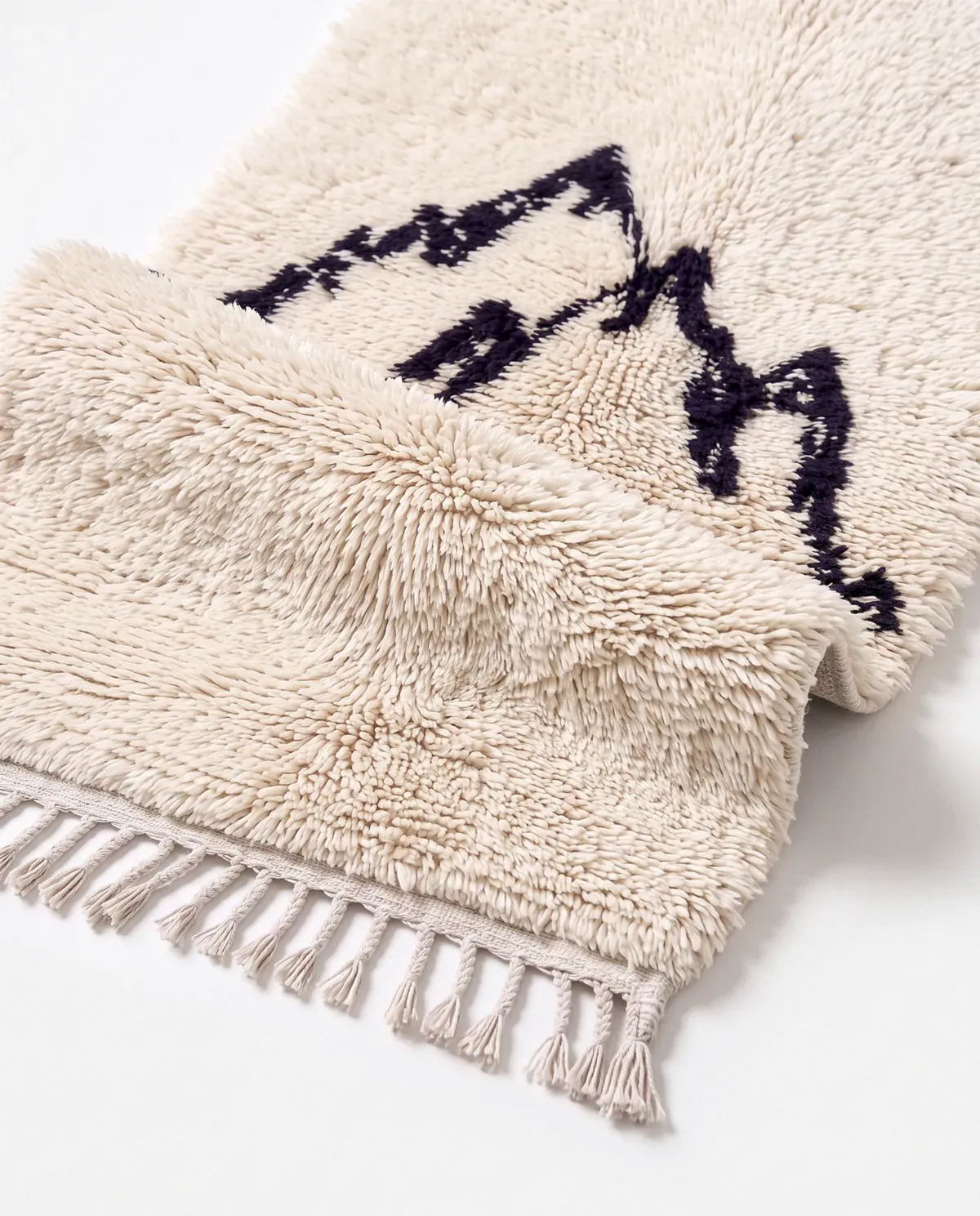
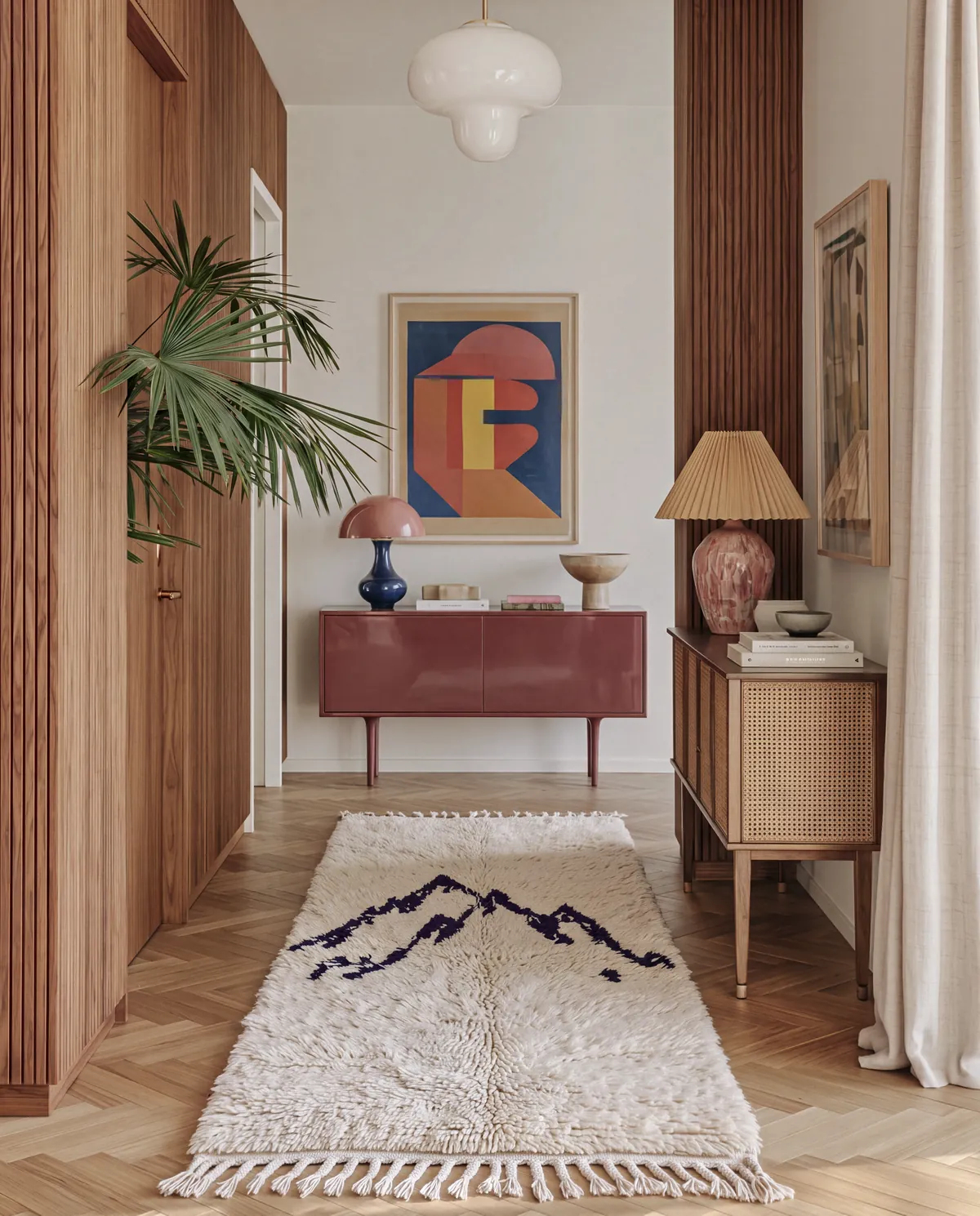
- A dark hallway: an open, light field. Siroua, pictured and named for the massif between the High Atlas and the Anti-Atlas, puts one black outline of a small mountain range on an otherwise open ivory field. Between wood-slat walls, a rattan cabinet and a rose sideboard, so much ivory stays open that the passage reads lighter, not narrower.
- The path from the front door: pattern or a mid tone. A mottled or patterned runner hides the track that forms where everyone walks; an ivory runner reads lightest and asks for more vacuuming.
- A long hallway: a border that runs the length. Lines along both edges pull the eye down the passage and make it read even longer.
- A plain white hallway: color at floor level. A runner is the one place in a passage where color does not compete with anything.
- A stopping point: texture. Sculpted pile earns its place where people stand still, at the entry or outside a bedroom door, as in the entry section below.
Siroua's open field and Legzira's arches sit at opposite ends of our runner rugs.
Should you put a runner in the kitchen?
Yes, along the work line, where you actually stand: in front of the sink, the range and the counter run. A kitchen runner lies parallel to the counters or the island, centered in the aisle, with 8 to 15 cm of floor to the cabinet feet, so drawers, the dishwasher door and the oven door open over it.
- Galley kitchen. Length: the counter run minus 30 to 60 cm. Width: most galley aisles are 105 to 120 cm, which take an 80 or 90 cm runner. A galley with 305 cm of counters and a 42 in aisle takes an 80 cm x 80x245 cm runner.
- Island kitchen. Run it between the island and the counter, about as long as the island or a little shorter, never past its ends into the walkway. Most islands of 185 to 245 cm take a 185 or 245 cm runner.
- Sink only. A 60x185 cm runner centered on the sink.
Short pile, 1 cm, is the best choice in a kitchen, medium, 2 cm, at most: stools slide back without dragging the wool, the dishwasher door drops over it, and crumbs come out with the vacuum. Wool releases most spills when they are blotted quickly. The natural dyes are fixed, so the color does not run or shift under a kitchen's daily use.
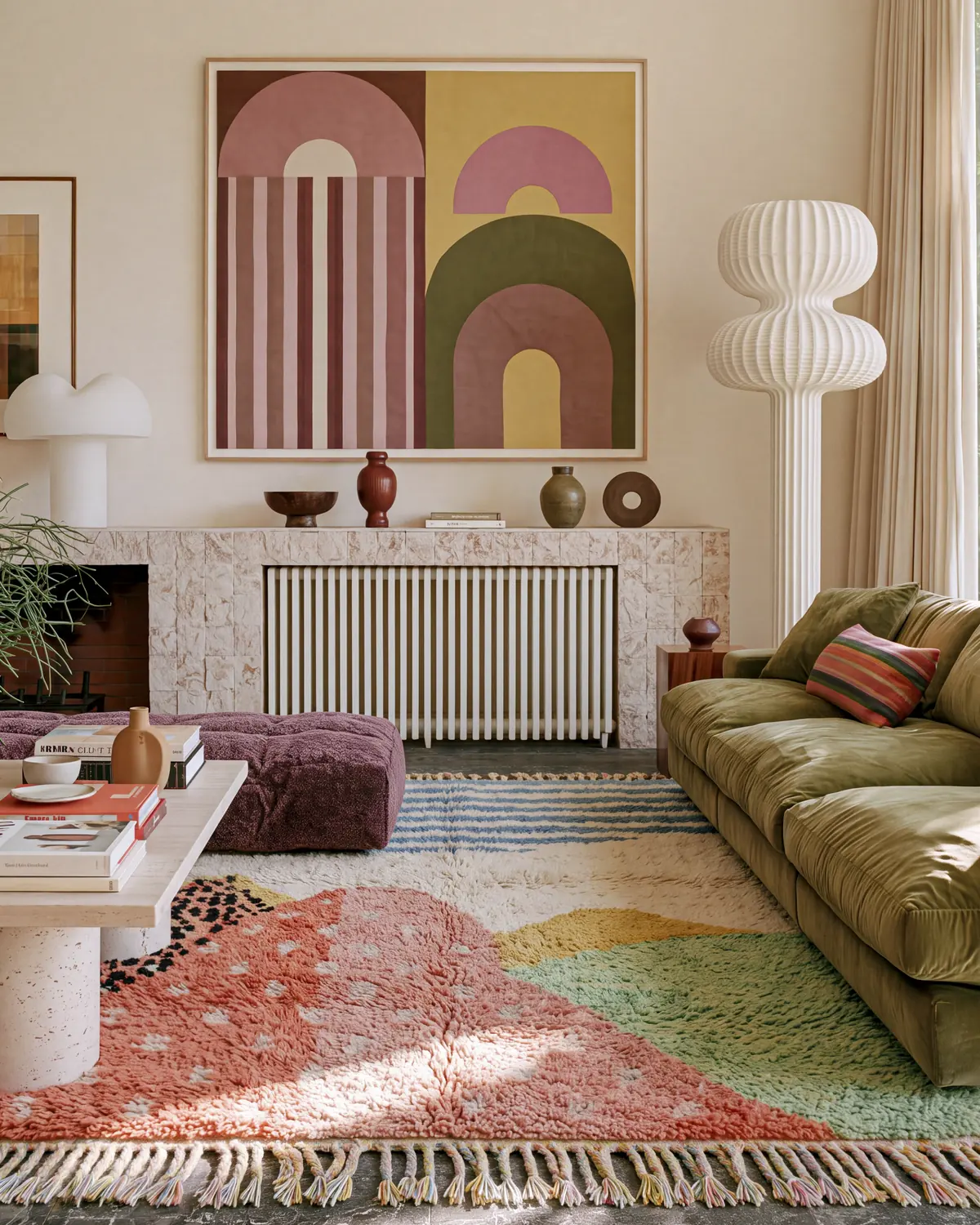
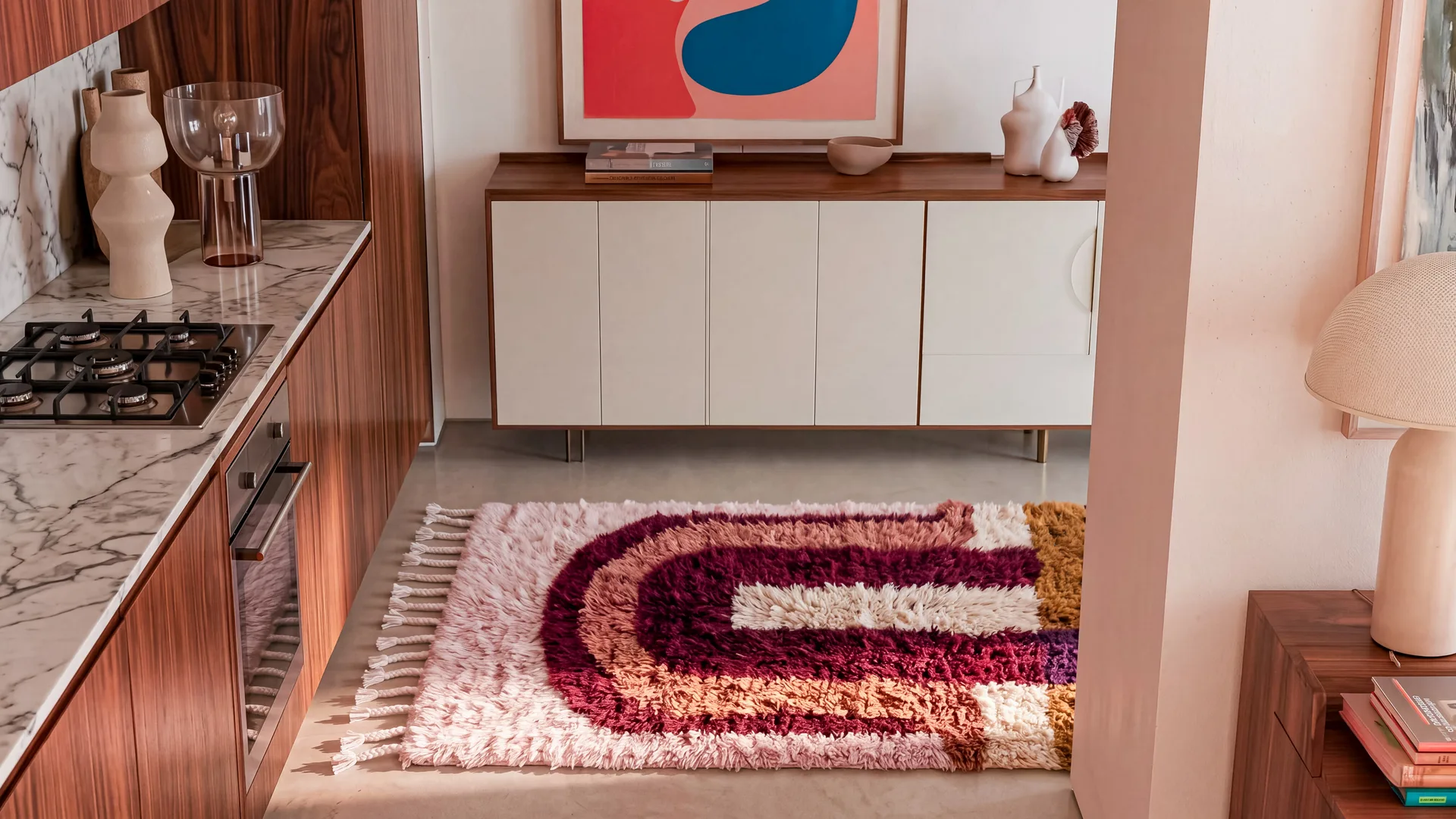
Legzira, at the top of this page, is the case for one motif on a plain ground: nested arches of burgundy, blush and ochre on a pale pink field, so the runner lines up with the counters while the plain ground takes the footsteps. Our design team recomposes every runner version of a design for the long shape rather than cutting it from the rectangle, which is why the arches sit whole inside the width. It comes from Dama, laid out for a runner.
Can you put a runner in a bedroom?
Yes, in three places: along the side of the bed, across its foot, and down a dressing area. A runner gives you wool underfoot for less floor, and less money, than a rug under the whole bed; for that larger rug, see the bedroom sizes.
- Beside the bed. Lay the runner parallel to the bed, starting level with the front of the nightstand and running toward the foot. A 185 cm runner covers the stretch you step onto beside a full or queen bed; a 245 cm runner runs the whole side of a queen or king mattress, 205 cm long, and a little past the foot. Width: 60 cm or 60 or 80 cm. One runner on the side you use beats two small mats, which drift apart and never line up again; for two sleepers, use the same design twice.
- Across the foot. Across a queen bed, 150 cm wide, an 80x185 cm runner shows 15 cm past each side. A king, 195 cm wide, takes an 80x245 cm or 80x245 or 90x245 cm runner.
- A dressing area. A runner down the length of the wardrobe gives you a line to stand on while you dress. If the wardrobe doors swing over it, choose short pile; if they slide, the runner can be as wide as 90 cm.
Beside the bed, choose medium, 2 cm, or shag, 3 cm: nothing rolls across it, and the first step of the morning lands on deep wool.

Tagant is named for the Amazigh word for forest, and it reads like one: an unbroken deep green the length of the run, no pattern to line up with the bed frame, a pink fringe at its end. Beside pale linen and warm wood, the green grounds the bed without crowding it. That is the quiet field of Dune at runner width.
Should you put a runner in your entryway?
Yes, when the entry is longer than it is wide. A runner fits the floor where a mat is too small and a rectangle is too much, and it takes the whole arrival: coats, boots, the pause before the rest of the house. Most entries take a 90 cm runner, 80 cm in a narrow one, at 185 or 245 cm. Set it back from the swing of the front door, leave the door's arc as bare floor, and keep the pile short, 1 cm, or medium, 2 cm, where the door clears it. A square entry with a pendant overhead suits a circle better: see round rugs in an entryway.
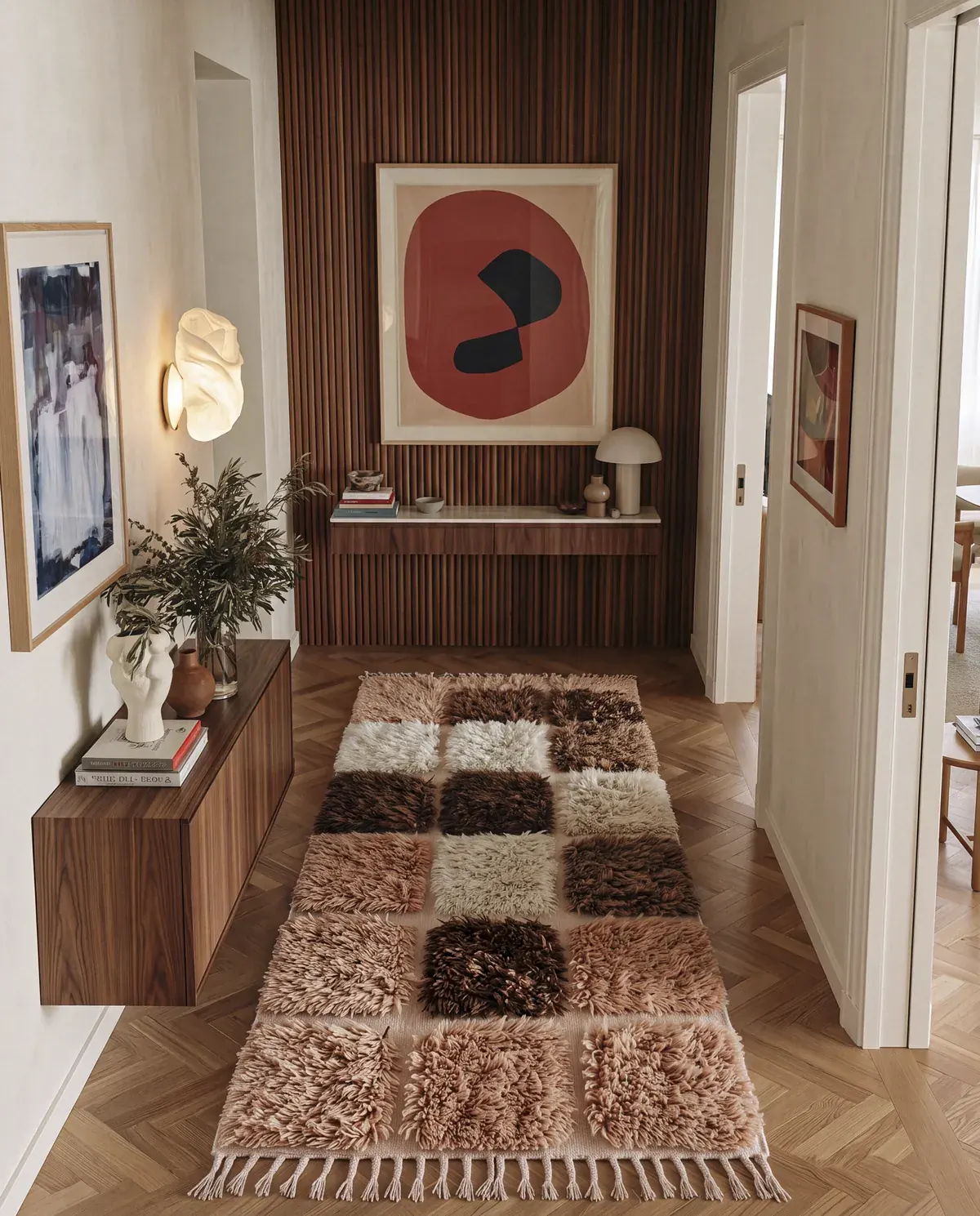
Tadla takes its name from a plain at the foot of the Middle Atlas, and its squares sit like tilled plots along the floor. The pile is carved into raised squares, so a bare foot meets ridge before it meets channel, and blush pink, chocolate brown and ivory cream pull warmer once the lights come on. Sculpted relief earns its place in an entry, the one floor people look down at while they take their shoes off.
Can a runner go on stairs?
Yes. A Zarbish runner can be laid on stairs, fitted with stair rods or by a fitter. Like a hallway runner, a stair runner leaves bare stair showing on both sides, so the wood or paint frames the wool, and it quiets every step and gives the foot more grip.
Measure it in two parts:
- The width. Measure the narrowest tread and leave 8 to 15 cm of bare stair on each side. Most staircases take a runner 60 to 80 cm wide.
- The length. Measure one tread from the back to the front edge and one riser from top to bottom, add the two, and multiply by the number of steps. Add the length of any landing the runner crosses.
Choose short pile, 1 cm, or medium, 2 cm. The front edge of each step takes the hardest wear on a staircase, and short pile folds most cleanly over it. Leave the tassels off, since the ends finish at the bottom and top of the flight. Stair rods at the back of each tread hold the runner in place and lift out for cleaning; a fitter can also fix it with grips and a stair underlay. A landing on its own takes a runner too: it marks the turn and softens the place where people stop.
Runner sizes
Our runners come in the widths and lengths below.
| Width | Lengths | Suits |
|---|---|---|
| 60 cm | 185, 245, 305, 365 cm | Narrow hallways, sinks, bedsides |
| 80 cm | 185, 245, 305, 365 cm | Most hallways, galley and island kitchens, the foot of a queen bed |
| 90 cm | 185, 245, 305, 335, 365 cm | Wide hallways, entries, dressing areas, the foot of a king bed |
If your passage falls between two lengths, take the shorter and leave floor at both ends. Tassels add about 10 cm at each end beyond the stated length, so count them when a runner ends near a door.
A hallway under 75 cm wide, or a staircase with a turn: a custom runner. Next: wool or washable for a hallway, then every runner rug.