


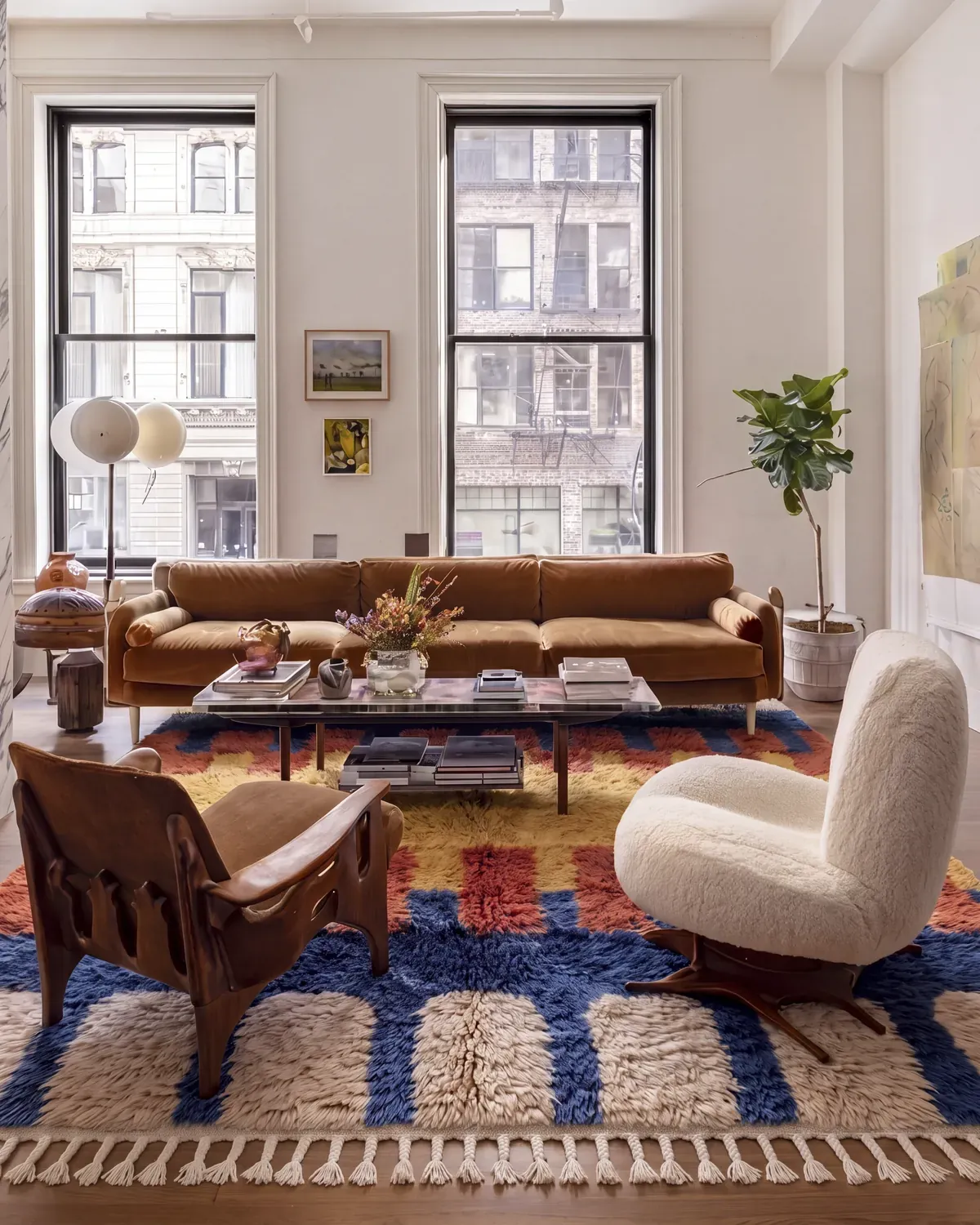
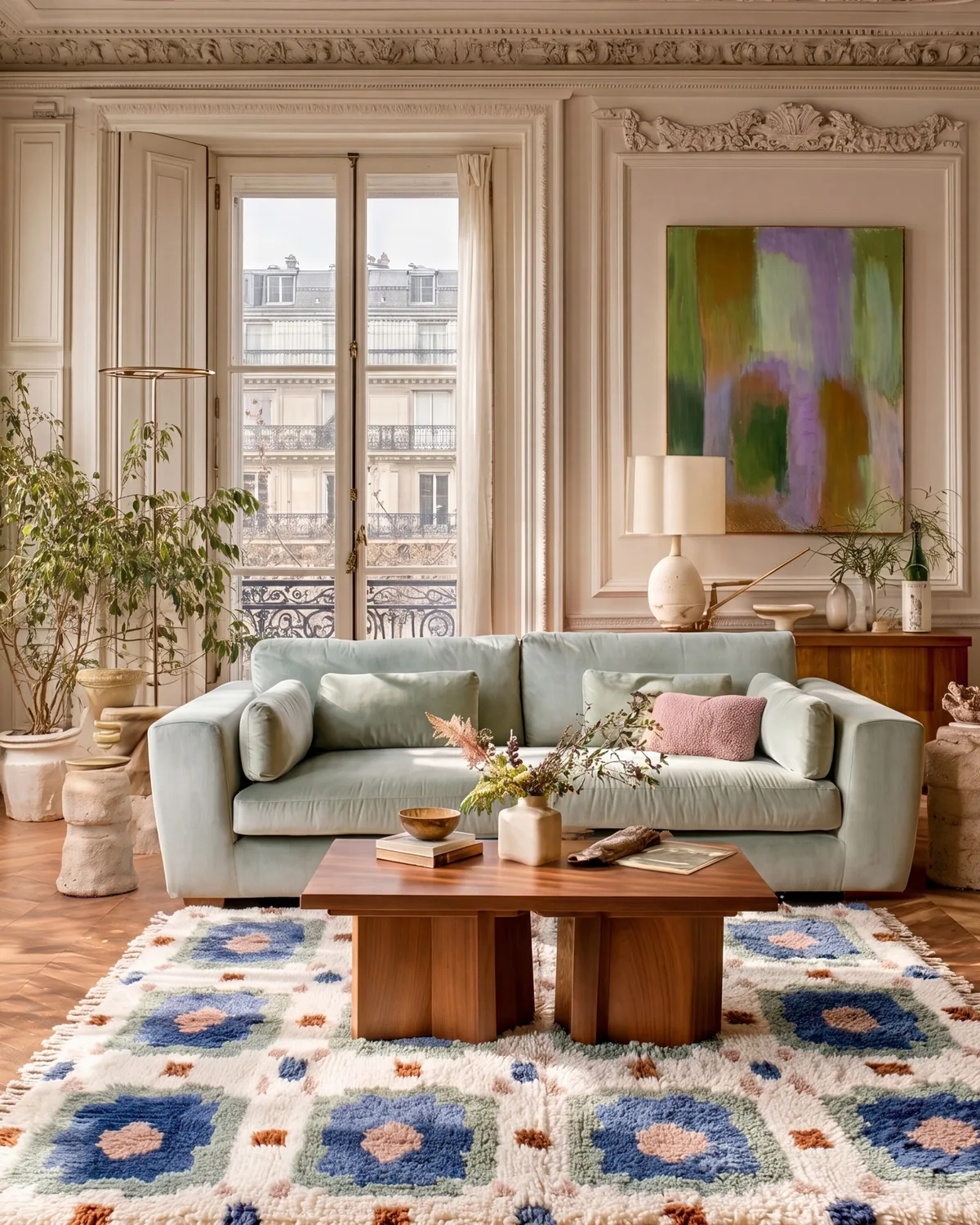
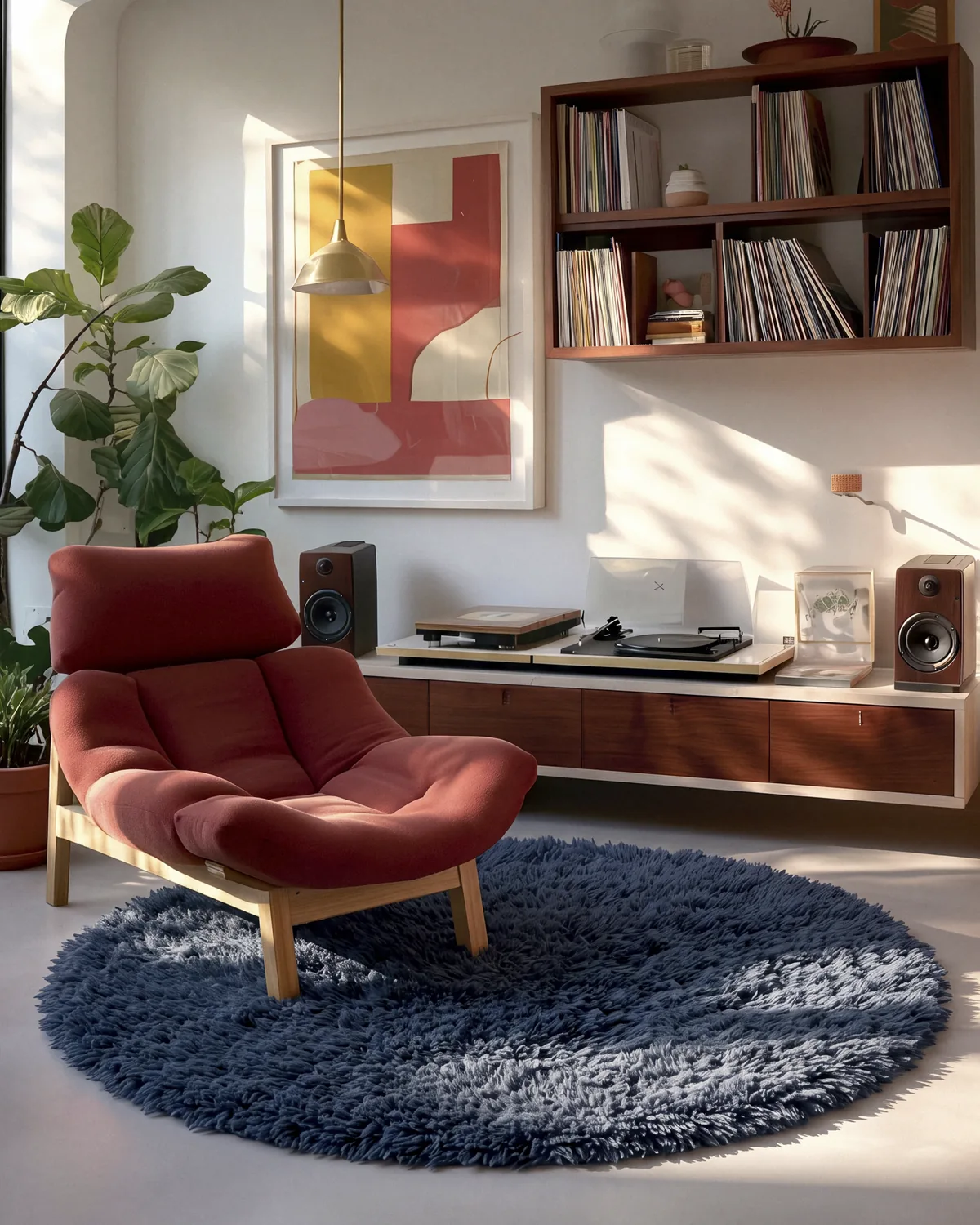
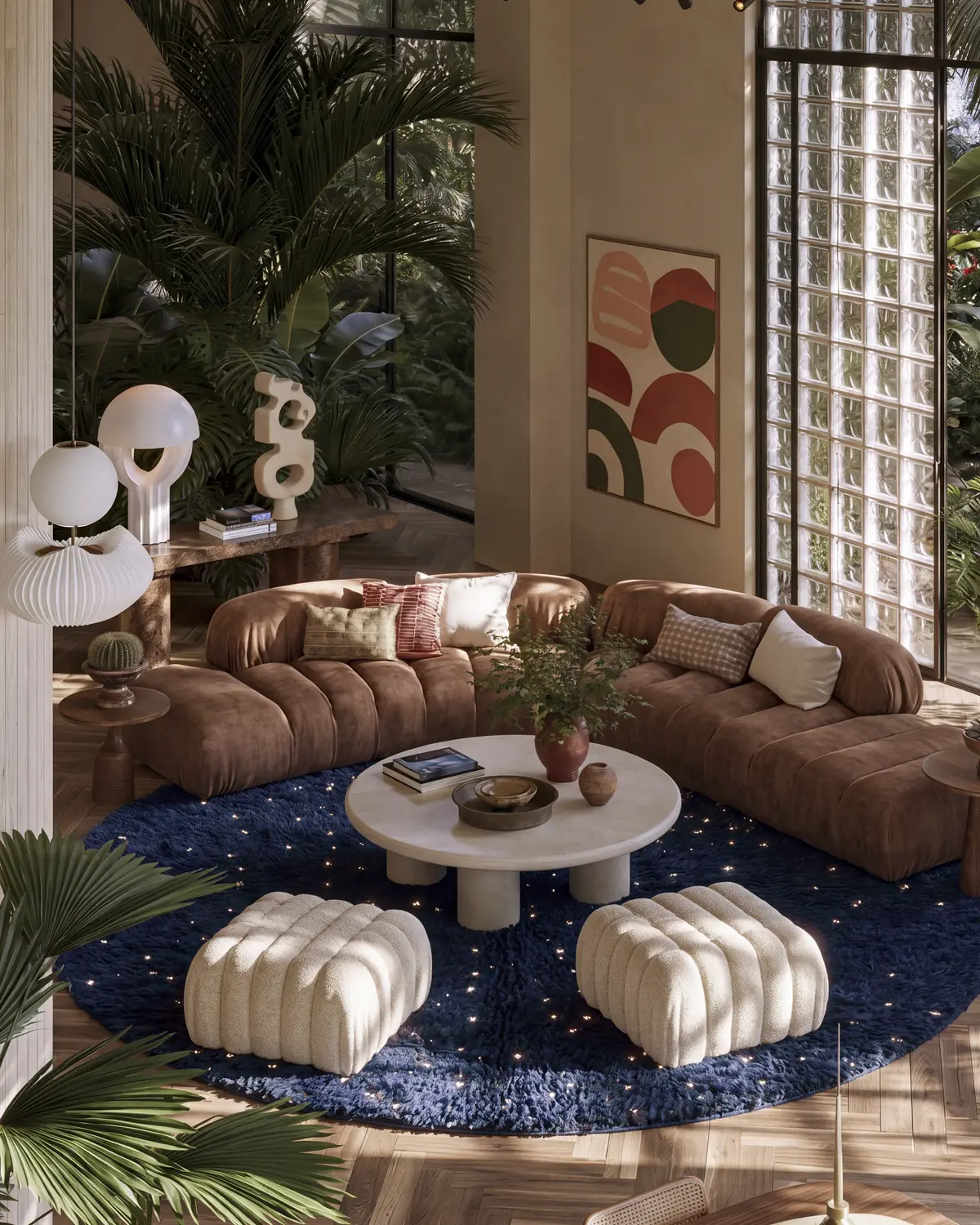
Rug styles
What Is a Boujaad Rug? Colors, Origin and Price
Where it comes from, how the color is made, what it costs.
By Zarbish · · 10 min read
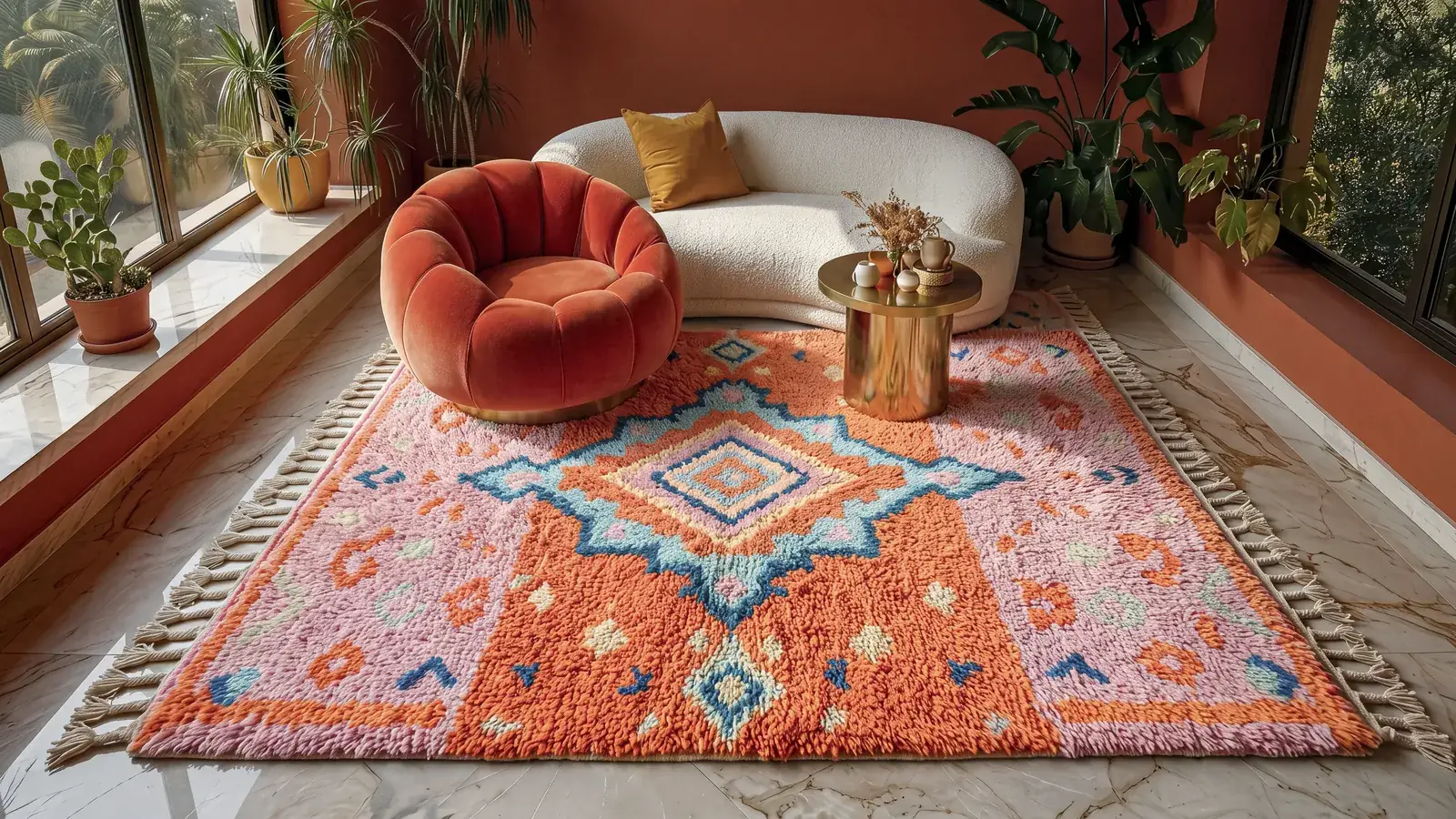
A Boujaad rug is a hand-knotted wool pile rug named for Boujaad, a town on the plains of central Morocco. It is known for warm, saturated color (pink, orange, red and coral) and for freehand motifs: diamonds, stepped medallions and scattered marks that rarely repeat. Old Boujaad rugs are lighter and thinner than a Beni Ourain rug.
Ours live in the Bloom collection, and they keep the color while changing the build: a dense weave where the old pieces were thin. Choosing one is mostly a color decision, so that is where this guide spends its time.
Key takeaways
- A Boujaad rug is a hand-knotted wool pile rug named for Boujaad, a town on the plains of central Morocco, known for warm saturated color and freehand diamonds.
- Old Boujaad rugs are usually lighter and less dense than Beni Ourain rugs; Zarbish knots the Boujaad design on a dense weave, in short, medium or shag pile.
- In a dyed-skein rug the color runs to the base of every knot, so the pile shows the same color at any height and as it wears.
- A real Boujaad rug shows its design mirrored on the back, knot by knot, with no canvas or glue.
Where do Boujaad rugs come from?
Boujaad rugs take their name from Boujaad, also spelled Boujad or Bejaad, a town in Khouribga Province, in the Béni Mellal-Khénifra region of central Morocco, considered the capital of the Beni Zemmour tribe (Wikipedia, Bejaad). The town sits on the plains west of the Middle Atlas, at about 1,9145 cm (400 m), and the rugs grew out of the weaving of the families around it. Seller pages describe the region loosely, so you will see Boujaad placed anywhere from the plains to the mountains; the town on the map is the anchor.
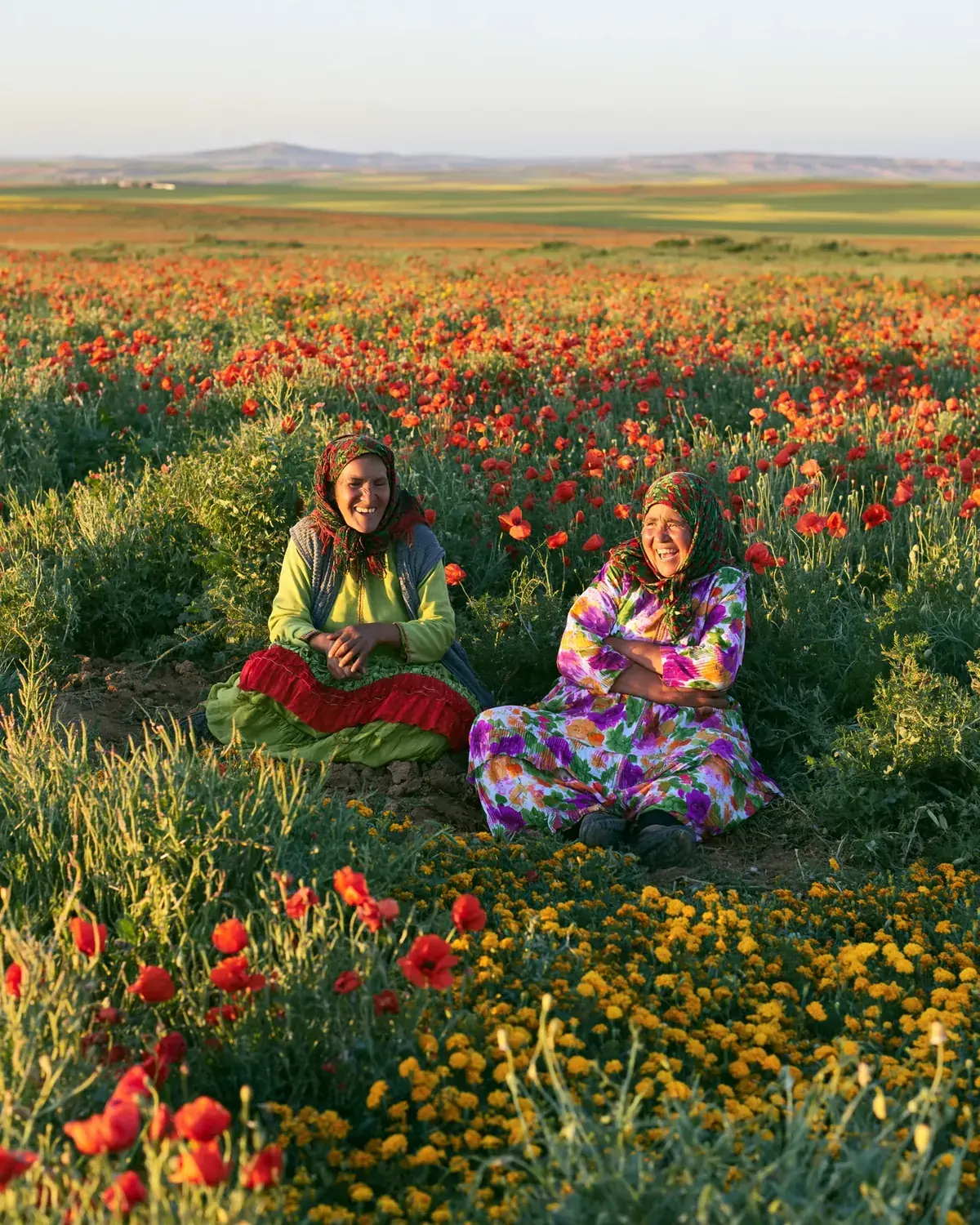
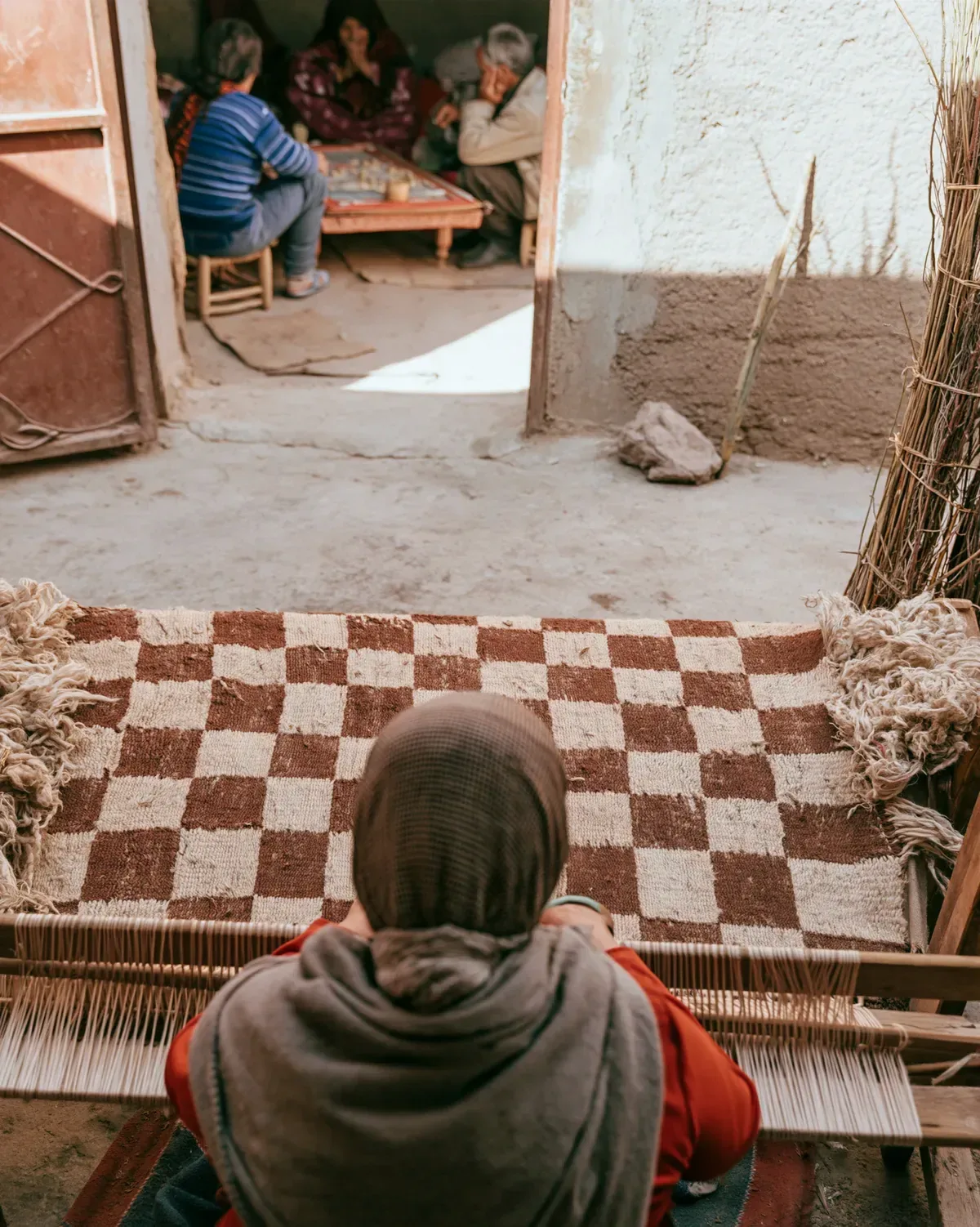
The rugs were woven for the home, not for sale: blankets, floor rugs, pieces for sitting and sleeping on. A traditional Boujaad rug is lighter, lower and more supple than a Beni Ourain, closer to a blanket than to a mattress, and the color does the work a deep pile does elsewhere.
A lineage name tells you what a rug looks like and how it is built. It does not name a workshop, and it is not a date. Our team of weavers knots Boujaad designs on the workshop's looms: the design language comes from the tradition; the density, the wool and the finish are ours. Nothing in the Boujaad rugs of our Bloom collection copies a particular old piece. The other names you will meet, Beni Ourain, Beni Mrirt and Azilal, sit beside Boujaad in the map of Moroccan rug types.
What colors are Boujaad rugs?
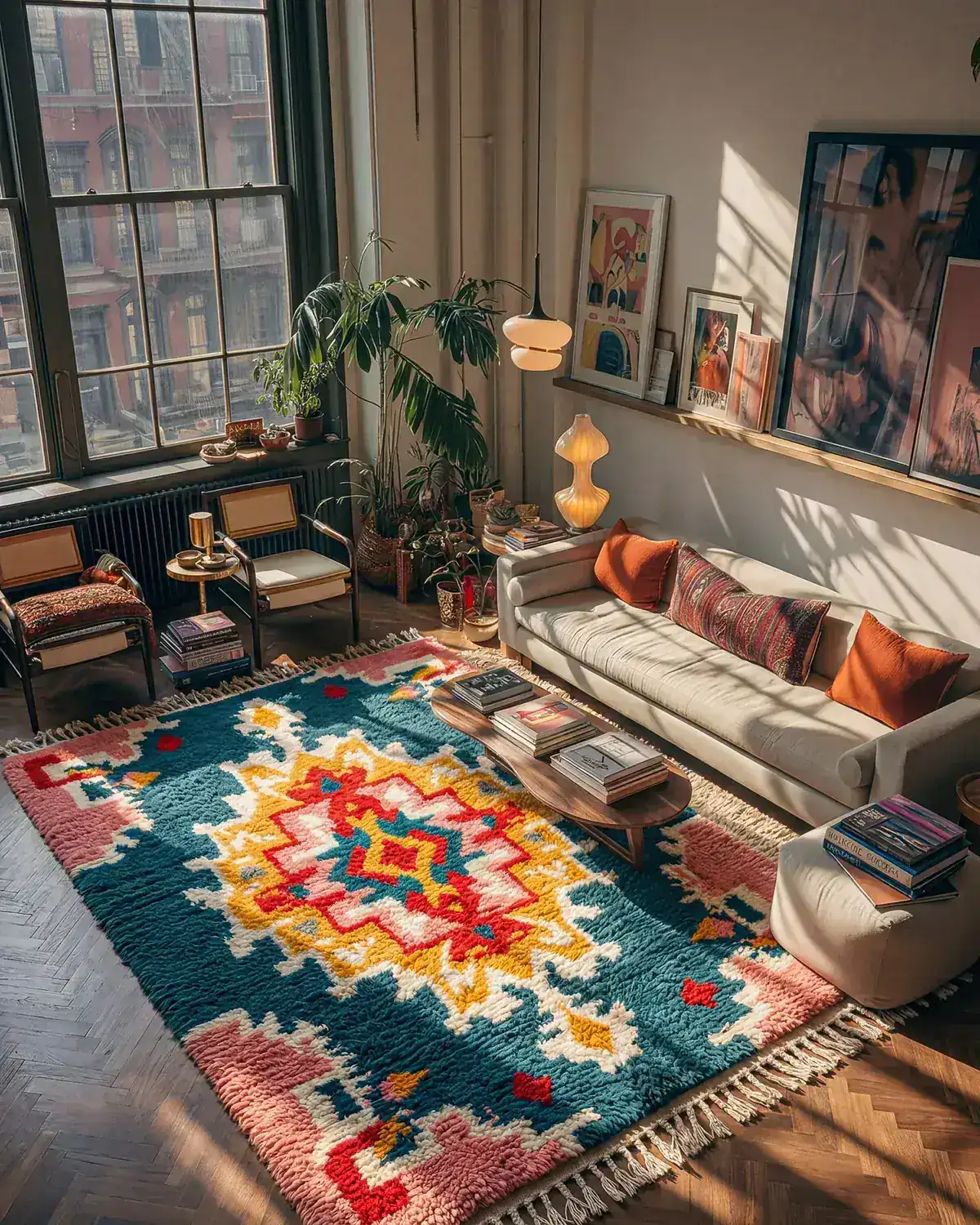
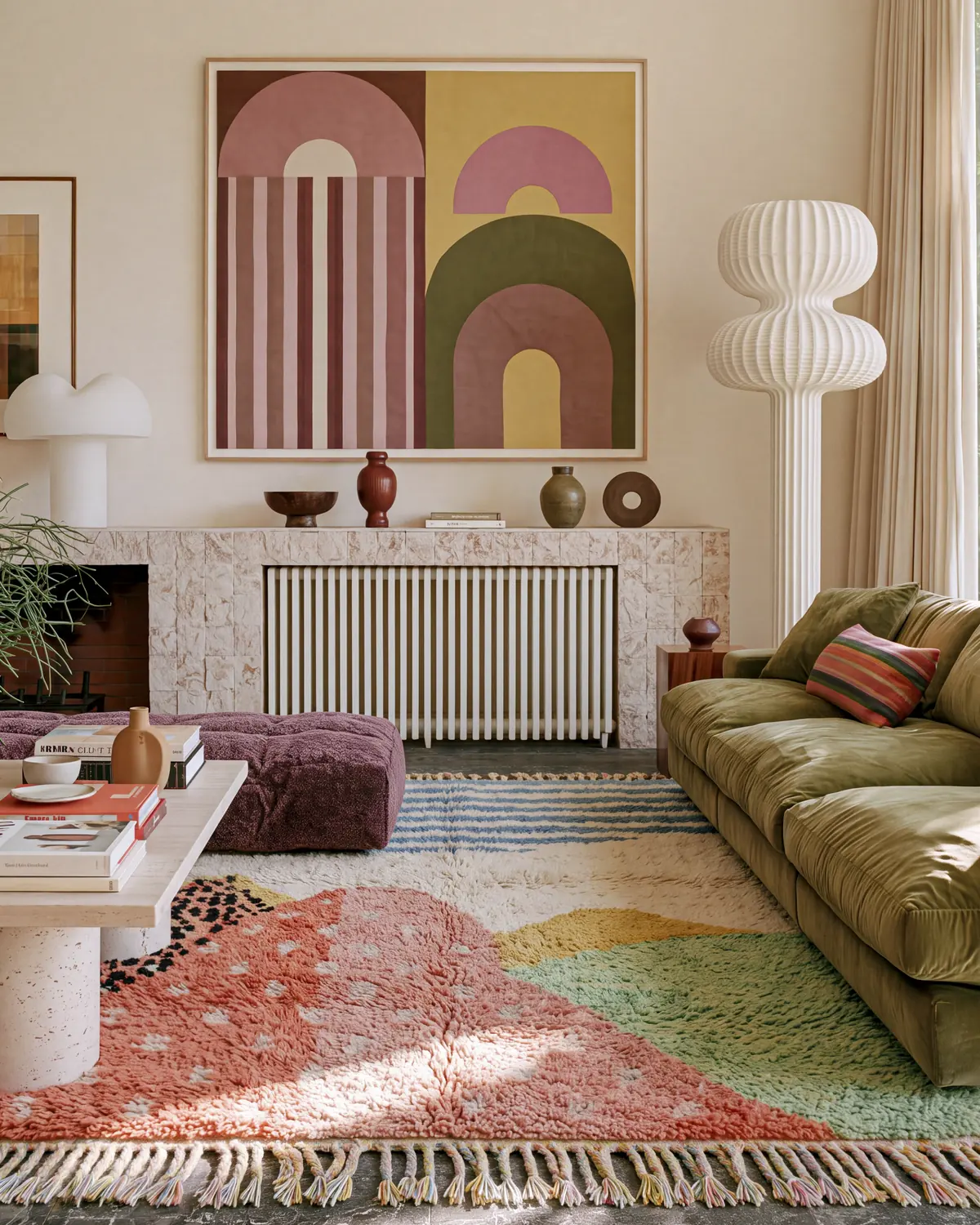
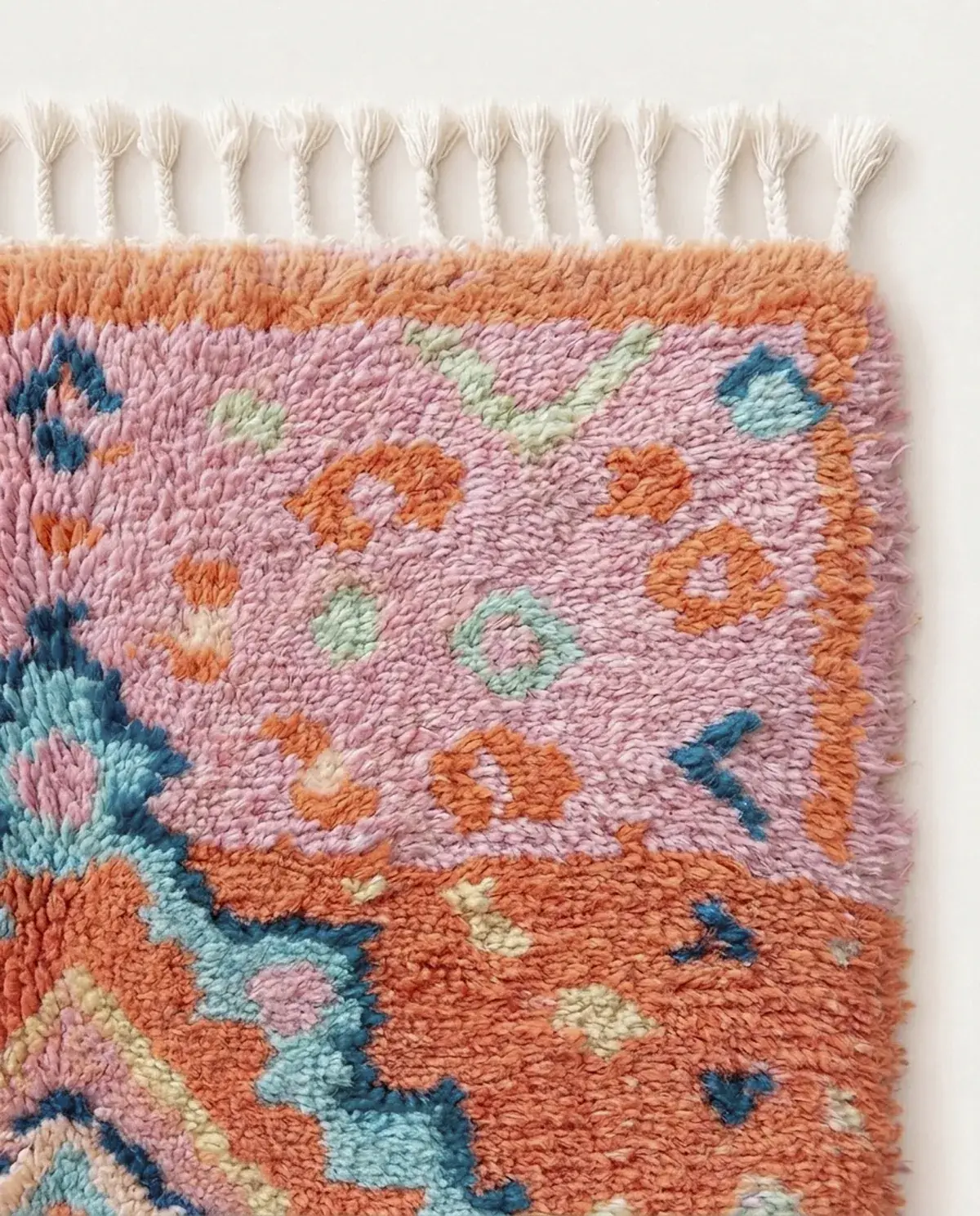
Boujaad rugs are known for warm, saturated color: pink, orange, red and coral lead, with magenta, purple, ochre and mustard beside them, and teal, turquoise, navy and ivory as the counterpoints that make the warm tones read. A new Boujaad rug is vivid. An old one is often soft and pastel, because years of sun and washing lift the color, and that faded look is what many vintage listings sell.
Bloom carries the palette in named colorways, each named for the colors the rug actually shows. Choose the colorway the way you would choose paint: by what the room already holds.
| If your room is... | Bloom colorways to look at |
|---|---|
| Cream, linen and walnut, needing one strong piece | Zahra, Orange & Pink · Amalou, Pink & Orange |
| Mostly white, wanting warmth without a crowd of color | Ayyur, Coral & Ivory · Warda, Pink |
| Green with plants, or wood and rattan | Jnane, Pink & Green · Tazerzit, Coral & Mustard |
| Soft and pale, a bedroom or a nursery | Zouak, Pastel Purple & Pastel Yellow · Louz, Blush & Mustard |
| Dark wood, books, a study | Rumana, Red-Orange & Ochre |
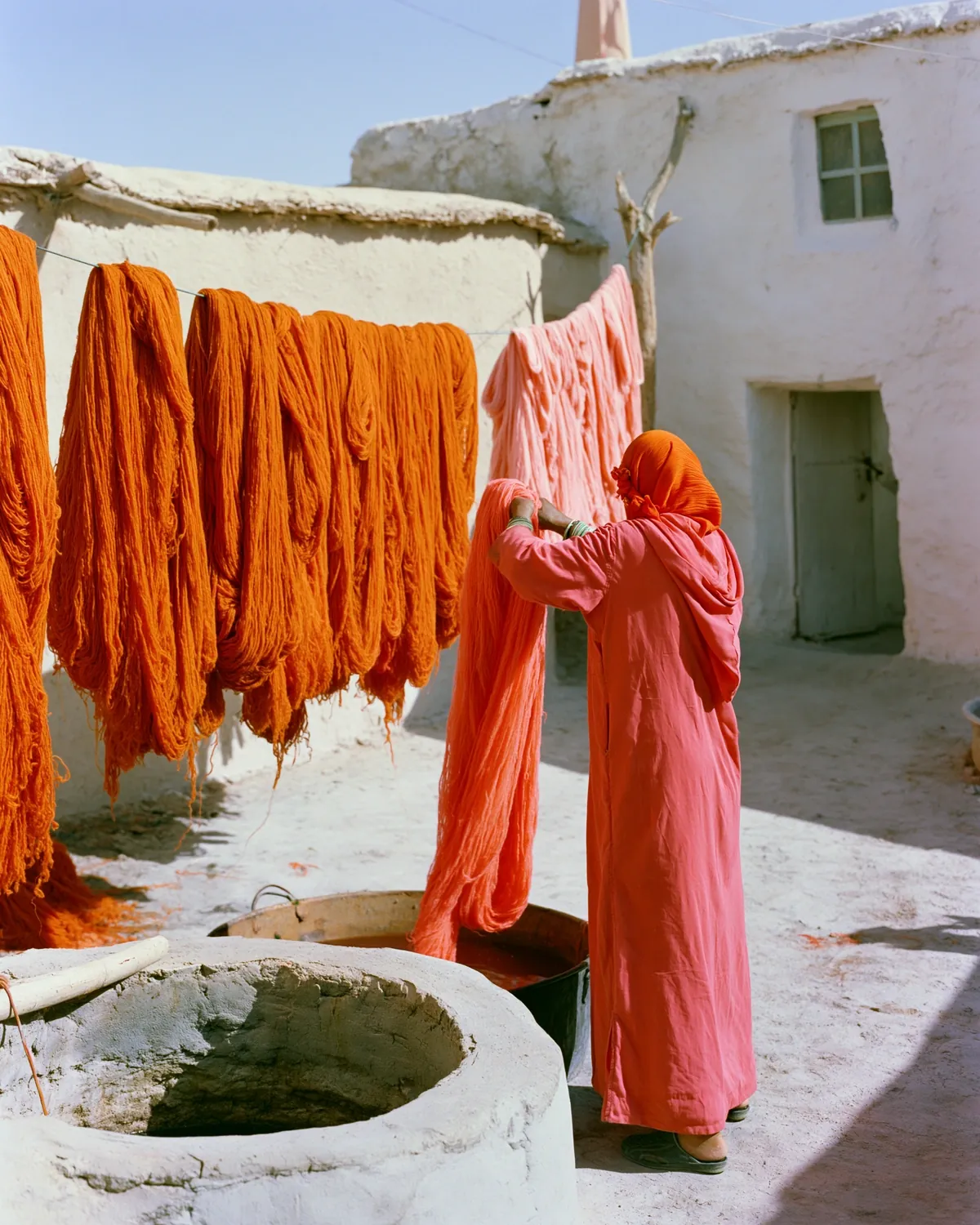
Color in wool also moves. A dyed wool pile is never one flat value, so the field shifts as the light crosses it: clearer and pinker at midday, warmer and deeper in the evening. Our photographs are edited toward neutral light and the true color of the rug, a faithful starting point rather than a promise about your lamps; the FAQ answers will the colors look the same in my home.
What do Boujaad patterns mean?
Boujaad design is freehand geometry: stacked diamonds, a stepped medallion set off center, zigzags, hooks and small marks filling the ground between them. There is no fixed dictionary of Boujaad motifs. The symbolism you will read online (a diamond for protection, a zigzag for water) is a set of readings gathered and repeated, not a code every weaver followed. Weavers once tied their designs from memory. Our design team composes ours for the rooms people live in now, and each keeps its freehand looseness. The symbols that do recur across Amazigh weaving, and how far each reading can be trusted, are in Berber symbols and their meanings.
The result is symmetry that is intended rather than measured. A lozenge widens where the weaver's hand widened. A border runs out of room and resolves itself. Read a Boujaad rug along its length and you can often see where the work paused and picked up again: that is the record of the making, and the fastest way to tell a hand-knotted piece from a printed one.
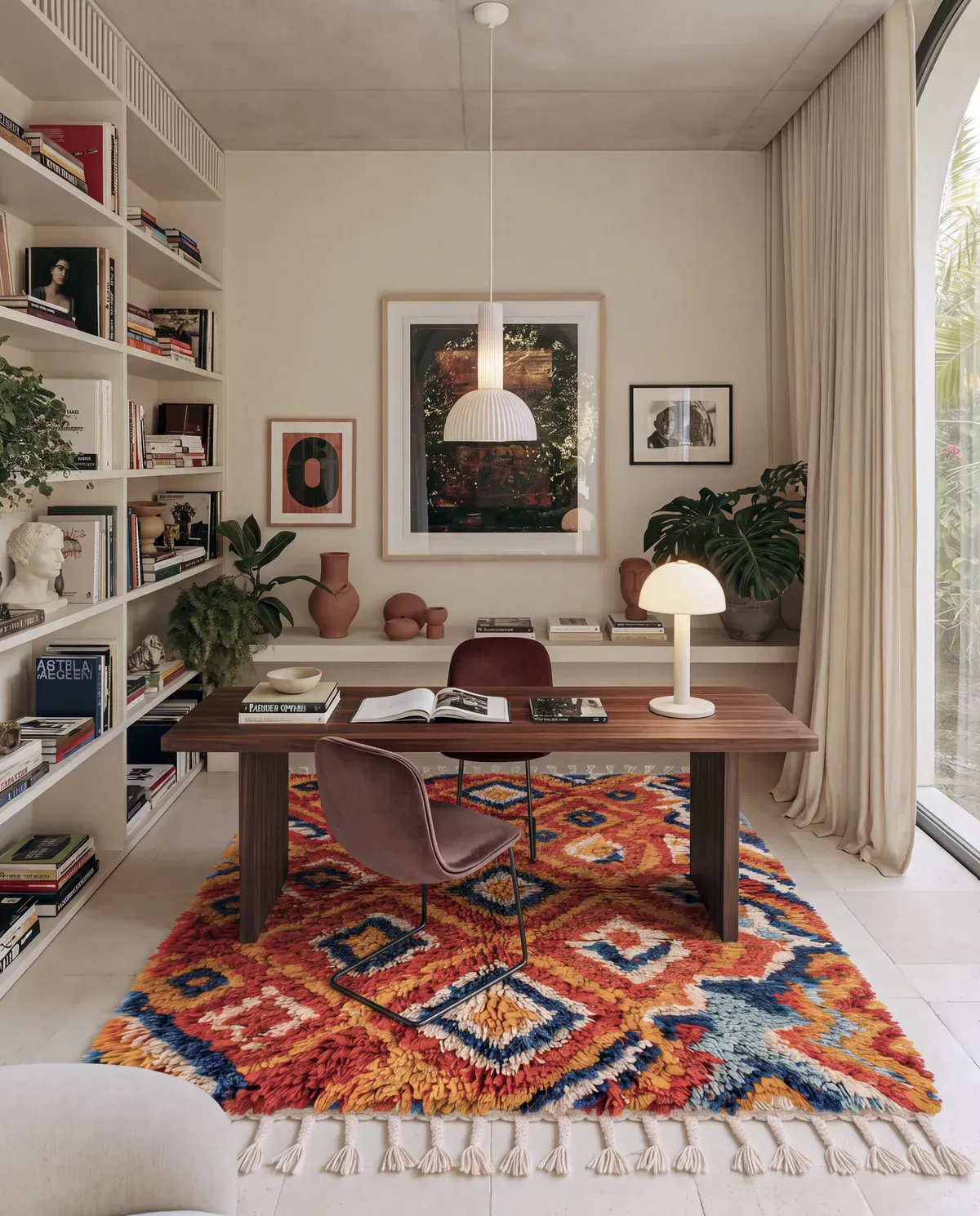
Each design in Bloom takes its own line from that tradition. Zahra is named for the Arabic word for flower: three bands (pink, orange, pink) with a stepped turquoise-and-navy medallion opening in the middle, the way the name promises. Rumana repeats an all-over lattice of red-orange and ochre diamonds, their centers outlined in navy, dense from edge to edge.
How thick is a Boujaad rug?
A traditional Boujaad rug is usually thinner and lighter than a Beni Ourain: a few old pieces are plush, many have worn close to a flat weave, and sellers often advise keeping them in low-traffic rooms. A Zarbish Boujaad rug is different in construction, not in look. We knot the Boujaad patterns on a dense, hand-knotted weave, so it sits heavier on the floor and is made for a living room or an office, not only a quiet corner.
The pile comes in three heights:
| Pile | Height | How a Boujaad pattern reads | Best for |
|---|---|---|---|
| Short | 1 cm | Crisp diamonds, flat and firm | Offices with rolling chairs, dining rooms, hallways |
| Medium | 2 cm | Soft and springy, color still sharp | Living rooms, bedrooms |
| Shag | 3 cm | Color blurs at the edges, pattern reads from across the room | Bedrooms, reading corners, quiet living rooms |
Here is the workshop fact that makes the choice safe. The weavers dye the skeins before a single knot is tied, in our workshop, with natural plant and mineral dyes, so the fiber takes the color through its whole thickness. Clip the pile short or leave it shag and the surface you see is the same color as the base of the knot. A printed rug has color on a surface that traffic wears through; a dyed-skein rug wears into more of the same color. Our dyes are fixed so the color does not transfer or shift with use, and the final wash checks every color against the design before the rug ships.
Boujaad vs Beni Ourain rugs
Boujaad and Beni Ourain are the two Moroccan lineages shoppers compare most, and the choice comes down to whether the floor should lead the room or hold still. Beni Ourain is ivory and line; Boujaad is color.
| Boujaad | Beni Ourain | |
|---|---|---|
| Ground | Color edge to edge: pink, orange, red, coral | Undyed ivory or cream wool |
| Pattern | Freehand diamonds, stepped medallions, scattered marks | Dark lozenges, bands, a loose lattice |
| Traditional build | Lighter, lower, more supple | Deep, heavy, plush |
| At Zarbish | Dense hand-knotted weave; short, medium or shag | Dense hand-knotted weave; short, medium or shag |
| Our collection | Bloom | Dune (solid), Jibal (patterned) |
If the second column is the one you keep reading, what a Beni Ourain rug is covers that lineage in full, and our Beni Mrirt vs Beni Ourain comparison sets out the carved alternative.
How much does a Boujaad rug cost?
A new hand-knotted Boujaad rug is priced by its size and by the weeks of knotting in it. Vintage Boujaad listings run from a few hundred dollars for a small, worn piece to a few thousand for a large one in good condition; the price follows condition and size more than age.
For how to judge any Moroccan rug price, and what one costs per year of use, read what a Moroccan rug costs
How to tell a real Boujaad rug
A real Boujaad rug is hand-knotted in wool, and a few checks settle it in a shop or from a seller's photos. If a listing shows no back, ask for one.
- The back. The design mirrors on the reverse, knot by knot, slightly coarser, with the rows visible. A canvas backing or a layer of glue means it was tufted, not knotted.
- The color at the base. Part the pile. On a dyed-skein rug the color runs to the base of the knot; color on the tips with pale wool underneath means a surface treatment or heavy bleaching.
- The fringe. On a hand-knotted rug the fringe is the ends of the warp threads the rug was built on, running out of the body. A fringe sewn onto a finished edge points to tufting or a machine.
- The pattern. Lines wander and diamonds change size. A perfectly repeating grid is a machine at work.
- The wool. Real wool is springy and slightly waxy with lanolin, like a wool sweater. Slick, squeaky fiber is synthetic.
When a listing puts "style" or "inspired" after the lineage name, the look was copied and the construction was not. The FAQ shows how handmade shows in the knots.
Buying a vintage Boujaad rug
Old Boujaad rugs were household pieces, woven by the families around the town for sitting and sleeping on, and used hard for years. What they offer now is what time did to them: reds softened to rose, oranges to apricot, a pile worn thin and supple. That is also what makes them hard to judge, because fading, repair and wear can look alike in a photograph. Buy one the way a dealer would. Beyond the checks above:
- The fading. Soft pastel color from years of sun is expected. Patches of sharply different color usually mean repair or re-dyeing.
- The materials. Some older pieces sold as Boujaad mix cotton or fabric strips into the pile, closer to a Boucherouite rag rug; lovely, but not a wool pile rug, and it cleans differently.
- The joins and edges. A hard line where color changes abruptly can mean two pieces joined; a re-bound side edge often hides a rug that was cut down.
- The wear. Hold it to the light. Where the knots show through the pile, the rug is worn, not characterful.
- The size. An old rug is the size it is. If it does not reach the front legs of the sofa, no price makes it fit.
How to style a Boujaad rug
A Boujaad rug is easier to live with than it looks, because the rug makes the color decision and the room follows it. Pull tones out of the rug rather than matching against it: take one color for the largest soft thing in the room, a second for the smallest, and leave the rest in wool, linen, wood and plaster.
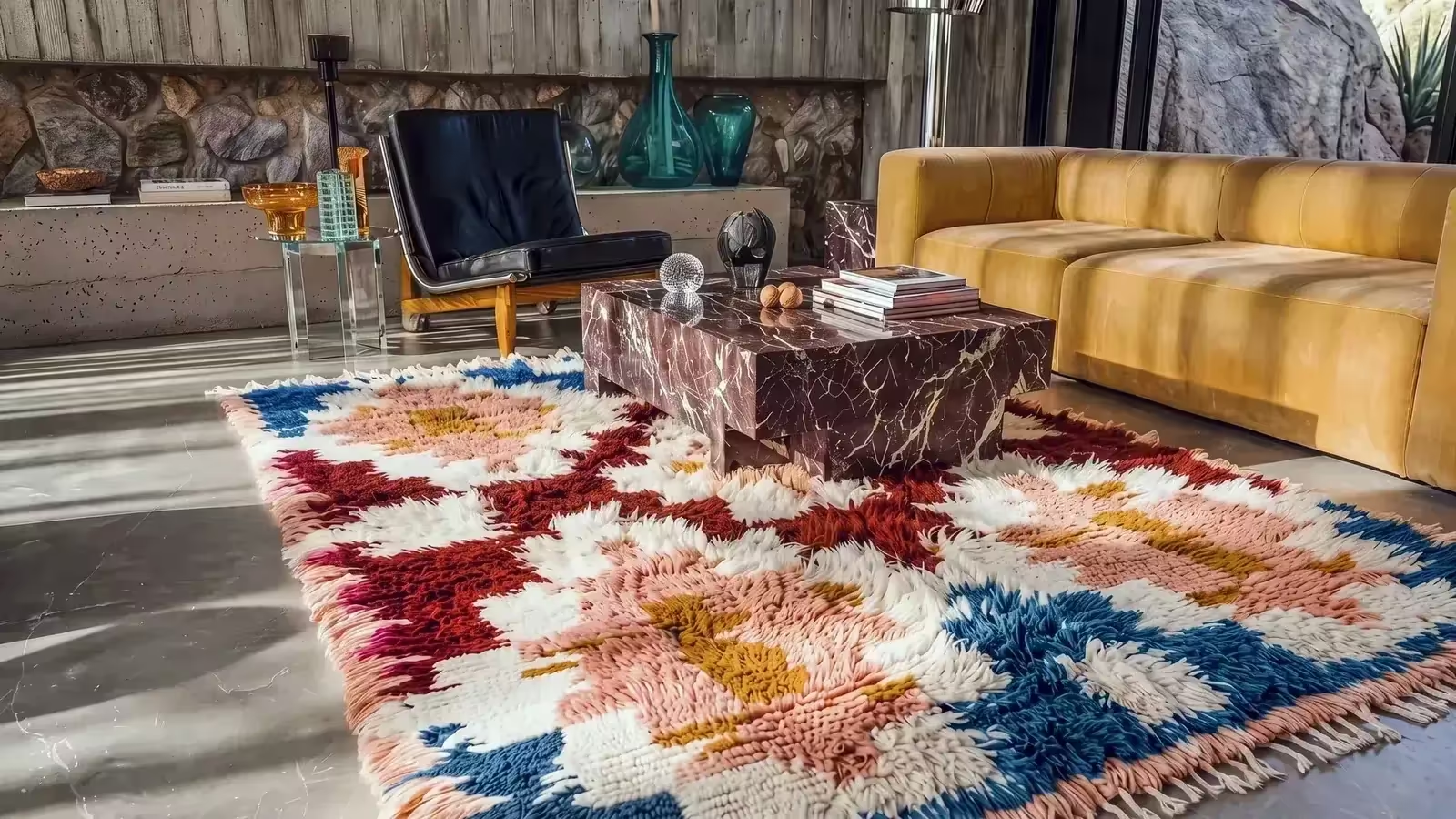
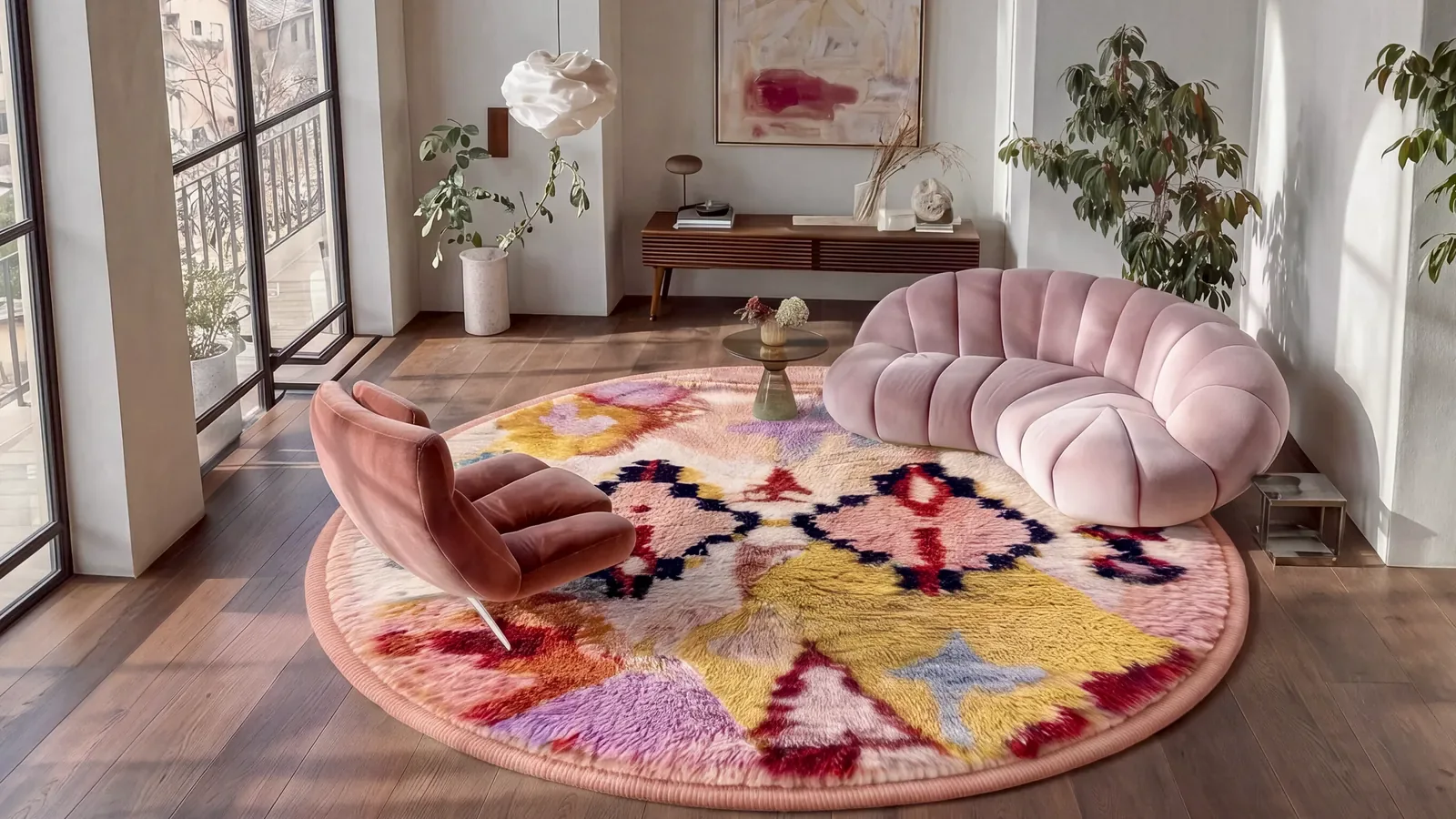
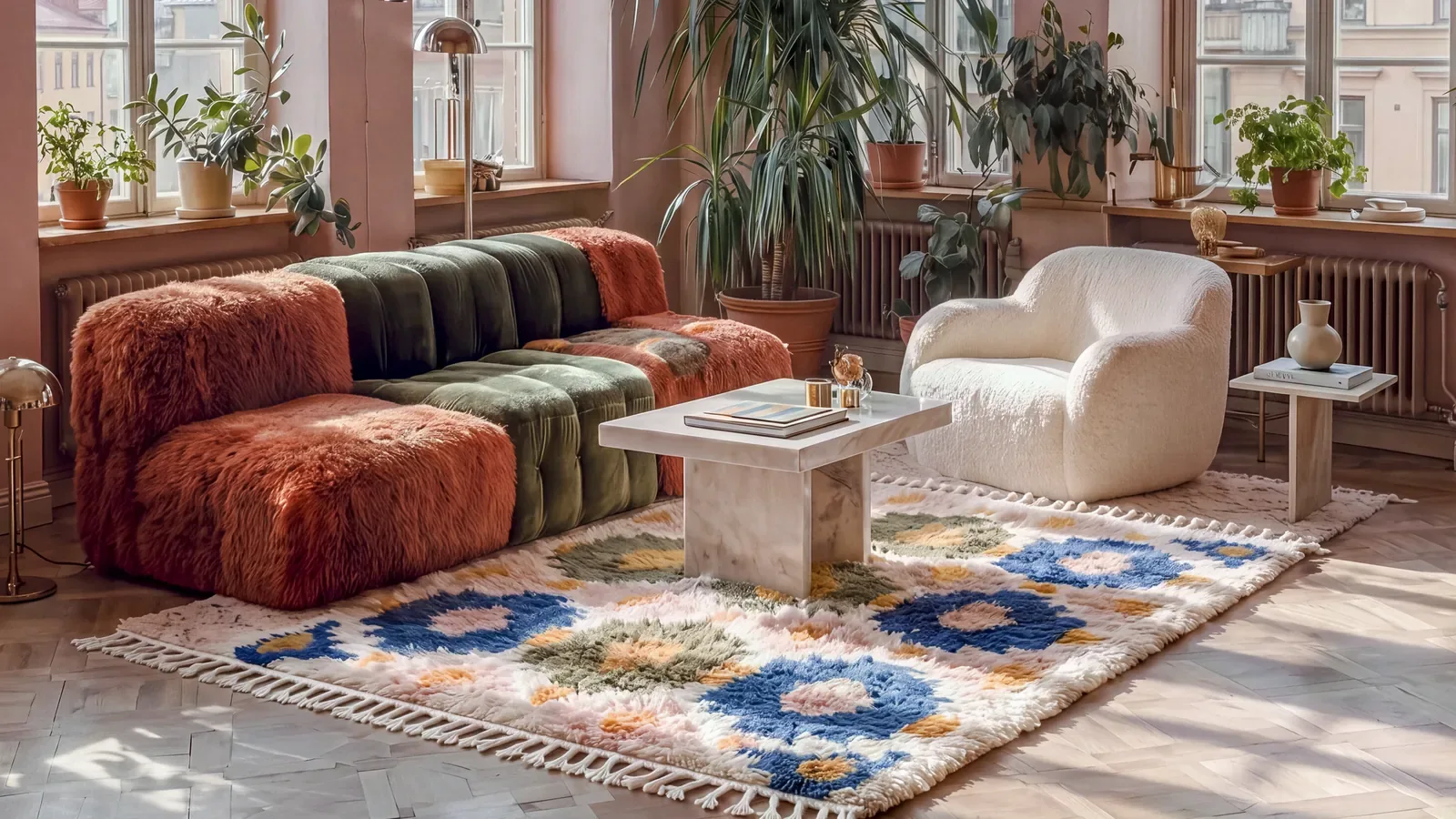
In the cover room, Zahra's orange and pink sit against an ivory bouclé sofa, one coral velvet chair and a marble floor, with warm walls repeating the rug's orange; the sofa stays neutral so the rug can be the color. In the office above, Rumana's red-orange and ochre lattice settles under a walnut desk against ivory walls, and the terracotta vases on the shelf pick up the rug's warmest tone. For a desk with a rolling chair, choose short pile.
Size the rug to the furniture, not to the floor. In a living room, an 245x305 cm rug takes the front legs of a 215 to 245 cm sofa and two chairs; a sectional wants 275x365 cm. Between two sizes, take the larger: a small colorful rug floating in front of a sofa reads as an afterthought, and a large one reads as a decision. The full method is in is my rug too small?
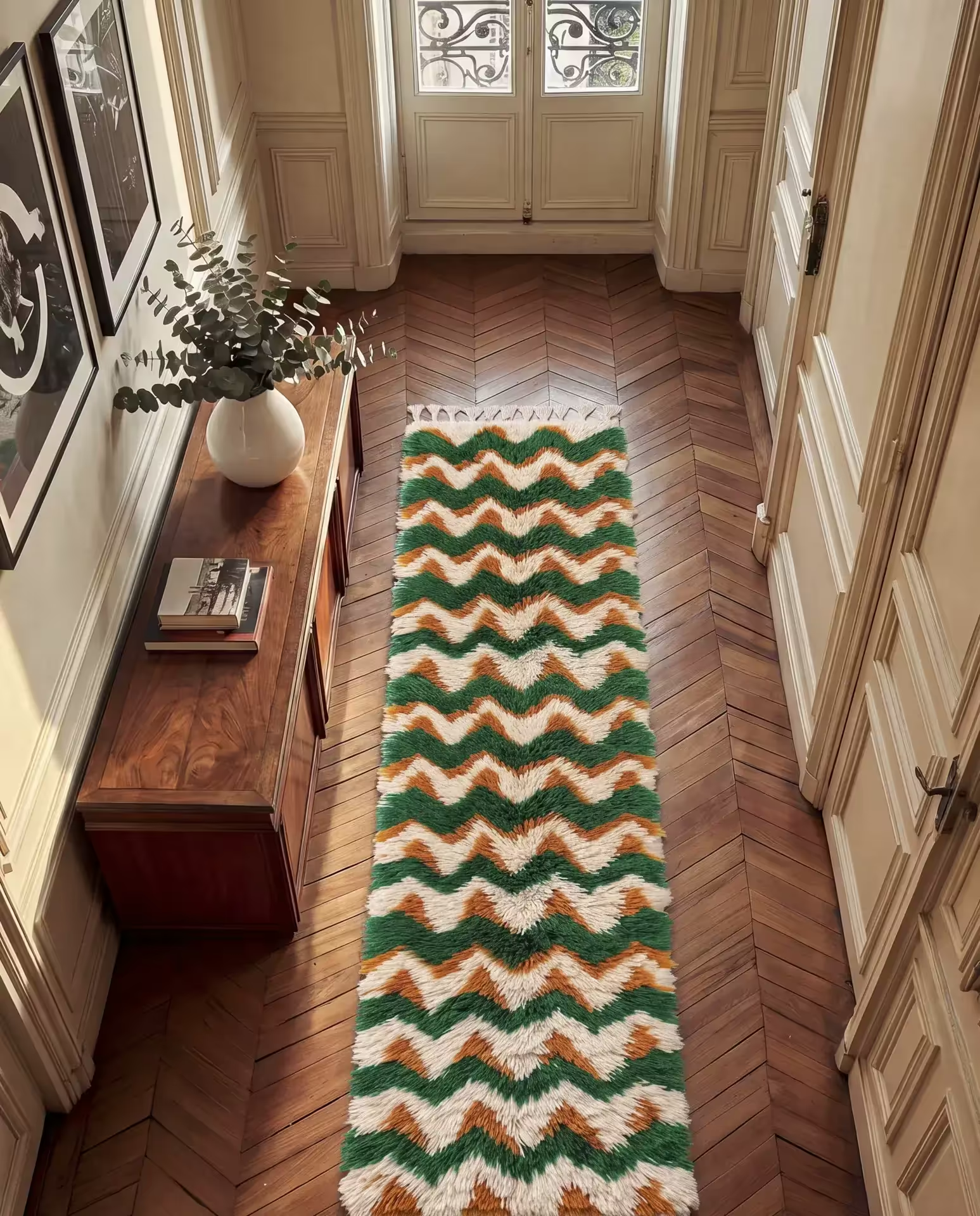
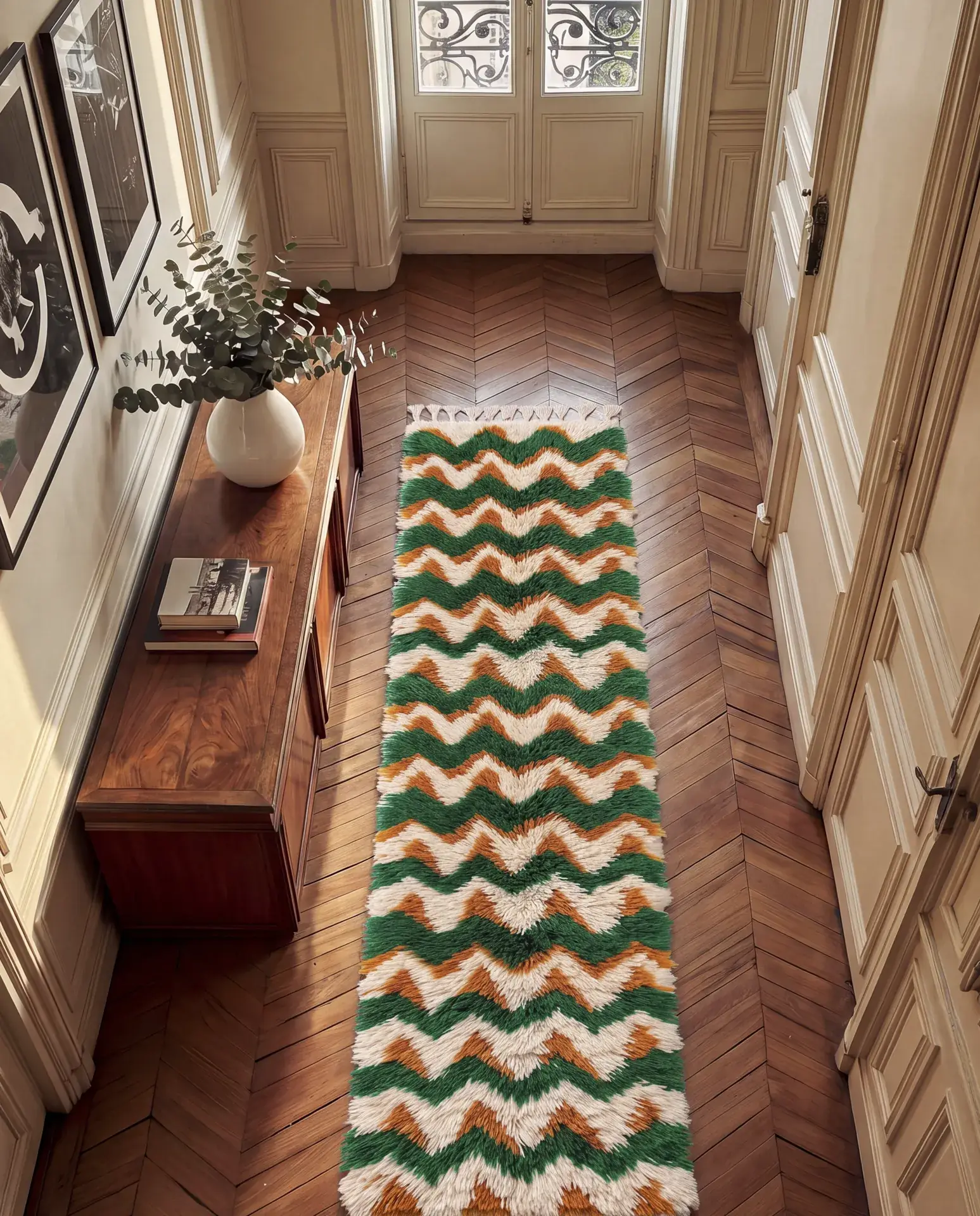
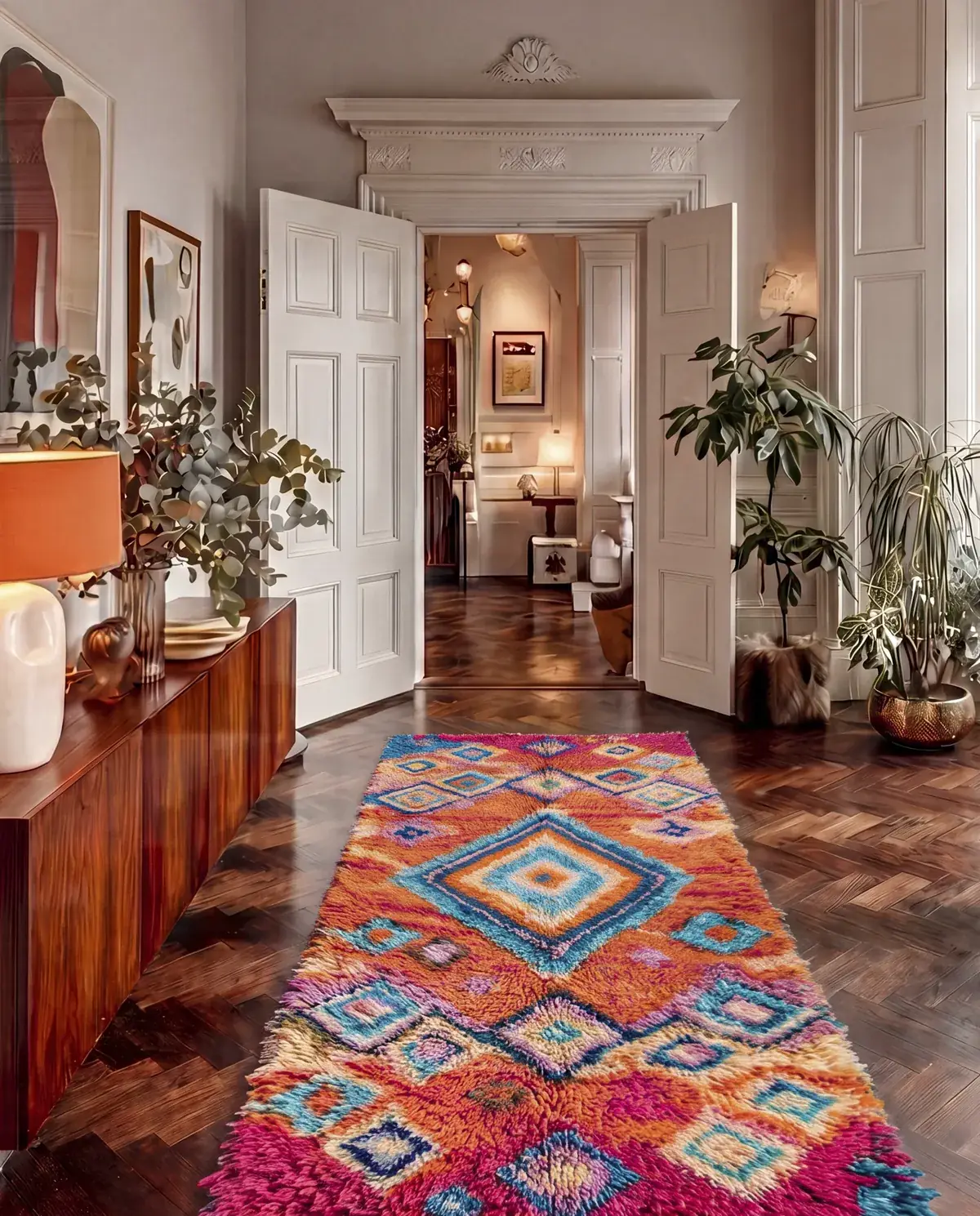
A runner works the same way in a narrow space, where a field of color reads as light rather than as a pattern to match. Amalou runs pink and orange down a hallway of herringbone parquet beside a long walnut sideboard, and the plain wood lets the diamonds carry all the color.
For whole-room palettes, our guide to decorating around a colorful rug works through the room; if the rug is mostly pink, our guide to what colors go with a pink rug takes it color by color.
If one warm color is enough for the room, start with Warda, Bloom's pink colorway. Next: decorating around a colorful rug, then every rug we make.