




Rug styles
How to Style a Checkered Rug in the Living Room
Check size, color, pairings and price for a checkered wool rug.
By Zarbish · · 10 min read
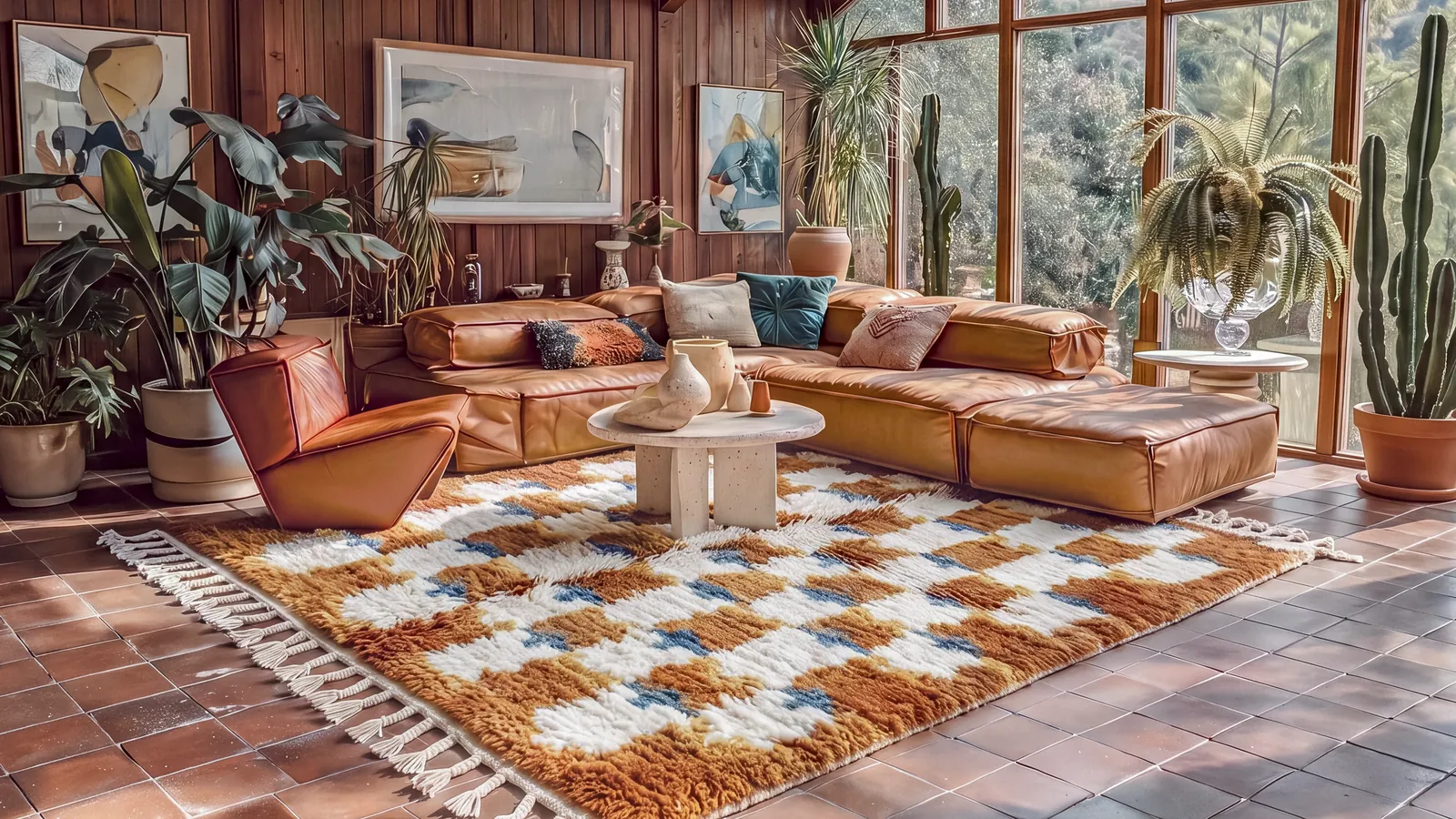
To style a checkered rug in a living room, get three things right: make it the one strong pattern in the room, choose checks that suit the distance you see them from, and run its grid square to the sofa or the longest wall. Get those right and a checkerboard reads as order rather than as a trend.
A checkered Moroccan rug is the hand-knotted wool version: blocks of color knotted row by row to a counted plan, their edges drifting by a knot. No single tribe owns the check; it belongs to Berber weaving at large. We design large checks in the Dama collection and small tile repeats in Mozaik.
Key takeaways
- A checkered rug works in a living room when it is the room's one strong pattern, its checks suit the distance you see them from, and its grid runs square to the sofa or the longest wall.
- Hand-knotted wool checks date more slowly than printed ones: the block edges wander by a knot or two, so the grid reads soft rather than graphic.
- Large checks (the Dama collection) give a room order; small tile repeats (Mozaik) sit more easily beside cushions and art that already carry pattern.
- Short pile, 1 cm, keeps a checkerboard's edges crisp; shag, 3 cm, lets the wool lean across them and softens the grid.
Are checkered rugs still in style?
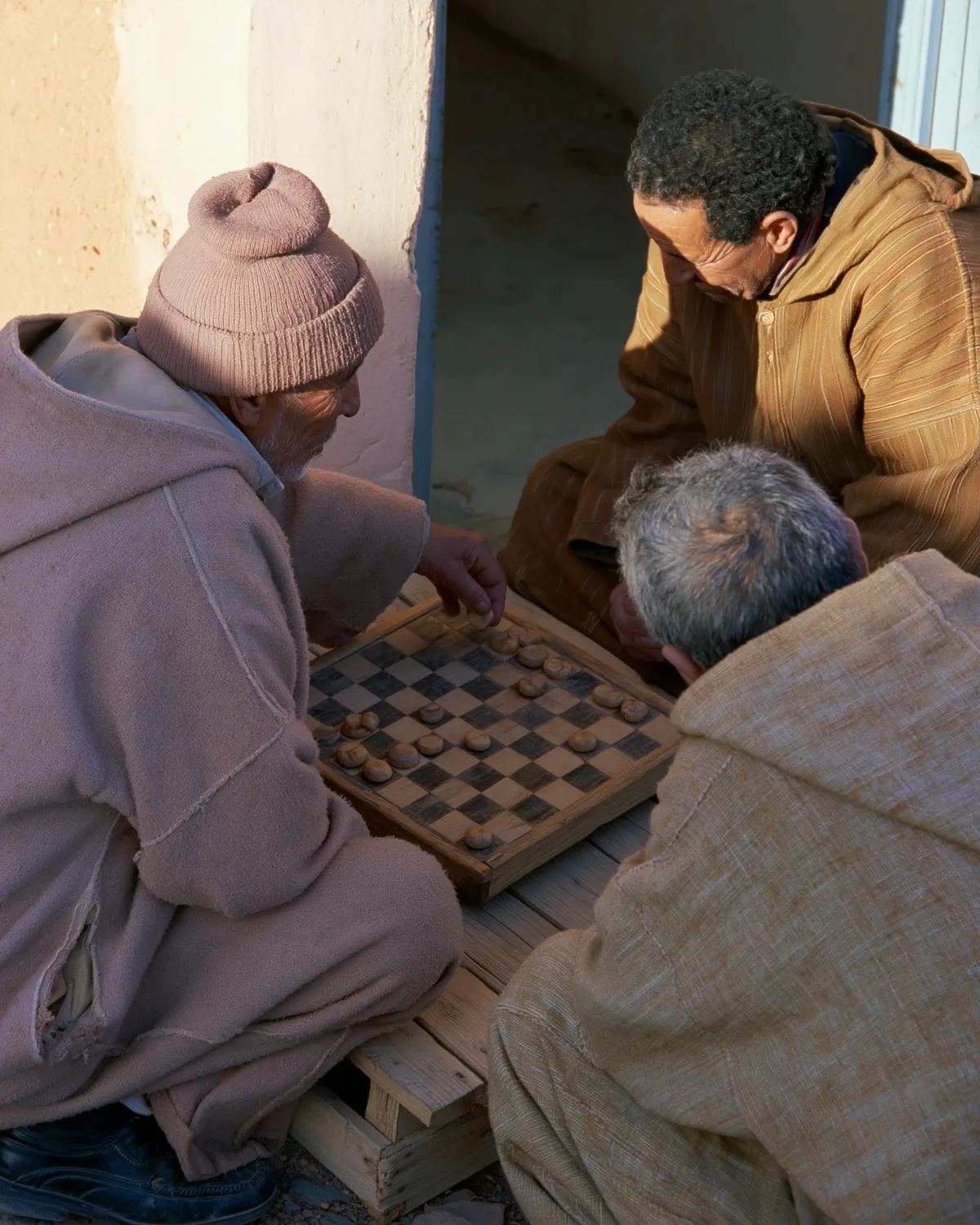
Yes. Checkered rugs are still in style, and the check itself is older than any trend: crossing colored threads produces it almost by accident, so it is one of the first patterns weaving ever made, long before it marked a game board (check pattern). What dates is a version of the pattern, not the pattern. How the board itself became a rug is in the history of checkers.
The checkerboard that will look tired first is the one that arrived with the trend: two flat colors, printed or tufted, every square identical, often in a synthetic pile with a sheen. The one you will still like later shares four traits:
- Knotted, not printed. Squares tied by hand, whose edges drift slightly, read as a textile. Squares printed to a stencil read as a graphic, and graphics date.
- Colors taken from your room. If the rug's colors already live in your sofa, your wood or your walls, it belongs to the room instead of to a year.
- Softened contrast. Peach against terracotta, navy against blush or ochre against ivory sits calmer than pure black against pure white, which works but reads as a fixed statement.
- Wool that ages. A wool pile settles and softens with use and ages beautifully; a synthetic one flattens and shows its paths.
If you love a checkered rug and it passes those four points, it is the rug you will keep. If you love it mainly because it is everywhere, choose a quieter grid or a small tile repeat instead.
Hand-knotted or printed: how to tell a check that lasts
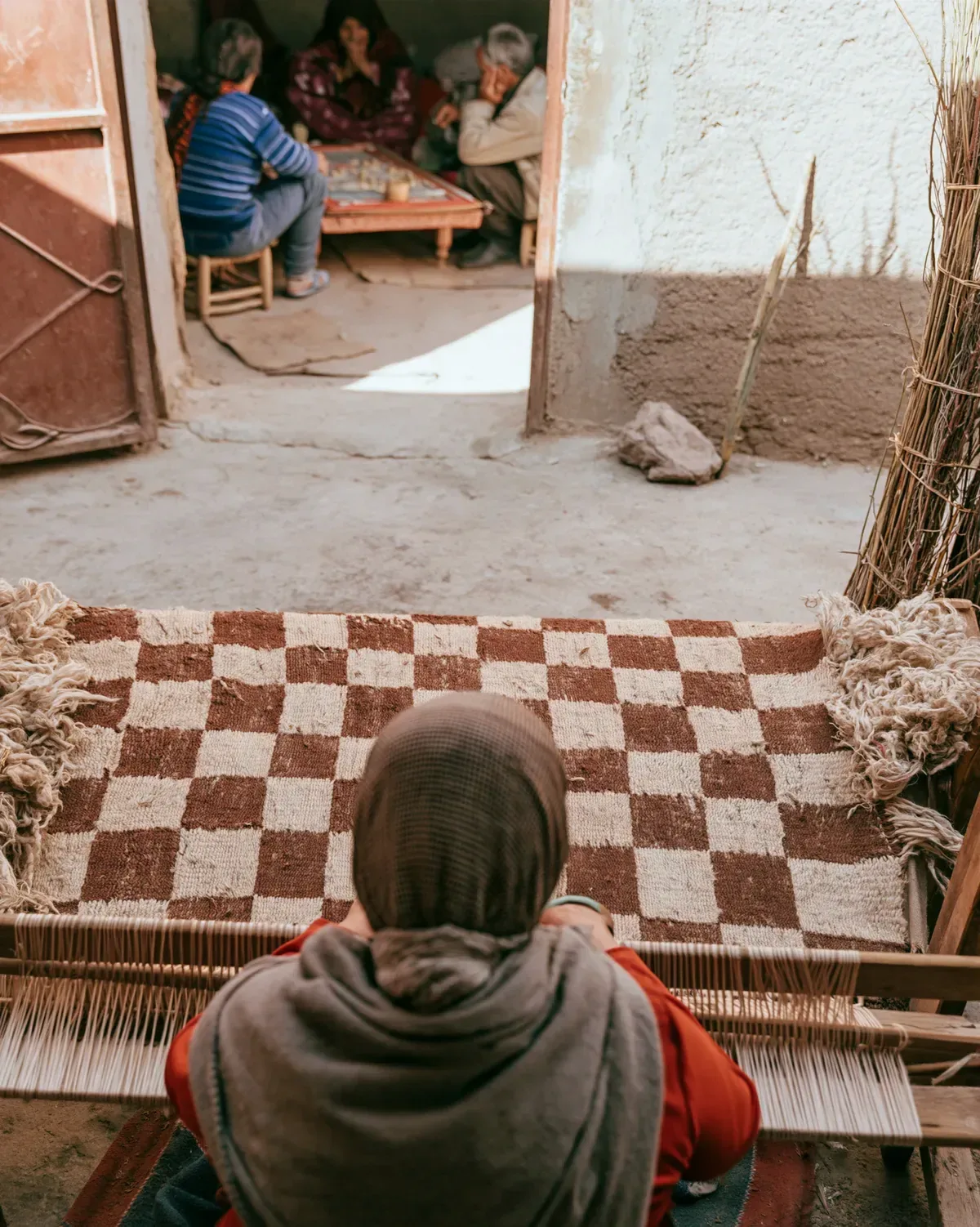
A hand-knotted checkered rug is built square by square. On our upright steel looms, the weaver ties each knot of wool around the warp in the color the counted plan calls for, one row at a time, and changes color at the knot where the plan says a block ends. Here is the part you only learn at the loom: the block edges still wander by a knot or two, because one hand's tension is never quite the next hand's.
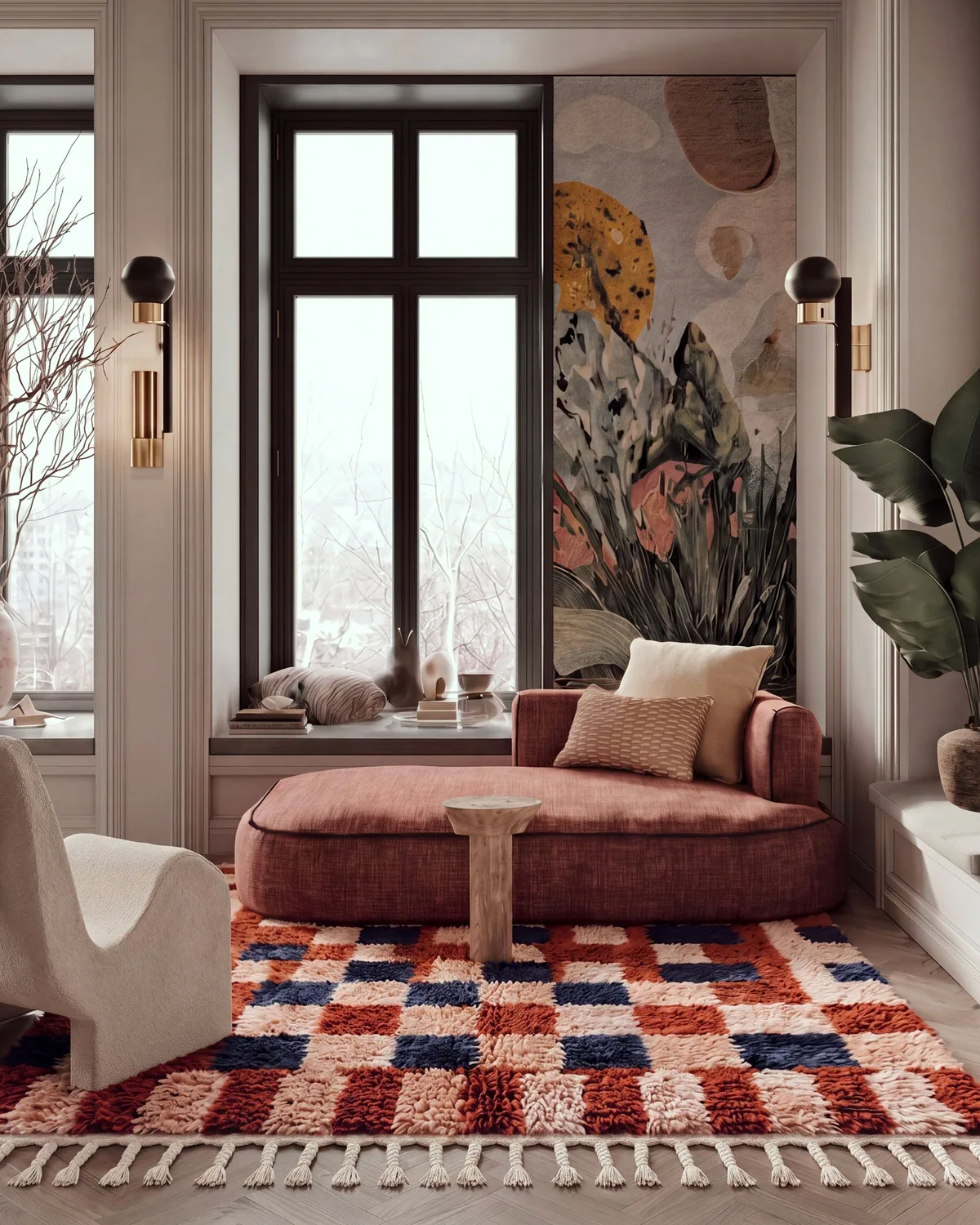
Darja sets a checked center of peach, navy and rust inside a stepped rust frame, and the photograph shows how little else a strong check needs. Before a rose daybed in a paneled window bay, the rust picks up the daybed and the navy stays the one cool note, so the grid ties the room together instead of competing with it.
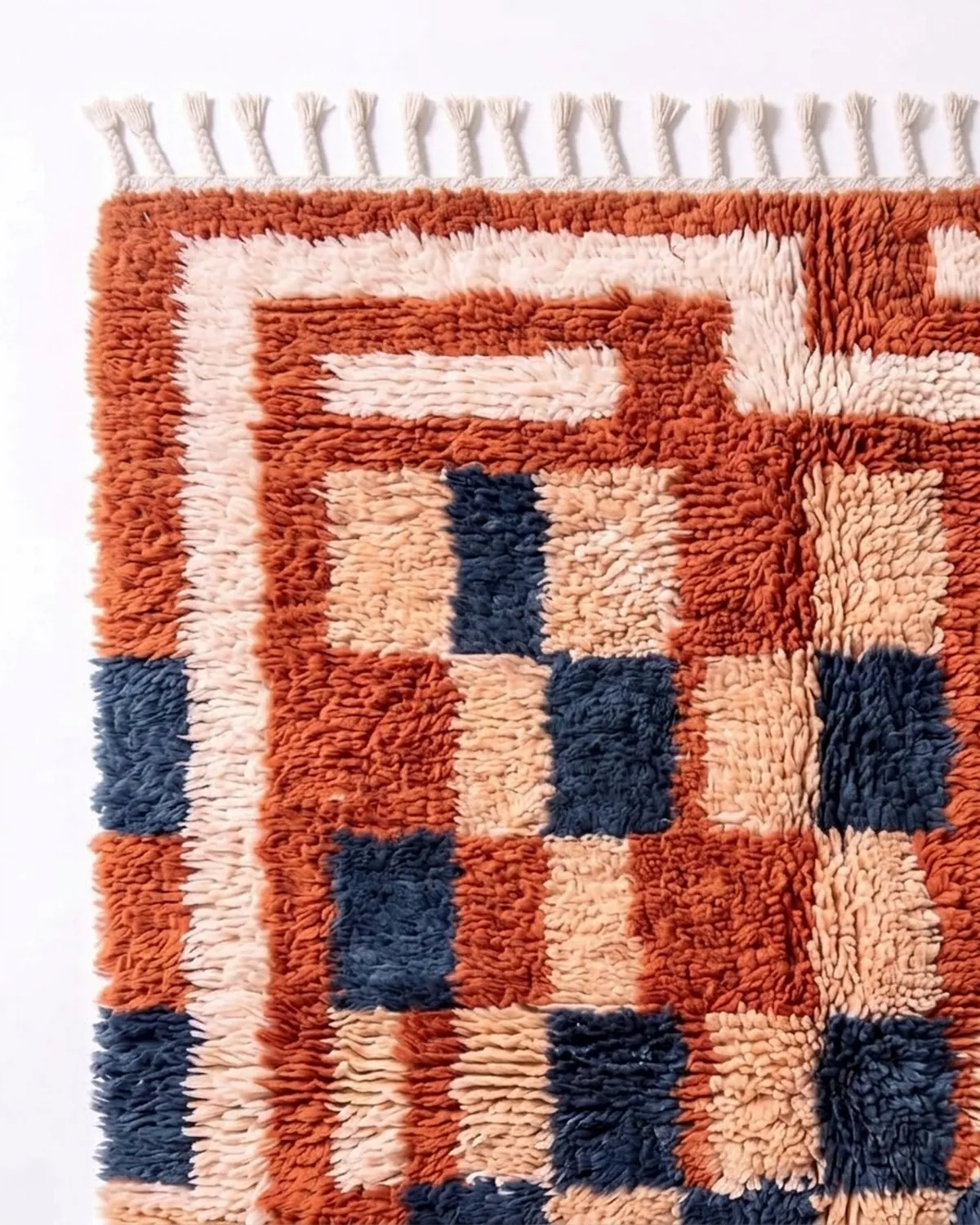
Look at any edge where ochre meets ivory in the close-up: no two steps are the same. That drift is the whole difference between a wool check and a printed one, and it is why a hand-knotted grid stays soft in a room instead of reading like flooring. When you shop, four things tell you how a checkered rug was made:
| Hand-knotted wool | Hand-tufted | Printed or machine-made | |
|---|---|---|---|
| How the check is made | Knot by knot, color changed at the knot | Yarn punched through a backing cloth, then glued | Printed on the surface, or woven by machine to a fixed repeat |
| Block edges | Wander by a knot or two | Clean, cut to a stencil | Identical down the whole rug |
| Back of the rug | The checks show through, knot for knot | Covered by a glued backing cloth | Faint or blank (printed), or a machine-even grid |
| Tassels | Formed from the warp threads | Sewn or glued on | Sewn on, or none |
The full comparison, with what each construction means for how long the rug lasts, is in how a Moroccan rug is made.
Which color checkered rug?
Choose the color of a checkered rug from the room, not from the pattern. A check sets its two colors edge to edge again and again, which makes both louder than they would be alone, so the pair has to be one you would happily see on the sofa or the walls.
- Warm earth checks (peach, terracotta, ochre, brown) are the easiest in a living room with wood floors: from the door they read as one warm field, and the grid appears as you come closer. Darja is the example above.
- Pink and blush checks soften a grid the most.
- Black and ivory checks are the most graphic. In hand-knotted wool the drift softens them, but they still lead the room. Our catalog checks lean warmer; a black and ivory checkerboard is a custom colorway. Styling one is covered in black and white rugs.
- Blue checks are the calmest strong pattern, which is why they get their own section.
Blue checkered rugs
A blue checkered rug sets navy or dusty blue against a warmer square, and blue is the color that keeps a grid calm: it sits back while peach, coral and rust come forward. In Dama, blue runs through several grids at two very different scales.
Tirra is the close-up version. Navy and warm brown squares sit on pale blush in a checker set by hand, tight at the center and loosening into long navy bars at the top, the bottom and both sides, so the grid seems to open out as it reaches the floor around it. It reads best from a few steps away, from the sofa rather than from the door.
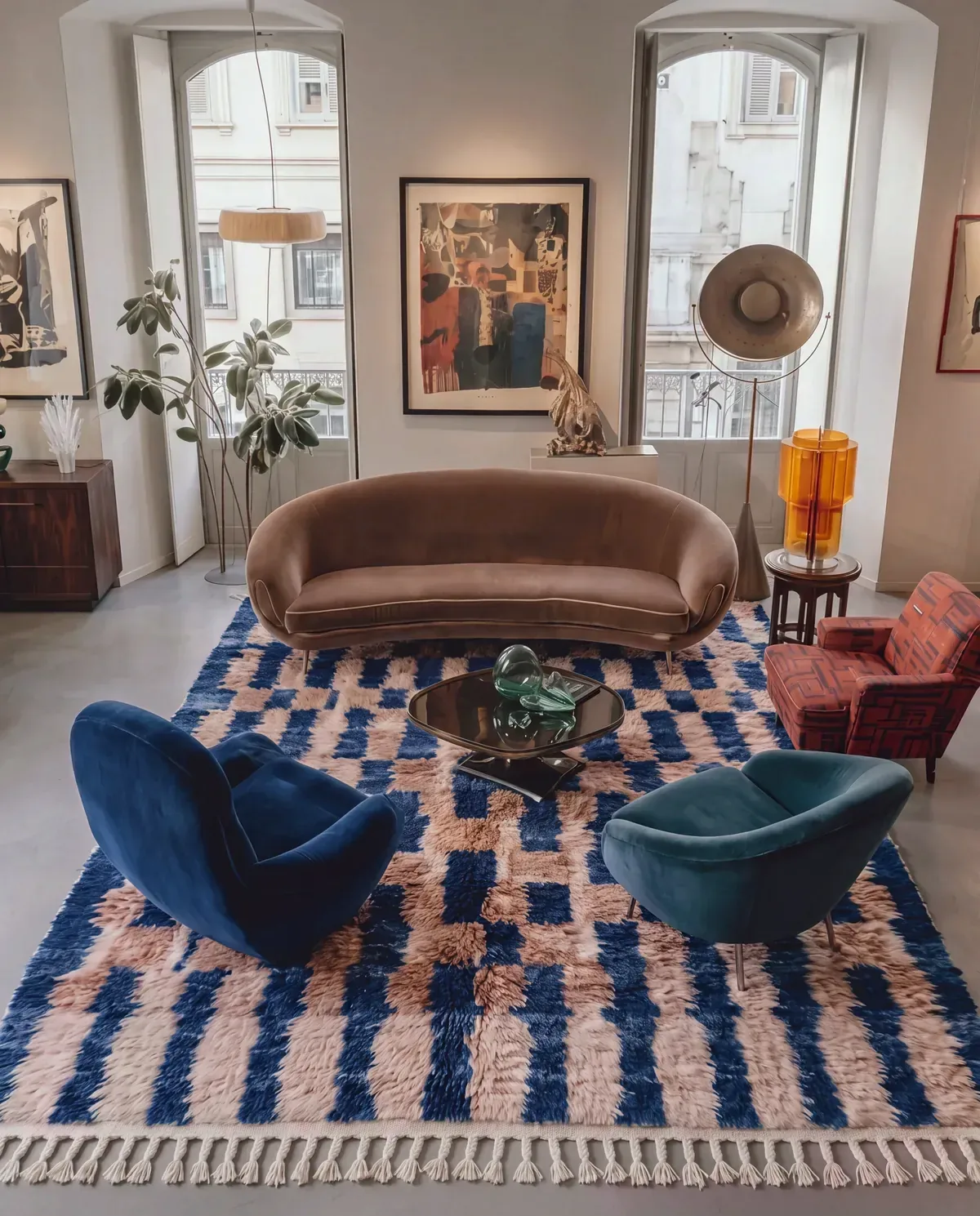
The room in the photograph does what a blue check asks for. The two blue velvet armchairs repeat the navy, the curved taupe sofa takes the warm brown, and the one other pattern in the room, a red armchair to the side, stays small against the rug.
Alwan works at the doorway scale: a large checkerboard of navy, coral pink, rust red and cream squares in three rows, with a row of rounded cream cells set in rust at each short end. Each square is big enough to read from across the room, which suits a living room with plain upholstery and a long view to the floor. Both sit with the other checkered Moroccan rugs in the Dama collection.
Large checks or small tiles: Dama or Mozaik?
The size of the check decides how a checkered rug behaves. Large blocks give a room a structure to sit inside, the way a tiled floor does; small repeats give it a surface with depth. Zarbish knots the first in Dama and the second in Mozaik. The small tile has its own source in the zellige of Moroccan walls and floors: what is zellige.
Read the check from where you will see it most. Large checks can make a small room feel bigger when nothing else in it is patterned, because the eye reads a few big shapes instead of many small things. In a room that already carries pattern in cushions, curtains or art, a small repeat sits more easily: from across the room it blurs into texture, and from the sofa it rewards a closer look.
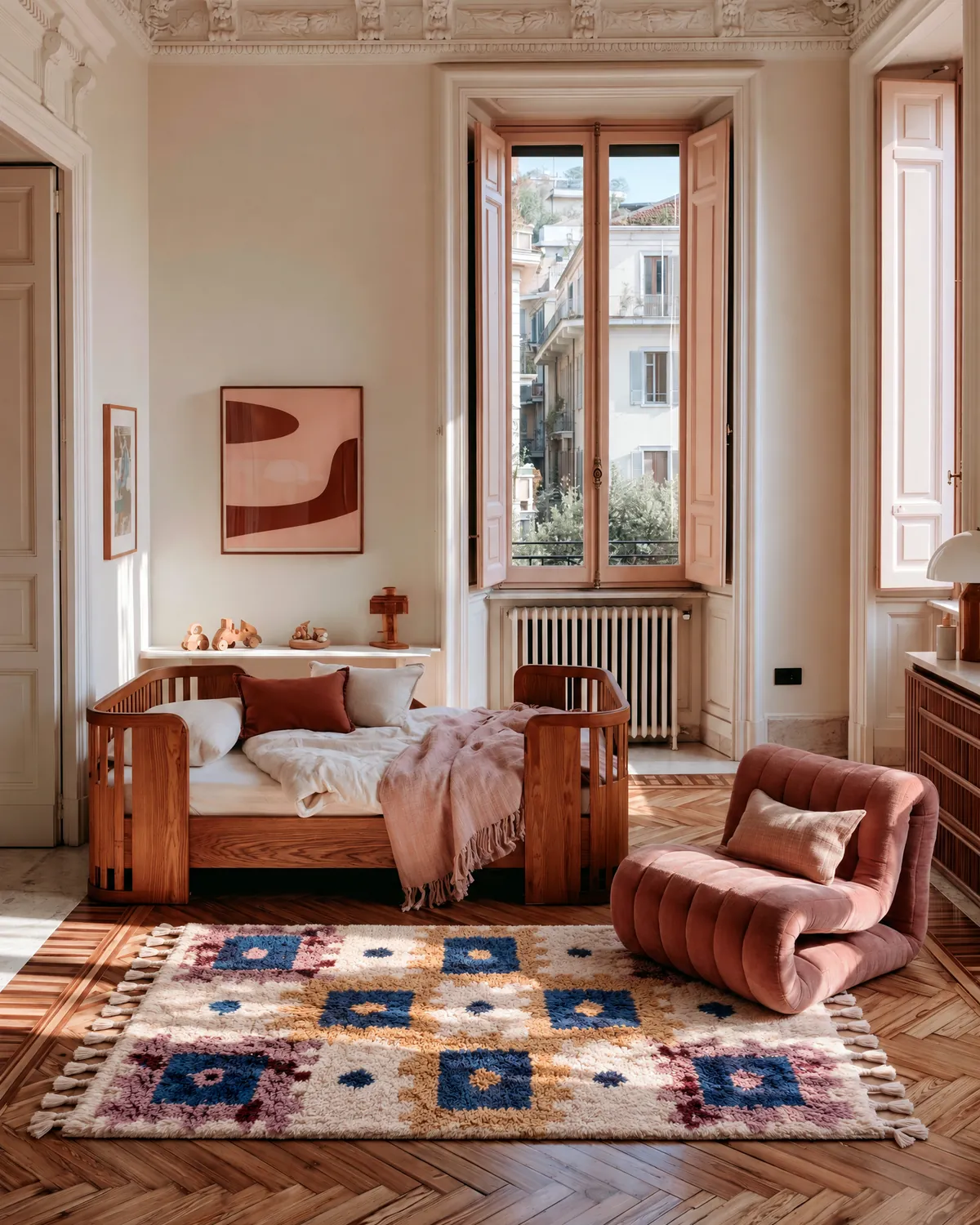
The photograph is the small-repeat case. Tarz sets small navy squares, each framed in camel or plum, across an ivory field. A timber daybed and a rust velvet chair bring more line and color into the room, and it still holds together, because the rug's units are small enough to read as a field rather than as a second loud pattern. Biban, in the close-up below, works the same scale in black: named for the Arabic word for gates, it repeats rows of ragged black blocks, each edged in a blush-peach halo, across ivory like a line of arched doorways.
| Dama | Mozaik | |
|---|---|---|
| Unit size | Large blocks, checkerboards, rows of arches | Small repeated blocks and floral forms |
| Contrast | Block against block, often high | Motif against ground, often ivory |
| Recorded palettes | Navy, peach, blush, terracotta, ivory | Ivory with navy, teal, pink, coral, burgundy |
| Relief | Raised motifs on many designs | Flat field on most designs |
| Best with | Plain upholstery, a room that needs order | Existing pattern, a room that needs surface |
| Slogan | The board, set free. | Wool that speaks in tiles. |
If your cushions and art already carry pattern, start with the mosaic and tile rugs of Mozaik.
What goes with a checkered rug in a living room?
A checkered rug goes with plain upholstery, wood, and one or two colors taken from its own squares. It clashes with other large patterns at the same scale. Five checks before a checkerboard goes down:
- Count the patterned surfaces. If the sofa, the curtains and the cushions already carry pattern, choose a small repeat or quiet the sofa. The rug should be the loudest pattern in the room and the only large one.
- Set the sofa against the rug's quietest color. A sofa in the rug's paler tone, or a clear step lighter or darker than the rug, keeps floor and seating reading as two things. The reasoning is in decorating around a colorful rug, with the method of pulling three tones from the rug and placing each twice.
- Repeat the check's colors, not its pattern. A cushion in the terracotta square does more than a second checkerboard on the sofa.
- Square the grid to the room. Run the checks parallel to the longest wall or to the sofa. A grid set at an angle reads as a mistake even when it is deliberate.
- Choose the pile for the grid. Short pile, 1 cm, keeps the block edges crisp and suits rooms where chairs move. Medium, 2 cm, softens them a little. Shag, 3 cm, lets the wool lean across the edges and turns the checkerboard into something closer to a cloud.
What size checkered rug for a living room?
Most living rooms take an 245x305 cm checkered rug, with the front legs of the sofa and chairs on it; long sofas and L-shaped sectionals take a 275x365 cm. A grid makes an undersized rug look smaller still, because the checks count out exactly where the rug stops short of the furniture. Measure from your sofa and your room with the two-limit method in living room rug size.
Checkered round rugs and runners
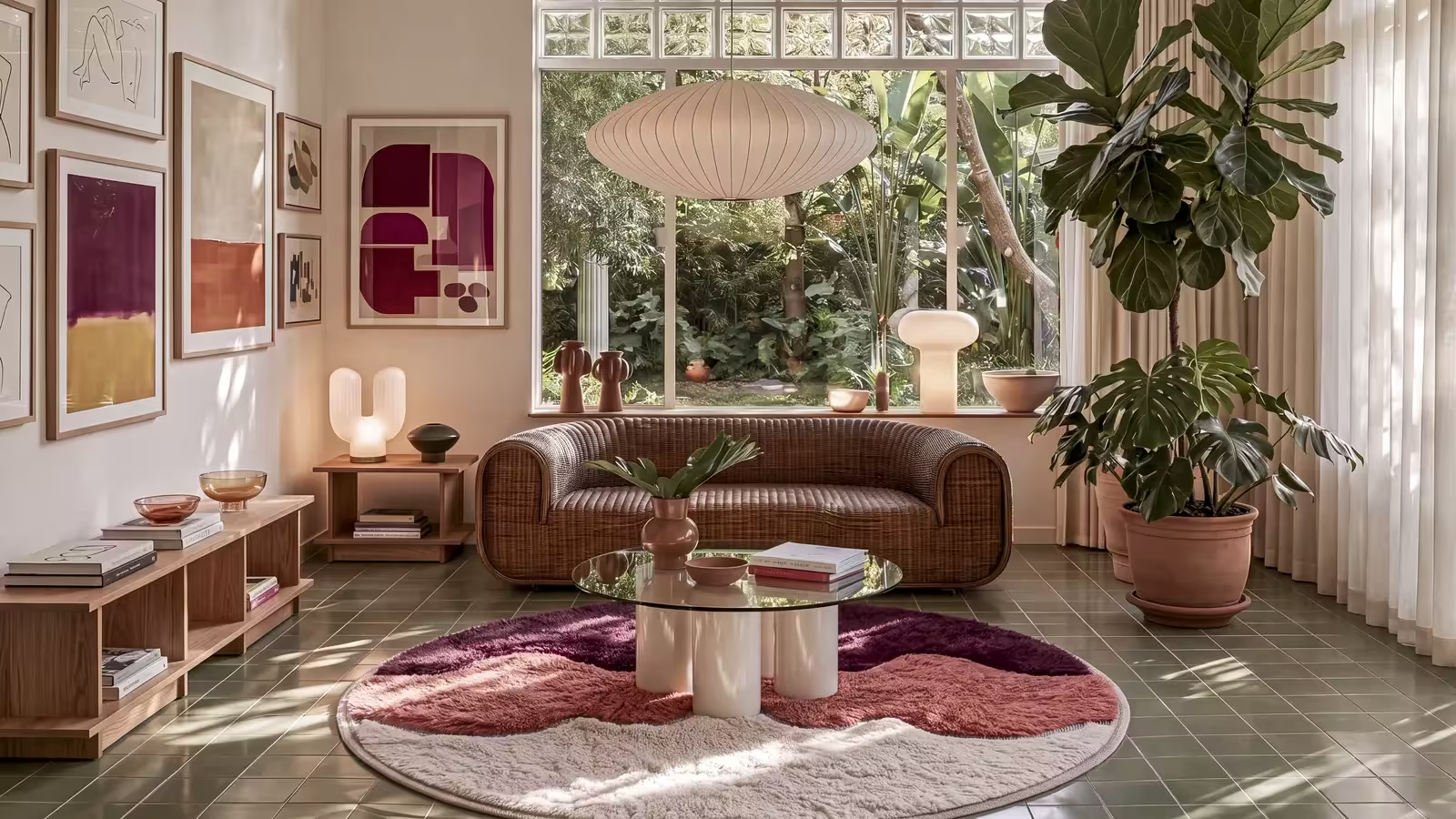
A checkered round rug works when the grid is redesigned for the circle. On a round checkerboard the outer squares are shaped to follow the curve, so the edge reads as part of the design. We recompose each design for the circle instead, so the pattern meets itself on every side, which is why our round and runner versions differ slightly from the standard design.
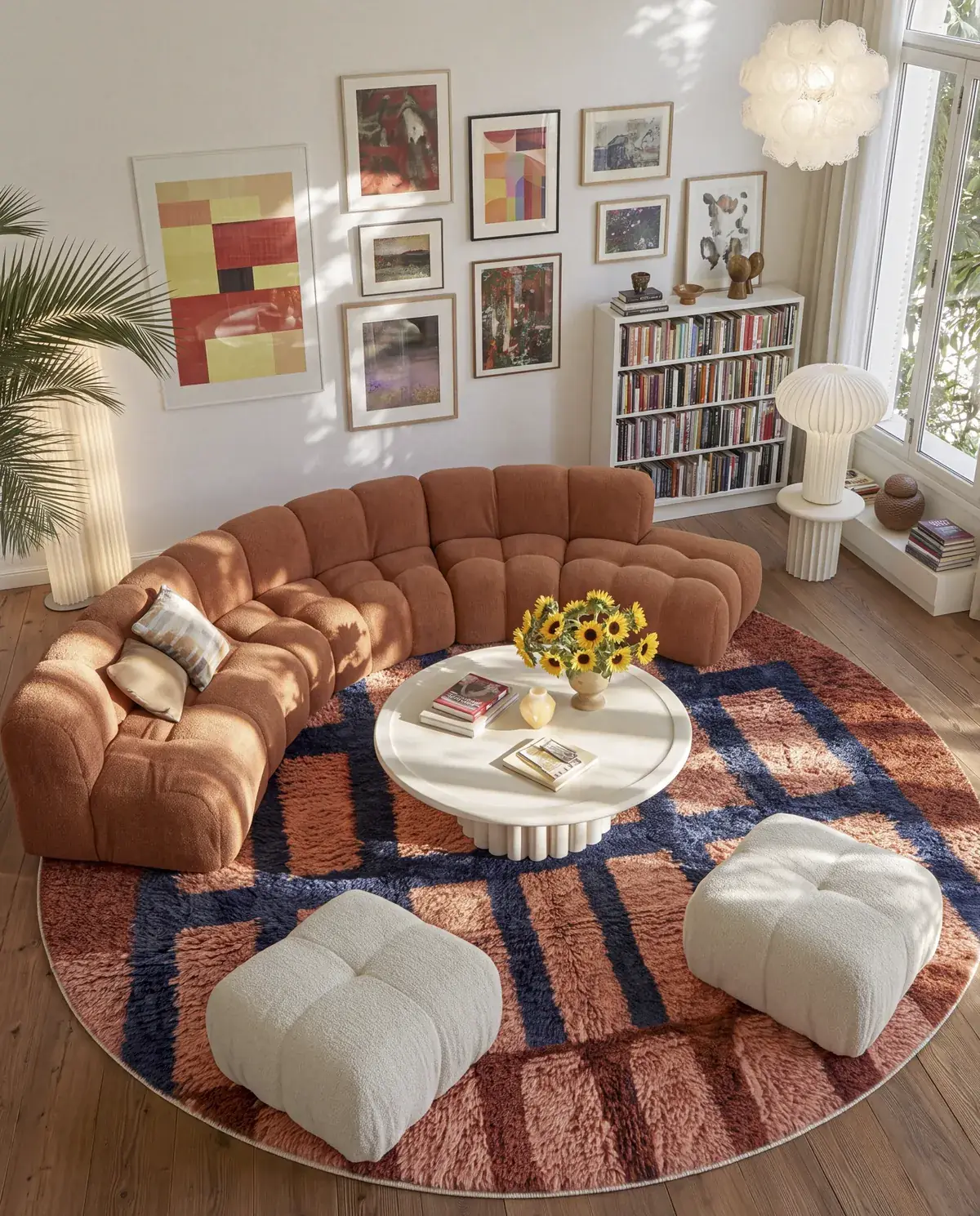
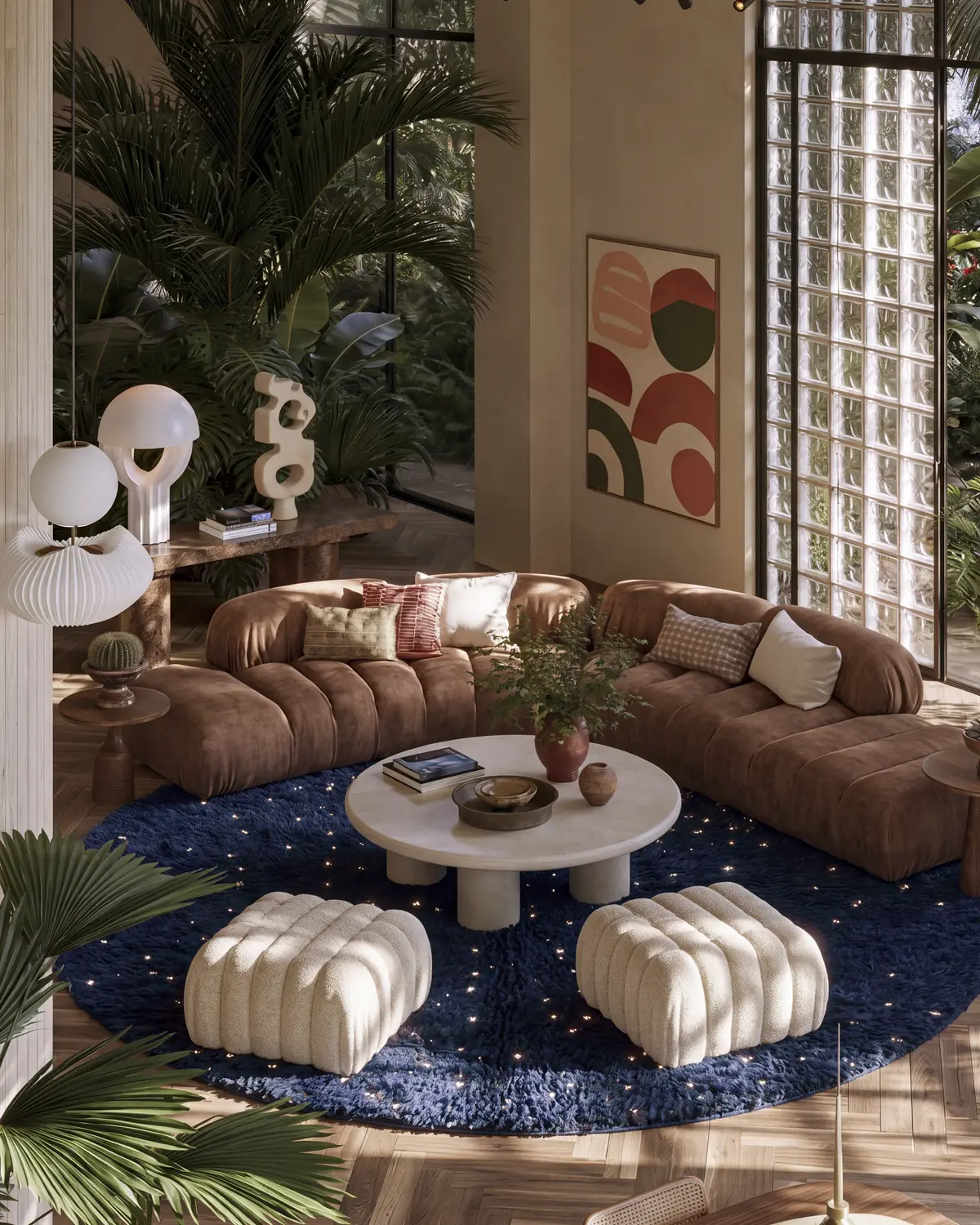
Tigmi is named for the Amazigh word for house: an arch-topped windowpane grid of peach squares divided by navy bars, set in terracotta. Under a round fluted coffee table, with a curved rust bouclé sofa bending around it and two ivory poufs opposite, the circle gathers the seating into a ring while the grid stays straight. The terracotta repeats the sofa, and the navy bars give the warm room its one dark line. Tamment, on the cover, does the same under a leather sectional. When a round rug is the better shape at all is its own question: the round rug guide. More checks and tiles recomposed for the circle are on the round rugs page.
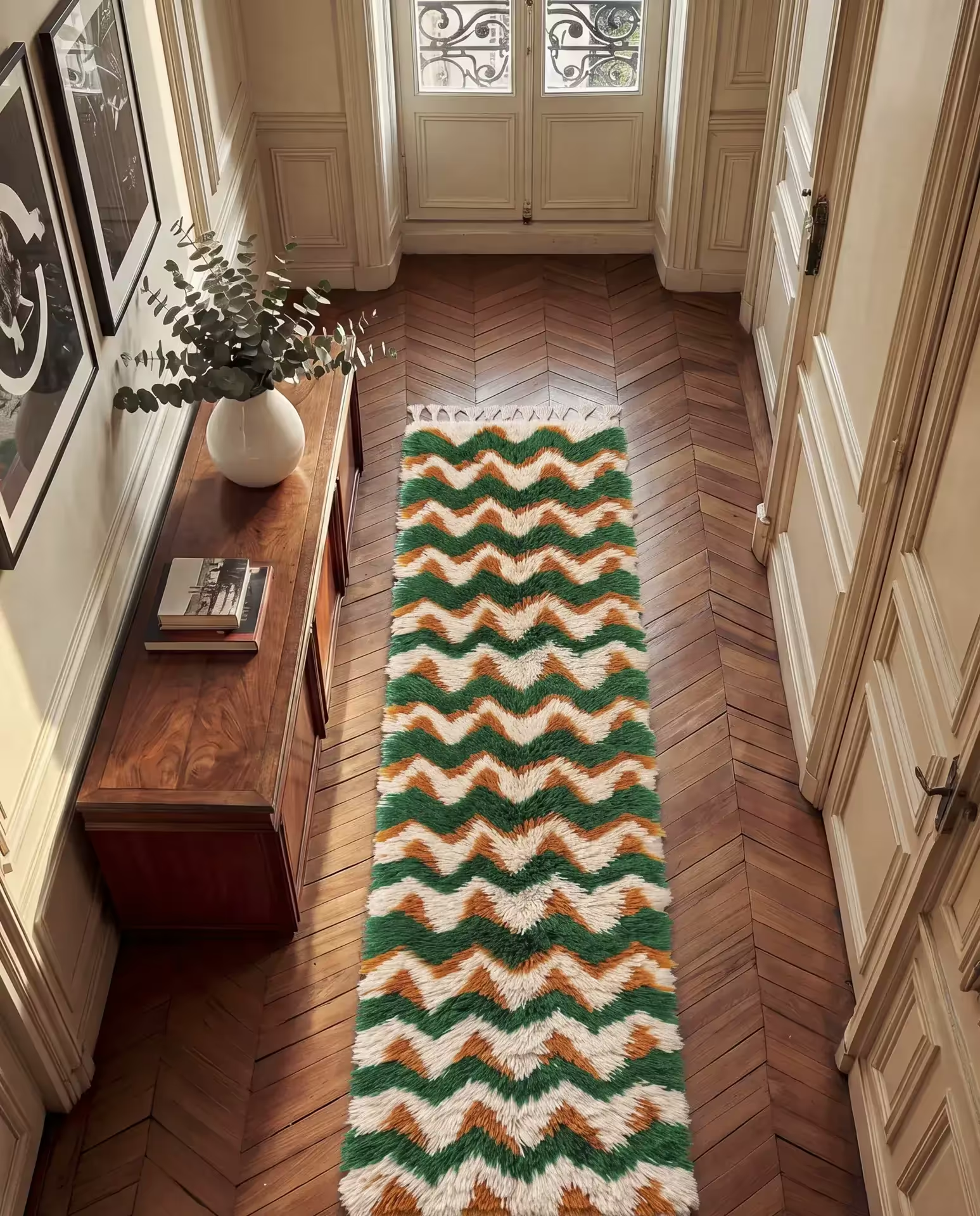
A checkered runner is redesigned for the narrow field the same way. In a hallway or a kitchen the squares set a walking rhythm, and short pile keeps the edges crisp underfoot, and the runner is knotted to the length of the hall.
Start a custom design. Next: the history of checkers, then small tile repeats in the Mozaik collection.