










Buying guide
Wool vs Polyester Rugs: Are Washable Rugs Worth It?
An honest comparison, including the rooms where washable wins.
By Zarbish · · 10 min read

Wool beats polyester on feel, spring under traffic and years; polyester beats wool on price, water-based spills and the washing machine. A washable rug is worth it where accidents are weekly, the rug is temporary or the budget is tight. For a room you are furnishing to keep, a hand-knotted wool rug is the better buy. How to look after one is in the care guide.
Most washable rugs are synthetic, usually polyester, so "wool or polyester" and "wool or washable" are one question.
Key takeaways
- Wool beats polyester on feel, spring under traffic and repair; polyester beats wool on price, water-based spills, fading in sun and the washing machine.
- A washable rug is worth it for weekly accidents, a toddler's floor, a short rental, a damp room or a budget that needs a rug now.
- Large washable rugs, 245x305 cm and up, may not fit a home washing machine, and every wash means moving the furniture off the rug.
- A hand-knotted wool rug cannot go in a washing machine; it is cleaned in place, with suction-only vacuuming, cool water for spills and a wool-rug specialist every few years.
Wool vs polyester rugs at a glance
A washable polyester rug and a hand-knotted wool rug differ on almost every line below, and each side wins some of them. The washable column describes the typical machine-washable rug: a thin polyester surface over a separate pad or a non-slip backing. Where each sits among the other constructions and materials is in types of rugs.
| Washable polyester rug | Hand-knotted wool rug | |
|---|---|---|
| Construction | Thin printed or low-woven polyester surface, on a pad or a non-slip backing | Wool tufts knotted onto a warp by hand, with no backing and no glue |
| Underfoot | Thin, light, cool | Weighted, springy, warm, quiet |
| Water-based spills | Resists them, and the cover goes in the machine | Resists them for the first minutes, so blotting early works |
| Oily spills | Hard to lift: oil binds to polyester | Blot early; a wool-rug specialist handles what stays |
| Heavy traffic | Flattens and mats where people walk most | Springs back, and wears by softening |
| Sun | Usually holds its color well | Constant direct sun fades any natural fiber; rotate it |
| Heat | Melts | Ignites at a higher temperature than some synthetics, with slower flame spread |
| Moths | Not a food for moth larvae | Moth and carpet beetle larvae can feed on wool in undisturbed corners |
| First weeks | Little or no shedding | Sheds loose fibers for the first weeks, then settles |
| Cleaning | Domestic machine, where the size fits | Cleaned in place; a specialist every few years |
| Repair | Replaced rather than repaired | Can be re-knotted, re-edged and washed again |
Polyester wins the rows about convenience. Wool wins the rows you feel with bare feet and the ones that only show after a few years. The heat row comes from the fiber itself: wool ignites at a higher temperature than cotton and some synthetic fibers, with a lower rate of flame spread (wool, on Wikipedia), where polyester melts.
What is the difference between a washable rug and a wool rug?
The difference between a washable rug and a wool rug is construction: a washable rug is built to fit a washing machine, and a hand-knotted wool rug is built to stay on a floor. Everything about the washable rug follows from its constraint. The surface is thin because thin is light, the pile is short because short dries quickly, and the grip comes from a pad or a rubbery backing because the weight that holds a heavier rug flat would not fit in a domestic drum.
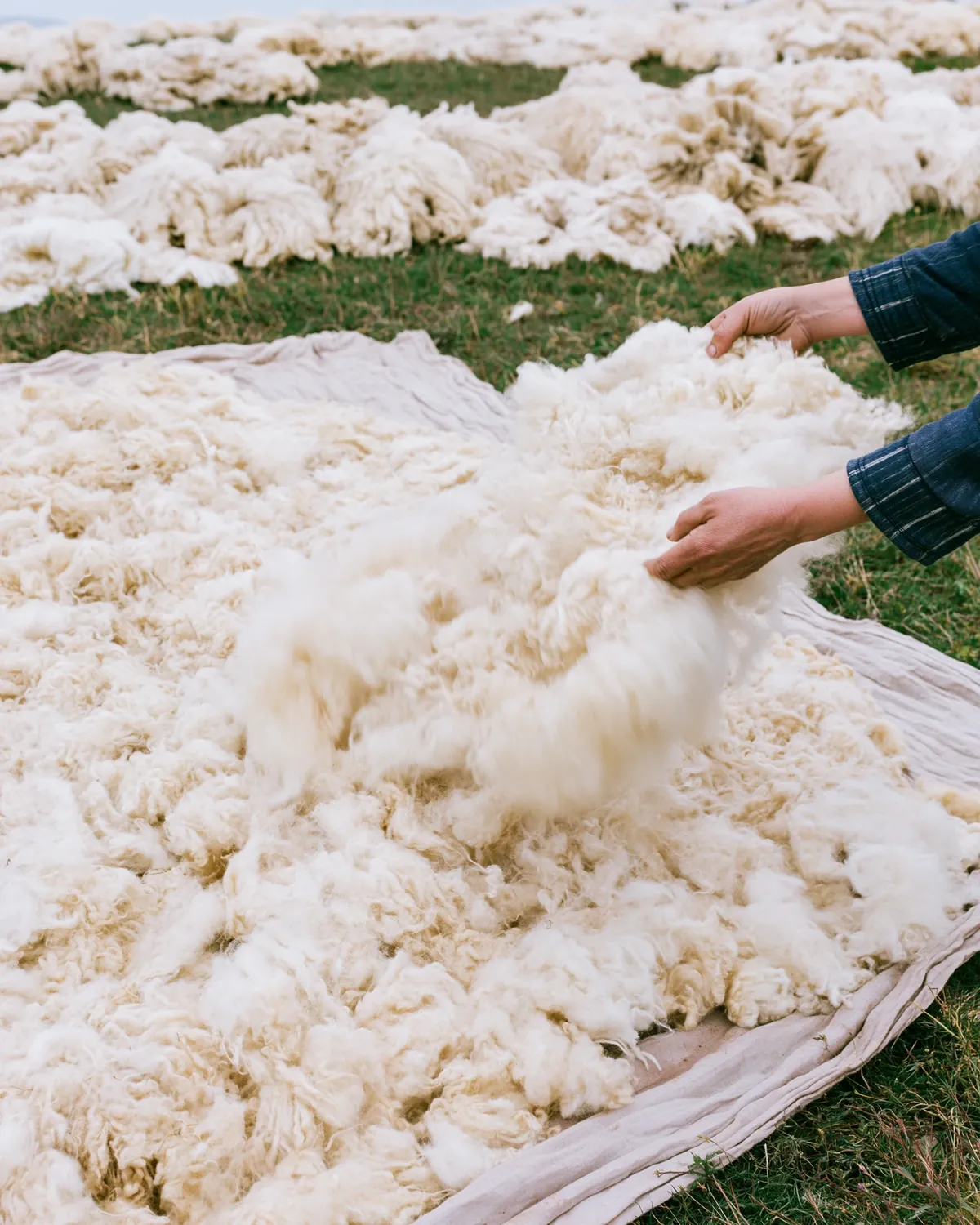
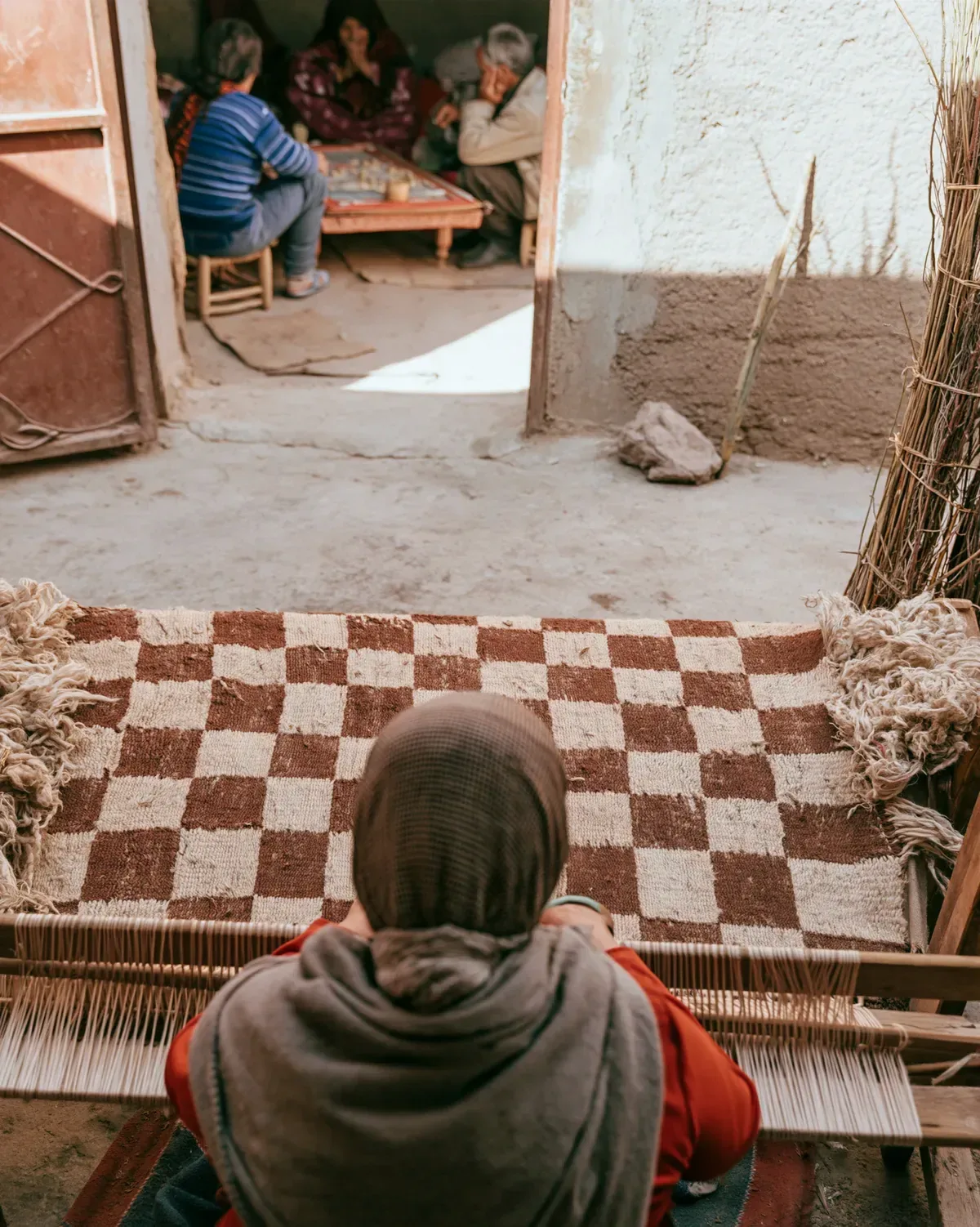
A knotted rug starts from the other end. Our team of weavers ties each tuft of wool onto the warp by hand, row after row, so the pile is wool the whole way down to the knot. Nothing about it is designed to be carried to a machine, so weight, density and depth are free to be whatever the design wants.
Two in-between rugs confuse the comparison:
- Washable wool rugs. They exist, usually flat-woven or with a very low pile, in sizes a home machine can take. A hand-knotted pile rug is not one of them, and ours cannot go in a washing machine.
- Hand-tufted wool rugs. Wool yarn punched through a canvas and held with glue, then backed with cloth. They are neither washable nor knotted, and they are the rugs behind most "sheds like crazy" and "the backing came apart" stories. Turn a corner over to tell: a knotted rug shows its pattern on the back, a tufted one shows canvas (how a Moroccan rug is made).
How each one feels underfoot
A washable rug feels thin underfoot and a hand-knotted wool rug feels weighted and springy. This is where most of the regret in the washable category lives, and it is a fair complaint rather than a snobbish one.
A thin surface over a pad reads as fabric underfoot, not as a rug. It creases at the edges, it moves against the pad, and it warms a room less because there is less of it. A dense wool pile does the opposite: it has weight, it springs back under a heel, it quiets a room, and it holds warmth the way a wool sweater does.
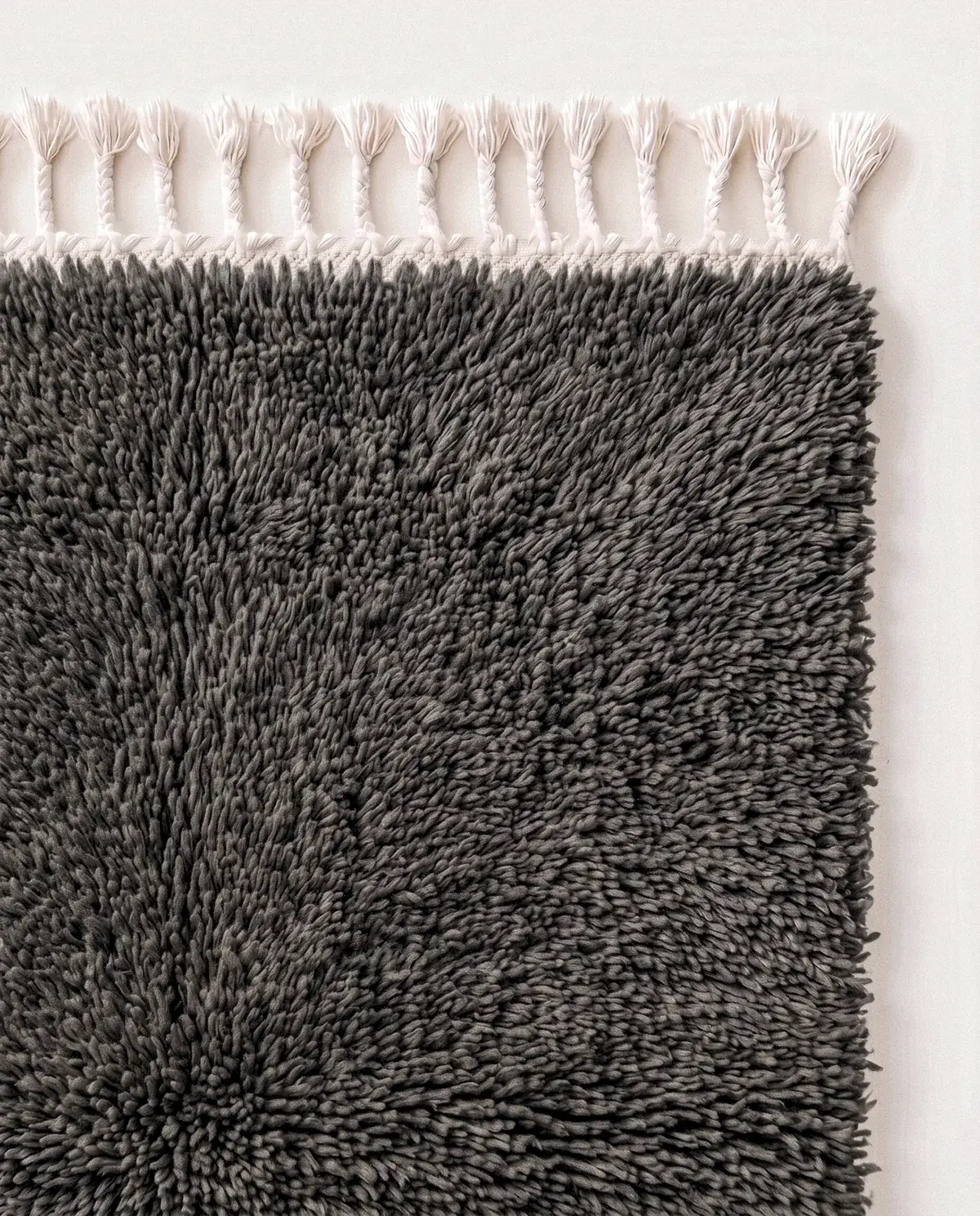
Kohl, a solid charcoal rug from the solid-field wool rugs of Dune, shows it up close: a dense pile, wool all the way through, with nothing printed on it to wear away. Wool also ages in a direction: the pile softens and takes on a patina, a low sheen from years of feet, while the fixed dyes hold their color. A printed surface has no equivalent process; it starts at its best and wears from there.
How each one is cleaned
A washable rug is cleaned in a domestic machine; a wool rug is cleaned in place. The machine is a genuine advantage, stated plainly: if a rug can go in the wash, a bad week costs one cycle. That holds while the rug fits the machine. Large washable rugs, 245x305 cm and up, may need a laundromat's larger machine, and every wash means lifting the furniture off, washing, and drying the rug flat before it goes back.
The wool method is short enough to learn once:
- Vacuum on suction only, with no beater bar and no roller brush, which pull fibers and eat tassels.
- Blot a spill with a clean cloth and cool water, pressing rather than rubbing.
- Rotate the rug twice a year so wear and light land evenly.
- Send it to a wool-rug specialist for a deep clean every few years, never to a machine.
The full routine, with spills, pets and the products never to use, is in how to clean a wool rug.
One thing from our side of it: the natural dyes are fixed, so the color holds without transfer or shift. The routine above, with a specialist every few years, is all a wool rug asks. Loose fibers in the first weeks are settling rather than a fault: is it normal for a wool rug to shed this much.
Wool vs polyester: which lasts longer?
A hand-knotted wool rug outlasts a polyester rug, and years are the axis the two separate on. Polyester flattens and mats in the paths people walk most, and on a washable rug the print wears where the traffic is. Washing is also what ages it: heat, agitation and repeat cycles are hard on a thin synthetic surface, so the feature that makes it convenient is the same one that shortens it.
A knotted pile is repairable, because a tuft that is tied can be re-tied and an edge that is sewn can be re-sewn. It can be washed properly, flat, many times in its life. Wear shows as softening rather than as bare patches, since there is no print to lose and no backing to come apart.
We publish no lifespan figure for our Moroccan wool rugs: a number would be a promise, and the years depend on the room. What we can say is what the construction allows, set out above. The FAQ makes the related comparison, handmade against machine-made.
Are washable rugs worth it?
Washable rugs are worth it in five cases.
- A nursery or a toddler's floor where accidents are weekly rather than occasional. Nothing beats a machine for those years.
- A dog in training, an older dog with accidents or a cat that marks. The pet version of this question, with what to do once the accidents stop, is in the best rug for dogs and cats.
- A short rental, or any floor the rug will not leave with you. Longevity you will not be there to collect is not worth paying for.
- A damp room: a bathroom, a mudroom, the floor by the back door, where a rug is wet more often than it is dry.
- A budget that needs a rug now rather than later. A rug you can afford beats a rug you keep postponing.
For a family room in a farmhouse style, where the floor does a lot of work, modern farmhouse decor shows where a wool rug fits.
Outside those, the calculation flips, and it flips on the thing you feel with bare feet every day.
One house, two rugs
Most homes do not need to choose one answer for every room. Take a family with a toddler and a dog, and a living room of 365x425 cm. A washable rug goes in the playroom and a washable mat at the back door, where the mess actually happens. The living room takes an 245x305 cm wool rug in a mid-tone pattern with short pile, 1 cm. The washable rugs do the hard jobs; the wool rug is the one that stays when the playroom changes.
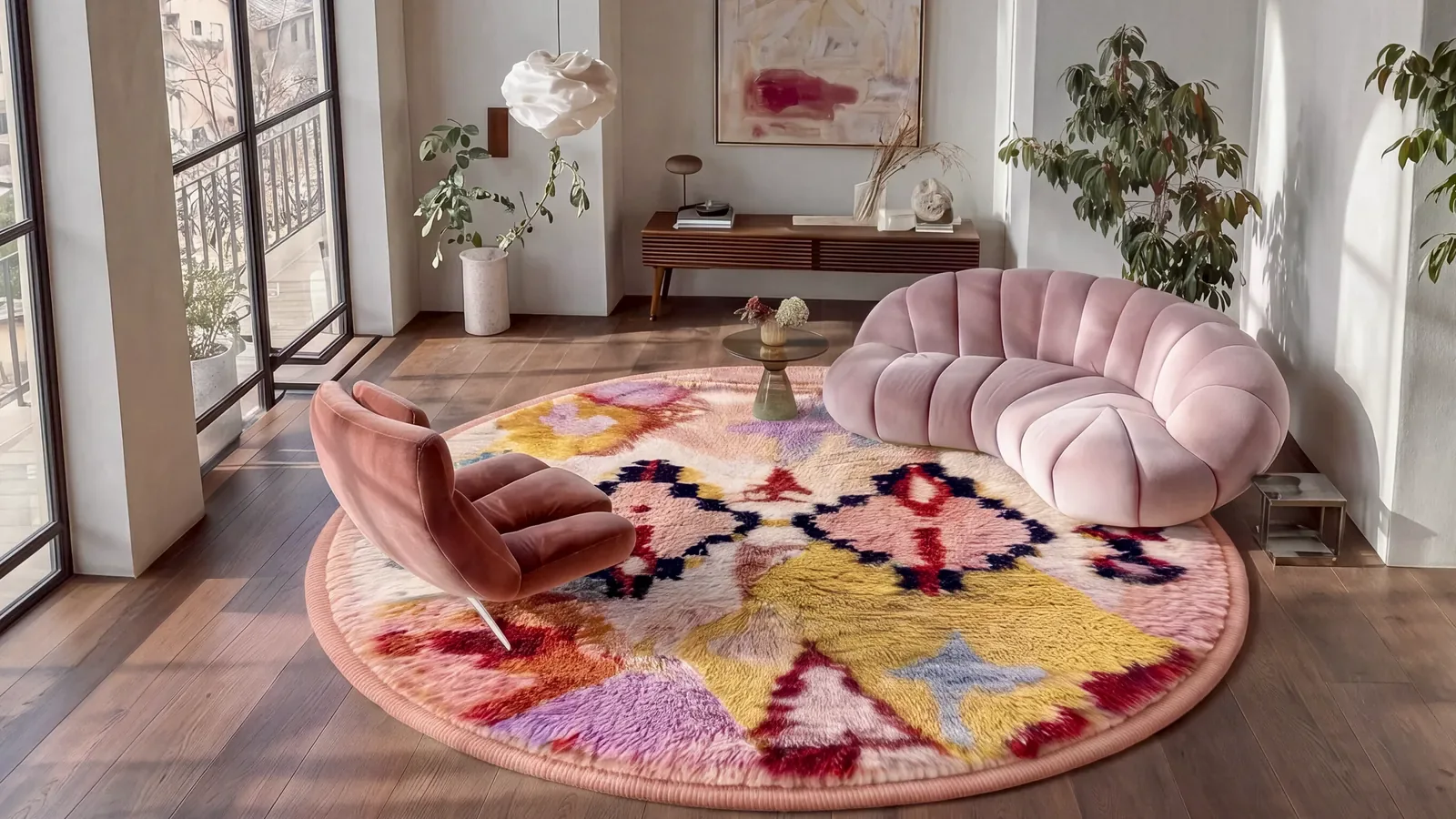
Hammam, from the tiled rugs of Mozaik, is that kind of living-room rug: teal-blue tiles haloed in coral and ochre on an ivory ground, here as a round under four velvet armchairs and a low table, a pattern that breaks up the evidence of a household.

What are the downsides of washable rugs?
The downsides of a washable rug are thinness and the work around the machine. None of them makes it a bad buy in the five cases above; all of them are worth knowing before you choose one for a room you live in.
- Thin underfoot. It reads as fabric, not as a rug, and warms and quiets a room less.
- The size limit. A home machine takes the smaller sizes; large ones may need a laundromat.
- The furniture. Every wash means moving the sofa and table off the rug and back.
- Drying. The rug dries flat, off the floor, before it can go back down.
- Curling and creeping. A light rug lifts under a strong vacuum and creeps on its pad.
- Oil and traffic. Oily stains bind to polyester, and the pile flattens where people walk most.
- Wear from washing. Each cycle is hard on the print and the backing.
What are the downsides of wool rugs?
The downsides of a wool rug are cost, care in the first minutes of a spill, and a few habits of a natural fiber. Each has a plain answer.
- Price. What the price pays for, size by size, is in what a Moroccan rug costs.
- No washing machine. A wool rug is cleaned in place, and repeated pet accidents in one spot are hard to lift fully.
- Shedding. A new hand-knotted rug sheds loose fibers for the first weeks; gentle vacuuming settles it.
- The smell of new wool. It smells of lanolin, like a wool sweater, for the first days, and airs out in a ventilated room.
- Moths. Moth and carpet beetle larvae can feed on wool in quiet corners under furniture. Vacuum there and check the edges now and then; the steps are in moths and beetles.
- Sun. Constant direct sun fades any natural fiber. Rotate the rug twice a year and think about the all-day bright spot.
- Weight. A large knotted rug is heavy to lift, which is also why it lies flat.
If the comparison sends you to wool, the next decision is the size, and the room-by-room size guide starts there. Next: wool rugs and pets, then the Dune collection.