








The making
How Moroccan Rugs Are Made: Hand-Knotted vs Hand-Tufted
From wool to wash, and how to tell knotted from tufted.
By Zarbish · · 12 min read

A Moroccan rug is hand-knotted, one knot at a time. Weavers dye natural wool, string a warp on an upright loom, tie a row of wool knots across it, lock the row with weft and repeat until the rug is complete. Then they clip the pile to its height, wash the rug and dry it in the sun.
A hand-tufted rug can look the same from above and is built another way: yarn punched through a canvas and held there with glue. To tell them apart, turn a corner over. A hand-knotted rug shows its pattern on the back; a hand-tufted one shows cloth, and the glue under that cloth is why the two age so differently.
Key takeaways
- A Moroccan rug is hand-knotted: weavers tie each knot of wool around the warp threads of a loom, lock every row with weft, then clip, wash and sun-dry the rug.
- A hand-tufted rug is made with a tufting gun that punches yarn through a canvas, and latex glue, not knots, holds its pile in place.
- To tell them apart, turn a corner over: a hand-knotted rug shows its pattern mirrored on the back, a hand-tufted rug shows a cloth backing.
- Our weaving team works on upright steel looms, the modern form of the traditional wooden loom; the knotting by hand is unchanged.
How is a Moroccan rug made?
A Moroccan rug goes through nine stages, and every one of them is handwork. Between them, our design team and our team of weavers take each Zarbish rug through all nine in the workshop in the Middle Atlas, and the weavers are paid fairly for every rug; how they do each one is set out on the making, step by step. Below, each stage is read for what it leaves in the rug you live with.
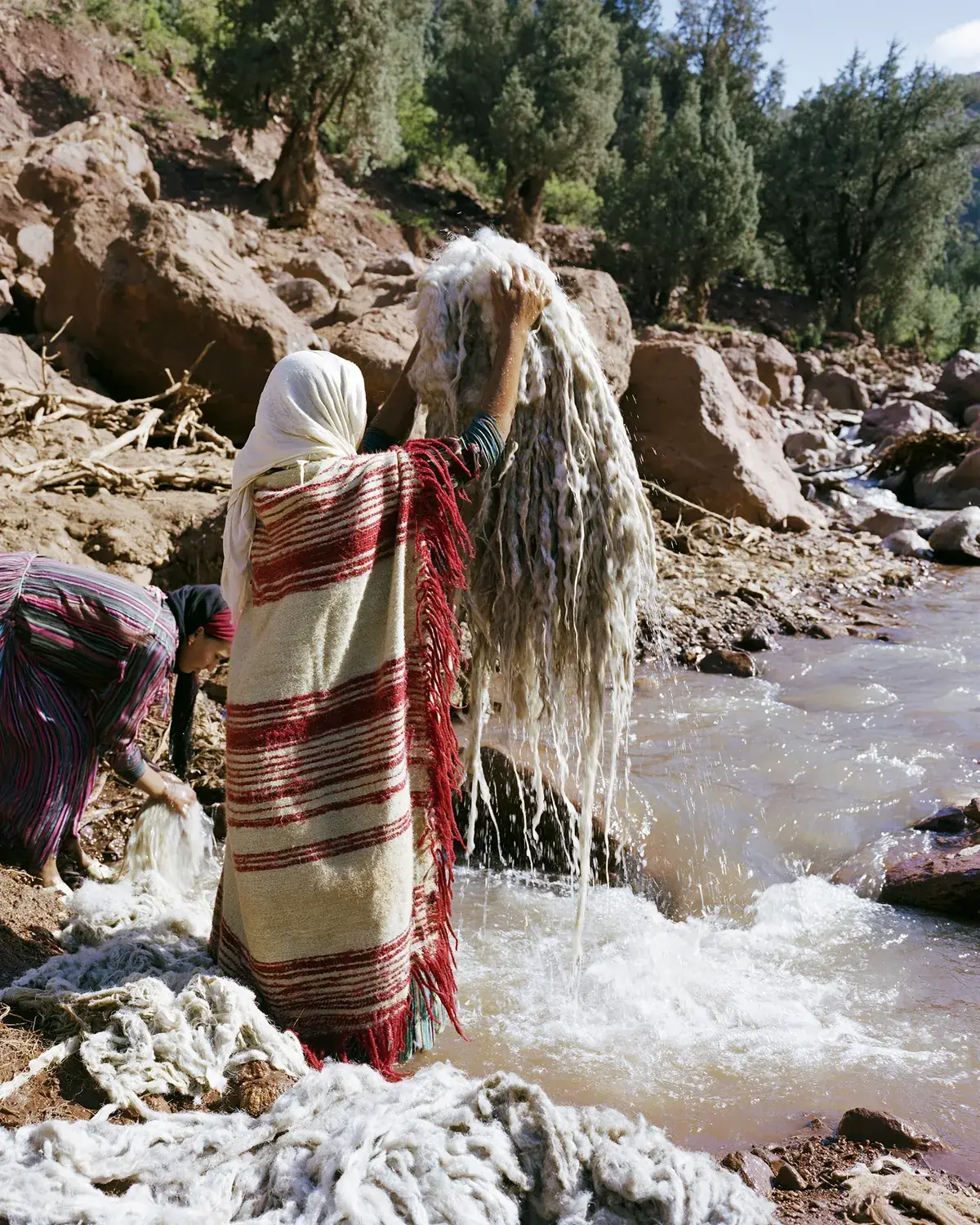
- Wool. Weavers prepare natural wool spun into yarn for knotting. Wool's spring lets the pile recover after feet and furniture press it down.
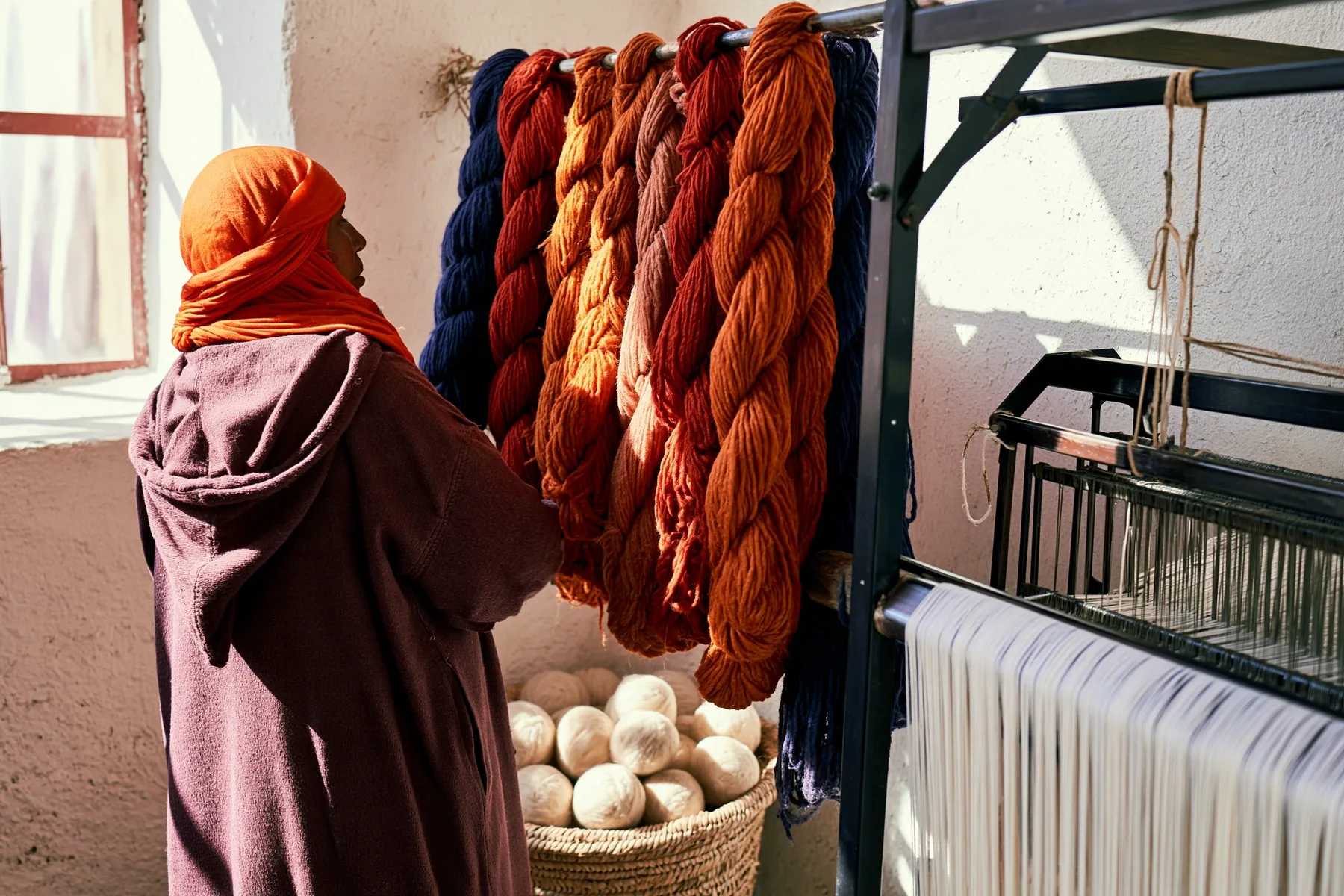
- Dye. Weavers dye the yarn that needs color before it reaches the loom, so the color runs through every tuft instead of sitting on top like a print. Ivory yarn can stay undyed.
- Design. Our design team sets the design to the shape it will take. A round rug or a runner gets its own composition for its outline, never a crop of the rectangle.
- Warp. The weaver strings vertical warp threads on the loom to the rug's finished width. These threads are the rug's skeleton and, at the ends, its fringe.
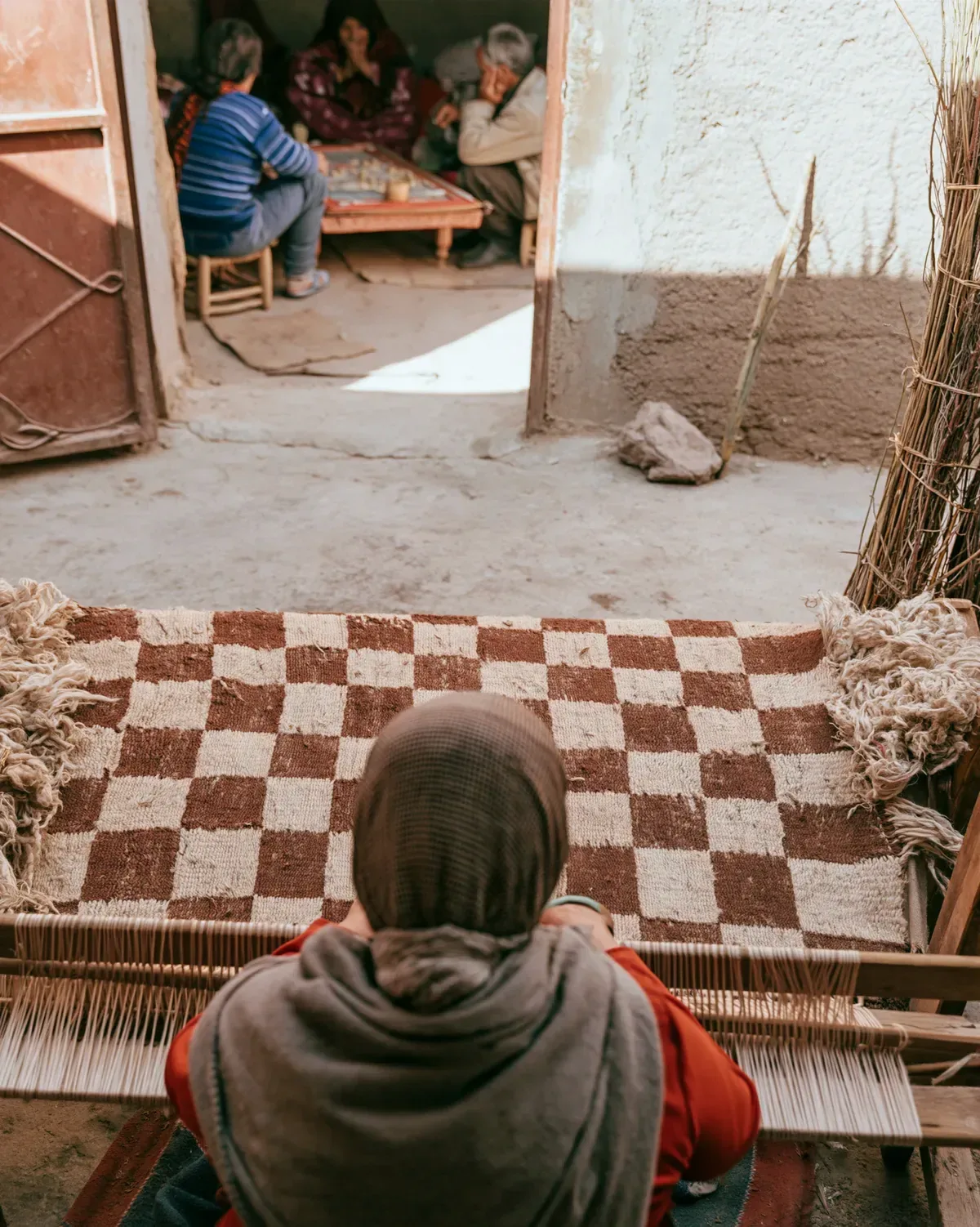
- Knots. Row by row, the weaver ties short lengths of wool around the warp threads by hand. The cut ends of the knots become the pile.
- Weft. After each row of knots, the weaver passes weft threads across the width and beats them down to lock the row in place.
- Clipping. Off the loom, weavers clip the pile to its height. On a sculpted rug, they carve the pattern into the pile at this stage.
- Washing and drying. Weavers wash the rug to clear loose fiber and check the colors, then dry it in the sun.
- Finishing. Weavers finish the edges and any tassels and inspect the rug.
The wool and its color
Wool is the material because it does what a floor asks of it. The fiber springs back after pressure, holds dye deep inside it, and feels warm and soft underfoot. Every Zarbish rug is 100% natural wool, and the density of the knotting is what turns that wool into a pile you can sink into without flattening it.
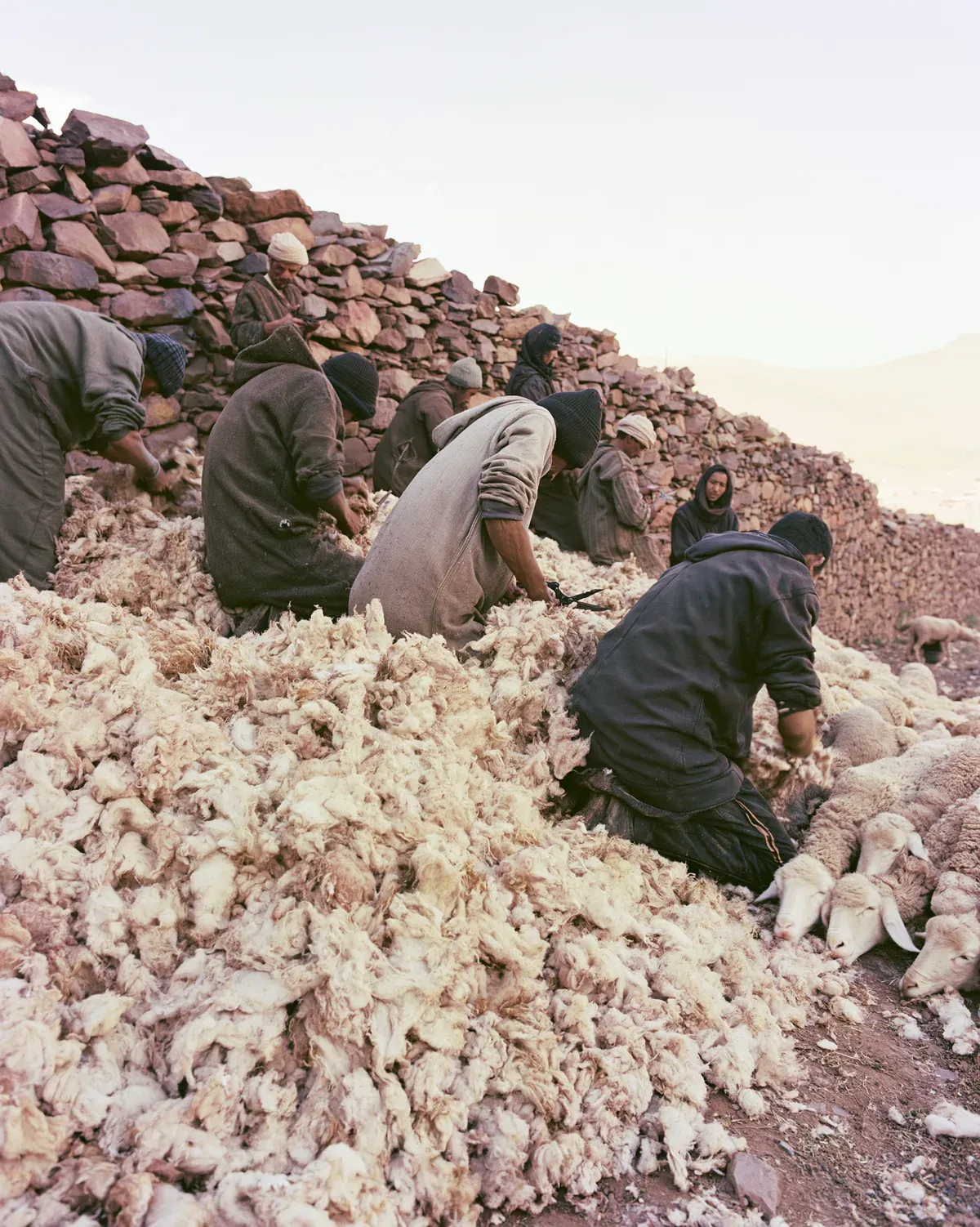
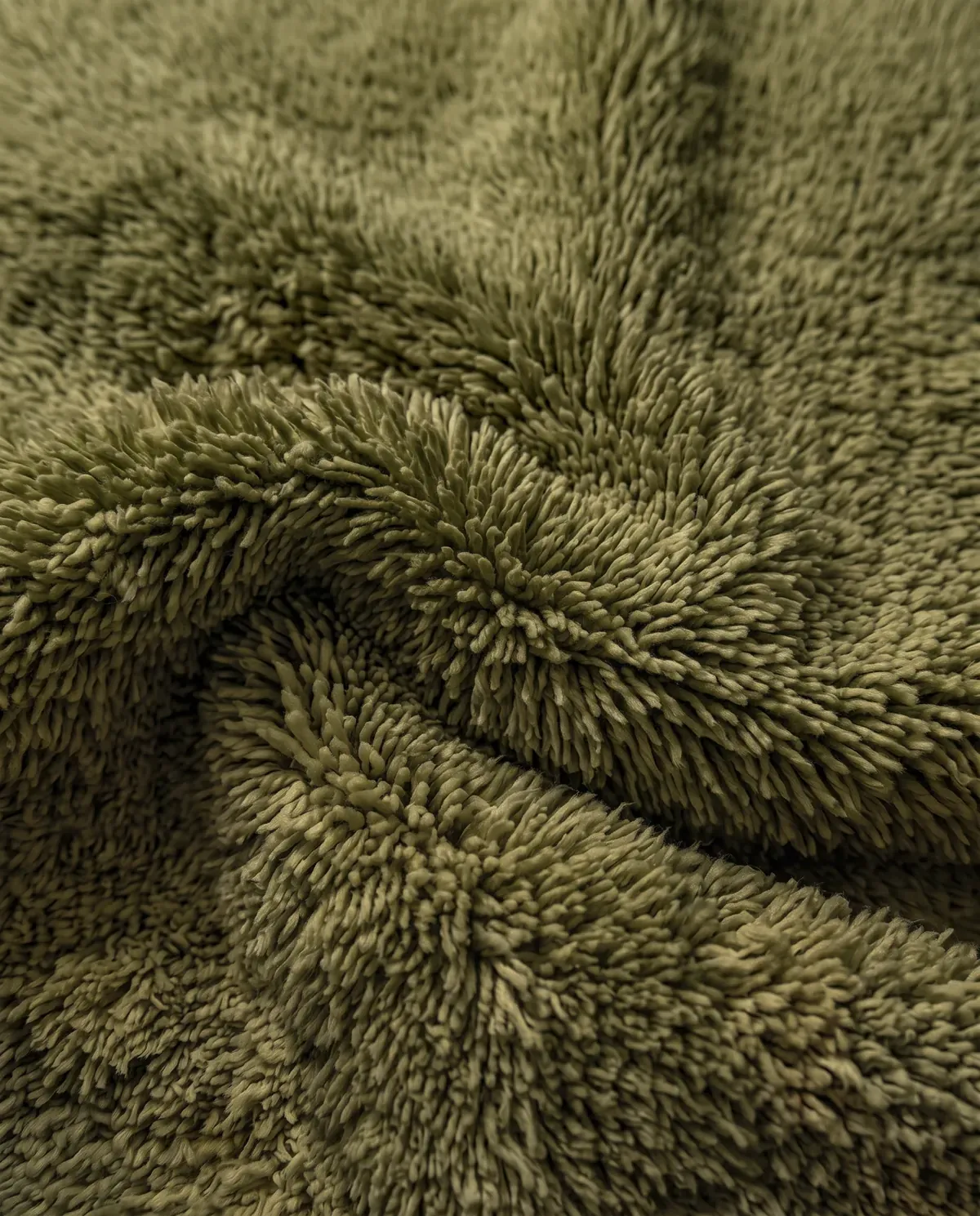
When a design needs color, we dye the wool in our workshop with natural plant and mineral dyes, before anyone ties a knot. Ivory designs, such as those in the Dune collection, can keep the natural color of the wool. Because the dye goes through the yarn, the color in a hand-knotted rug goes all the way down each tuft: as the surface wears over the years, the color below it is the same color.
The dye also has to stay where it was put. Our natural dyes are fixed so the color does not transfer or shift with use.
Color in a wool pile still moves with the light. A pink reads clearer at midday and deeper under lamps, because the pile catches light from one side and shades on the other. The dye has not changed; the angle has.
The loom: wooden by tradition, steel in our workshop
A rug loom is an upright frame that holds the warp threads tight while the weaver knots across them. Traditionally, Berber weavers knotted their rugs on upright wooden looms, often at home, and once tied their designs from memory. That is the loom in most accounts of how Moroccan rugs are made, and it is the history of the craft. The marks the weavers tied into those rows, and what they are read to mean, are in Berber symbols and their meanings.
In our workshop the loom is steel, upright like the wooden loom it grew out of. The frame is what changed. The knotting by hand is unchanged: the same warp, the same knot tied by a weaver's fingers, the same row locked with weft. Our designs have moved on too. They start from the Berber touch the weavers carried from the beginning of the craft, and our design house reworks it for how people decorate today, from the color of Bloom to the carved relief of Terrain.
The loom also fixes the finished width. The weavers string the warp to the finished width, so a hand-knotted rug is built to its size rather than cut down from a larger piece.
How the knots are tied
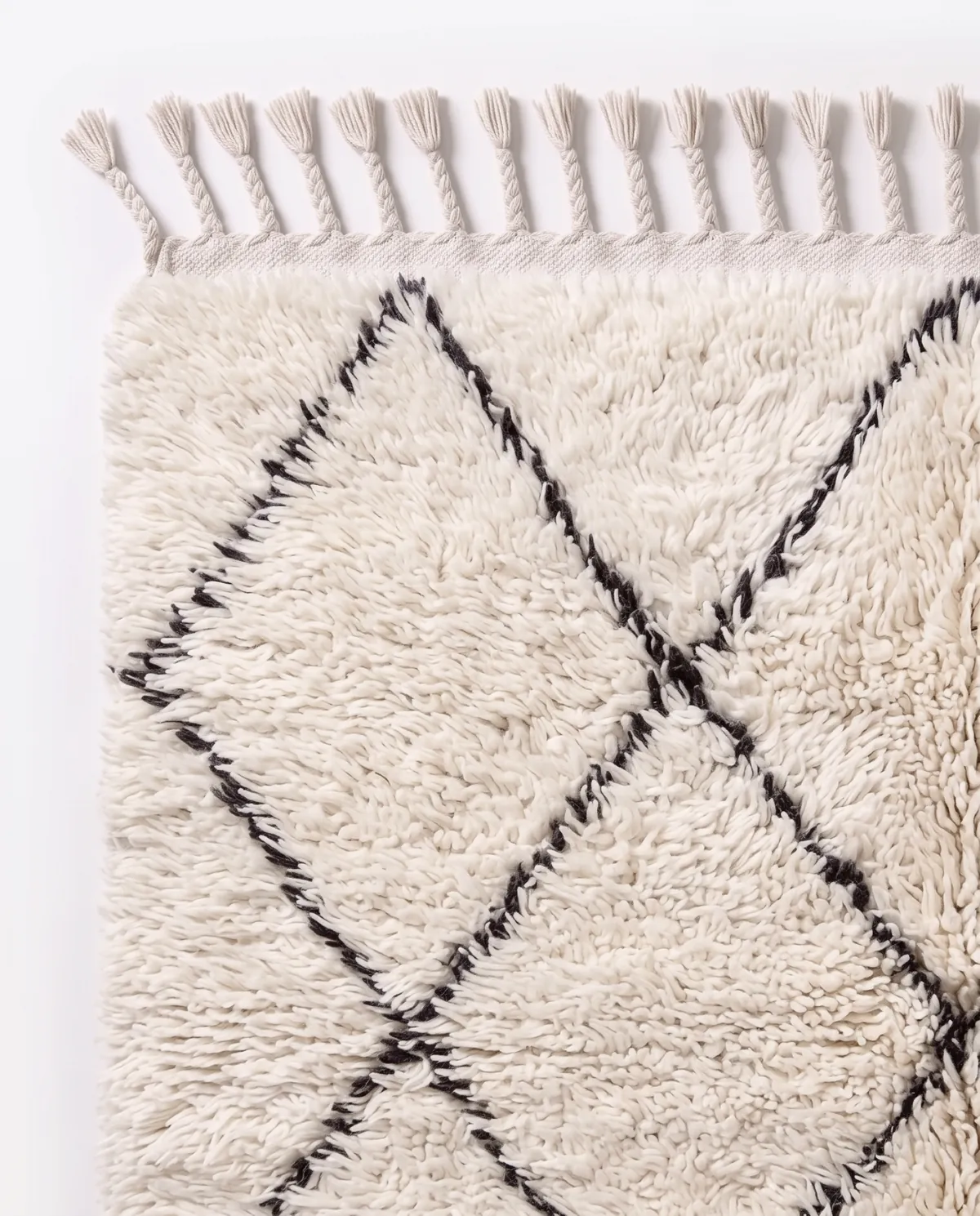
A hand-knotted rug is built from knots tied one by one across the warp. In the symmetrical knot, common in Moroccan pile rugs, a short length of wool wraps two neighboring warp threads and its two cut ends rise to form the pile (how a knotted-pile carpet is built). The weaver ties a full row across the width, passes weft threads over it and beats them down, then starts the next row above.
Three things follow from that construction, and each one matters when you own the rug:
- The pattern goes through the rug. Every knot is a colored point in the design, so the pattern shows on the back too, mirrored and a little coarser.
- The knots hold the pile. No glue holds a hand-knotted pile, so there is nothing to dry out or let go with age.
- Density is resolution. The more knots in a given area, the finer the design can be. Our weave runs at a high knot density, fine enough for the thin lattice of a Jibal rug or the small tiled repeat of a Mozaik rug; the number itself is in how handmade shows in the knots.
Clipping, washing and sun drying
Off the loom, the rug is still rough: the knot ends stand at different lengths and the surface cannot yet show its pattern cleanly. The team clips the pile to its height, short 1 cm, medium 2 cm or shag 3 cm. Clipping sets both the feel and the sharpness of the pattern: a short pile reads crisply, a shag pile softens the lines into the wool. Every step of it belongs to the Amazigh weaving tradition, the culture the craft grew in.
On the sculpted Beni Mrirt designs of Terrain, clipping becomes carving. Weavers cut the pile to two levels, so raised blocks and lower channels build the pattern in height as well as color.
Then we wash every rug. The wash clears loose fiber and checks every color against the final design. It also lifts the raw-fleece smell from the wool, so what reaches your floor carries only a faint note of lanolin for the first days, and a little loose fiber that works free over the first weeks. After the wash, we dry the rug in the sun. Weavers finish the edges and any tassels by hand and inspect the rug before it ships.
How long does it take to make a hand-knotted rug?
A hand-knotted rug takes weeks, and the weeks follow its size. A weaver ties every knot by hand, so a wider rug means a longer row and a longer rug means more rows, and no shortcut keeps a rug hand-knotted. How fine the knotting is changes the time too, which is why the estimates you read elsewhere range so widely.
Every rug gets its own place on the loom, and the loom schedule explains when that place starts. A hand-tufted rug of the same size is made far faster, because a tufting gun fires yarn continuously instead of one knot at a time. That difference in hours is most of the difference in price.
Hand-knotted vs hand-tufted rugs: what is the difference?
A hand-knotted rug is built knot by knot on the warp of a loom, and the knots hold the pile. A hand-tufted rug is made by pushing loops of yarn through a canvas stretched on a frame with a tufting gun, then coating the back with latex glue and covering it with a second cloth. Both involve hands, and from above they can look alike. The construction is what separates them. The wider field of weaves and materials is in the guide to rug types.
| Hand-knotted | Hand-tufted | |
|---|---|---|
| How it is built | Each knot tied by hand around the warp, rows locked with weft | Yarn punched through a stretched canvas with a tufting gun |
| What holds the pile | The knots | Latex glue on the back of the canvas |
| The back | The pattern, mirrored, in rows of knots | A cloth or canvas cover, no pattern |
| The fringe | The warp threads, part of the rug | Sewn or glued on afterwards, if there is one |
| Folded in the hand | Folds like heavy cloth | Stiff, held by the glued backing |
| Shedding | Loose fibers in the first weeks, then it settles | Can keep shedding as tufts work loose |
| Wet cleaning | The whole rug can be washed; ours are washed before they ship | Soaking can weaken the glue |
| Repair | Worn knots can be re-tied | Hard to repair once the backing fails |
| Time to make | Weeks, by size | Far faster |
| Price | Higher, for the hours of knotting | Lower |
Are hand-knotted rugs better?
For a rug meant to stay, yes. The knots hold the pile, so there is no glue layer to age, and the color and the design run through the whole construction. A hand-knotted wool rug wears slowly and evenly and can be washed and repaired, which is why it outlives the room it was bought for.
A hand-tufted rug has an honest advantage: it costs less and arrives sooner. For a room you plan to redo in a few seasons, a rental you will leave, or a bold look you are testing, it can be the sensible buy. If what you need is a rug you can put in a washing machine, a washable rug fits better than either; wool or washable sets the two side by side.
What are the downsides of tufted rugs?
Every downside of a tufted rug comes from the glue. Latex holds the tufts in the canvas, and latex dries and stiffens with age, so tufts can work loose and the rug keeps shedding longer than a knotted one. A deep wash can weaken the backing, the fringe is usually a separate strip that can come away, and once the backing fails there is no knot to re-tie.
Shedding alone does not prove a rug is tufted. A new hand-knotted wool rug sheds too, for its first weeks, as short fibers from the weaving work free; the care guide explains what is normal in the first weeks.
Hand-loomed, flatweave and machine-made rugs
Three more words turn up on rug labels, and each describes a different construction:
- Hand-loomed. Woven on a hand-operated loom, with the pile made by looping yarn over a rod rather than tying knots, and usually finished with a glued backing like a tufted rug. Faster than knotting, and closer to tufting in how it ages.
- Flatweave. No pile at all: the weft itself makes the pattern. A Moroccan kilim is a flatweave, light and usually reversible.
- Machine-made. Power loomed on an automated loom, often from synthetic yarn. The rows are perfectly even and any fringe is sewn on.
Loop pile wall-to-wall carpet sold as "Berber" is another construction again, and Berber carpet or Berber rug untangles the name.
How to tell if a rug is hand-knotted
A hand-knotted rug gives itself away on the back, at the fringe and in the hand. These checks take about a minute on a rug in front of you; on a rug bought online, ask the seller for the photos that let you run them.
- Turn a corner over. The back of a hand-knotted rug shows the pattern mirrored, in rows of small knots you can feel with a fingertip. A cloth or canvas cover with no pattern means tufted or hand-loomed.
- Follow the fringe. On a hand-knotted rug, the fringe is the warp threads running out of the body of the rug. A fringe stitched to the edge as a separate strip points to tufting or a machine.
- Fold it. A hand-knotted rug folds softly, like heavy cloth. A glued backing makes a tufted rug stiff and resistant.
- Part the pile. Push the pile apart with two fingers. At the base of a knotted rug you see knots and the rows between them; at the base of a tufted rug you see the canvas the loops were punched through.
- Look along a row. A knotted pattern wavers slightly, and no two rows match exactly. A perfectly even grid points to a power loom.
- Ask who made it and where. A seller who knows the workshop can say so, and can send a photo of the back.
Every Zarbish rug passes the last check the same way: turn a corner back and the pattern shows on the back, knot for knot.
Price is a check as well. A 245x305 cm rug described as hand-knotted wool at the price of a machine-made one is too good to be true, and what a Moroccan rug costs sets out what the hours of knotting cost at each size.
What the making means for the rug you choose
What is, and is not, in the wool and the finish is covered in non-toxic rugs.
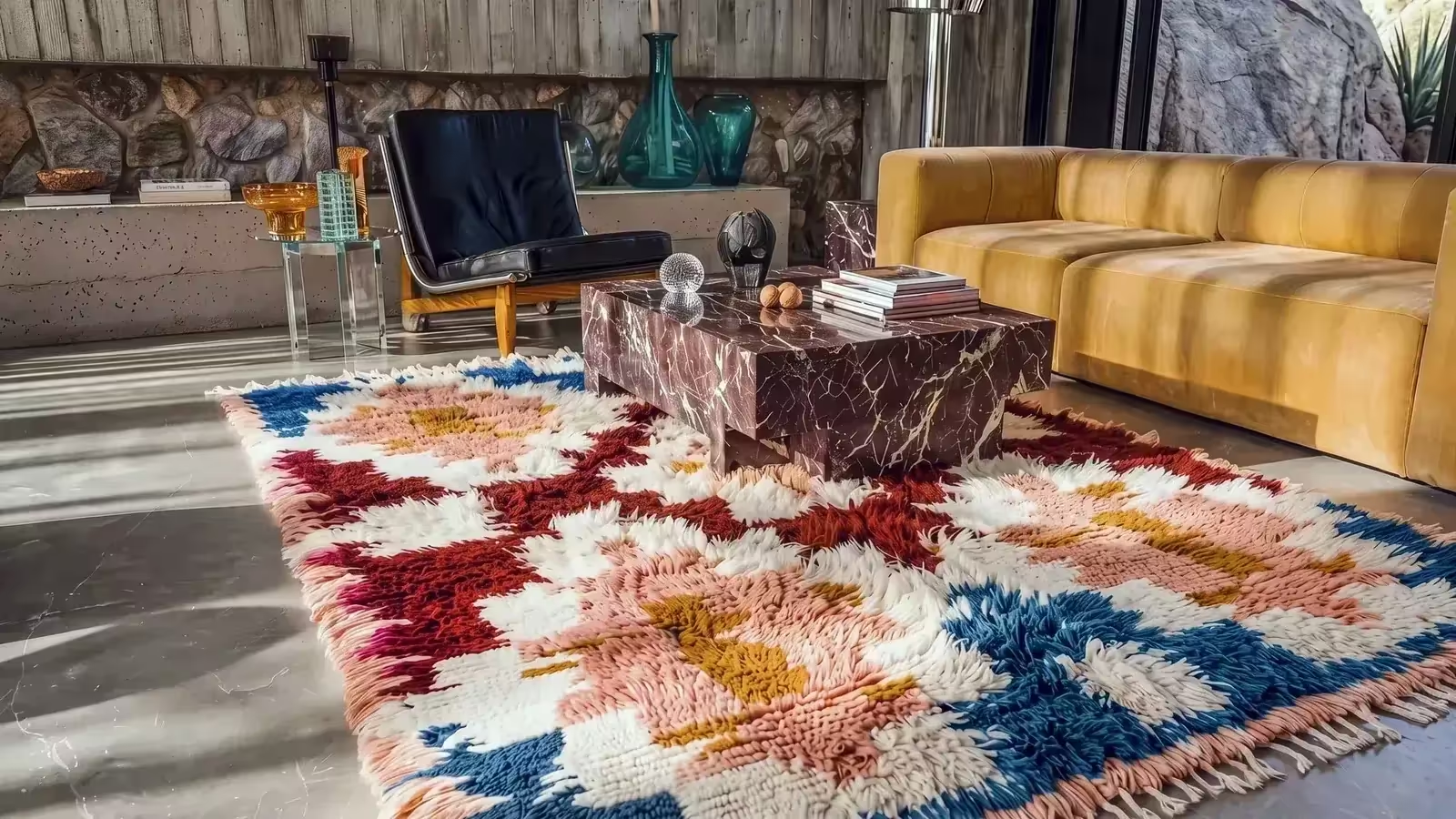
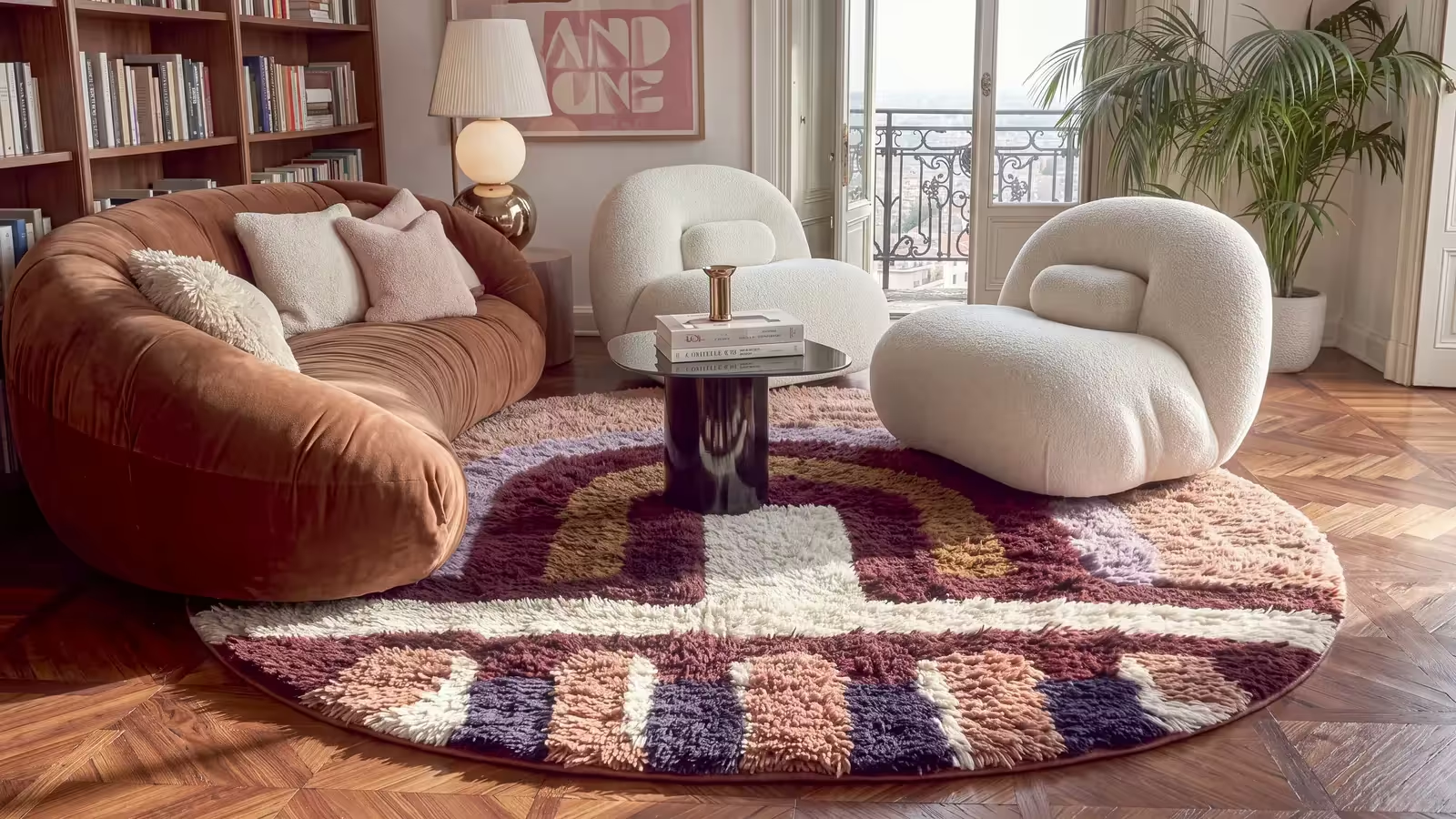
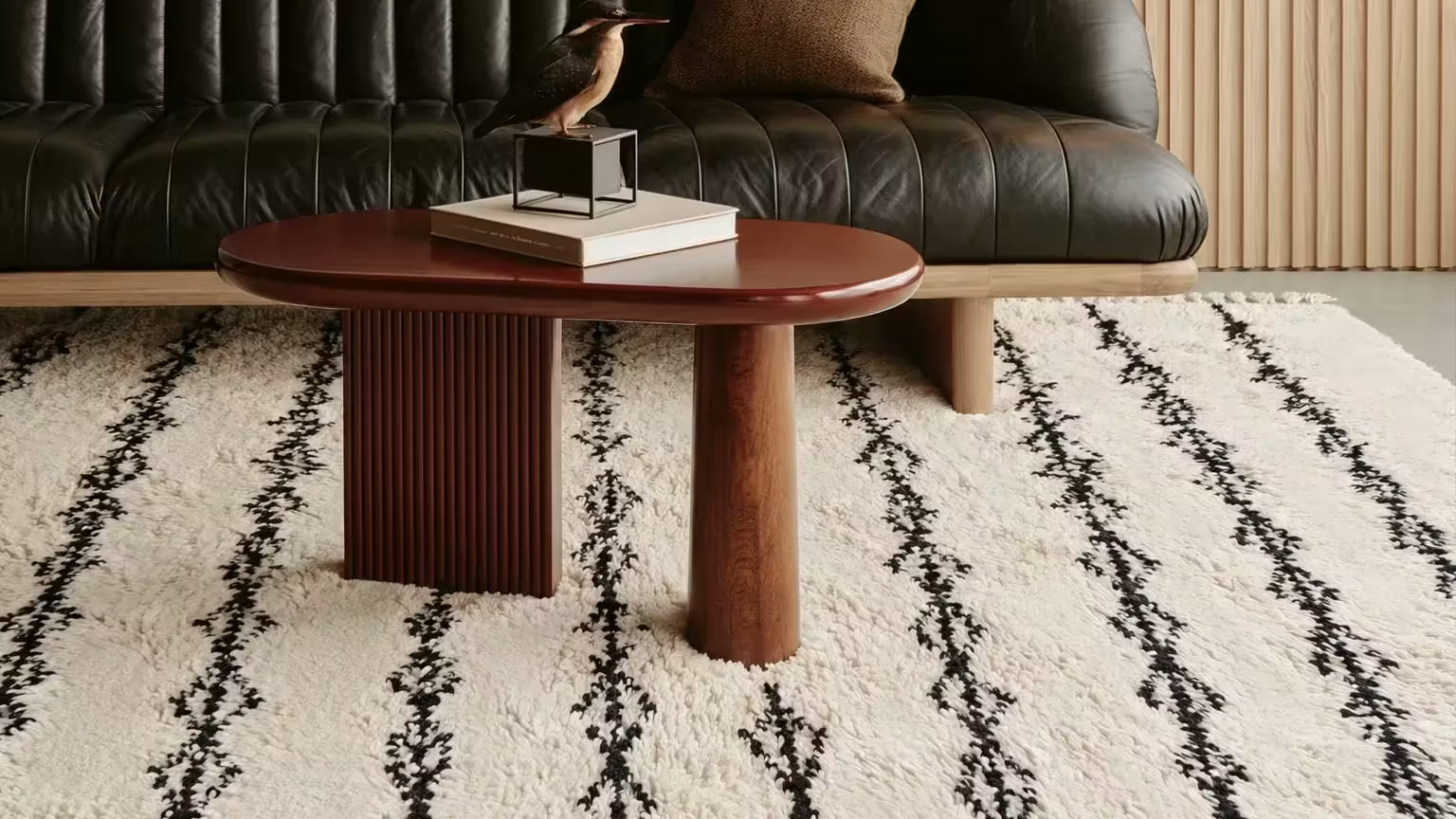
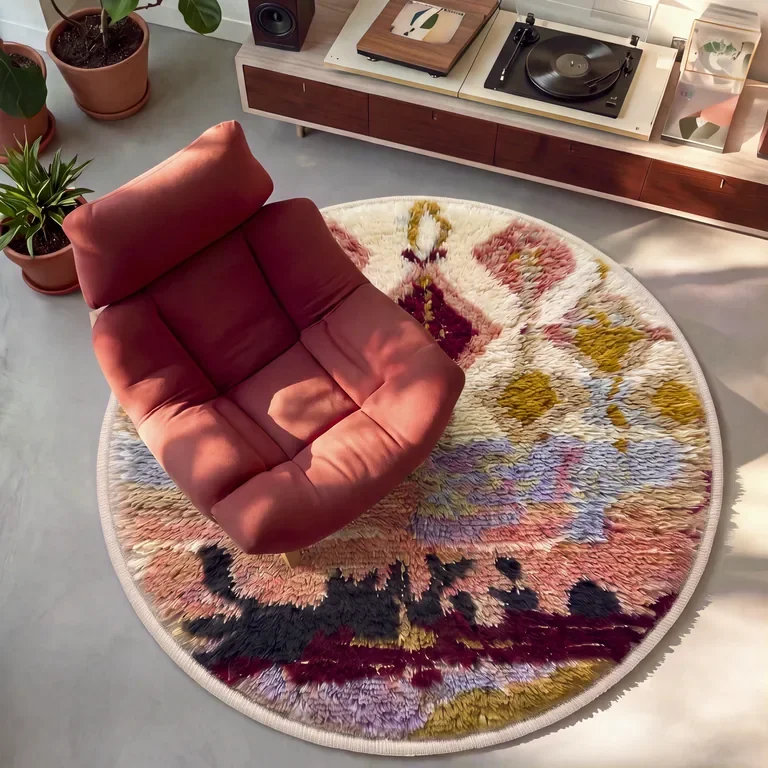
The same method carries every collection. Tichka, in Jibal, uses the knot to set black lines across ivory wool in a diamond lattice. Warda, in Bloom, carries pink, mustard and red that went into the yarn before the first knot was tied. Tadla, in Terrain, adds the carving step: its pile is cut to two levels after the loom, so the squares stand up in shag blocks between lower channels, and the check reads by touch as much as by color. Carved pattern against graphic pattern is the difference between two lineages, explained in our Beni Mrirt vs Beni Ourain comparison, and the carved designs sit together in the Terrain collection of sculpted Beni Mrirt rugs.
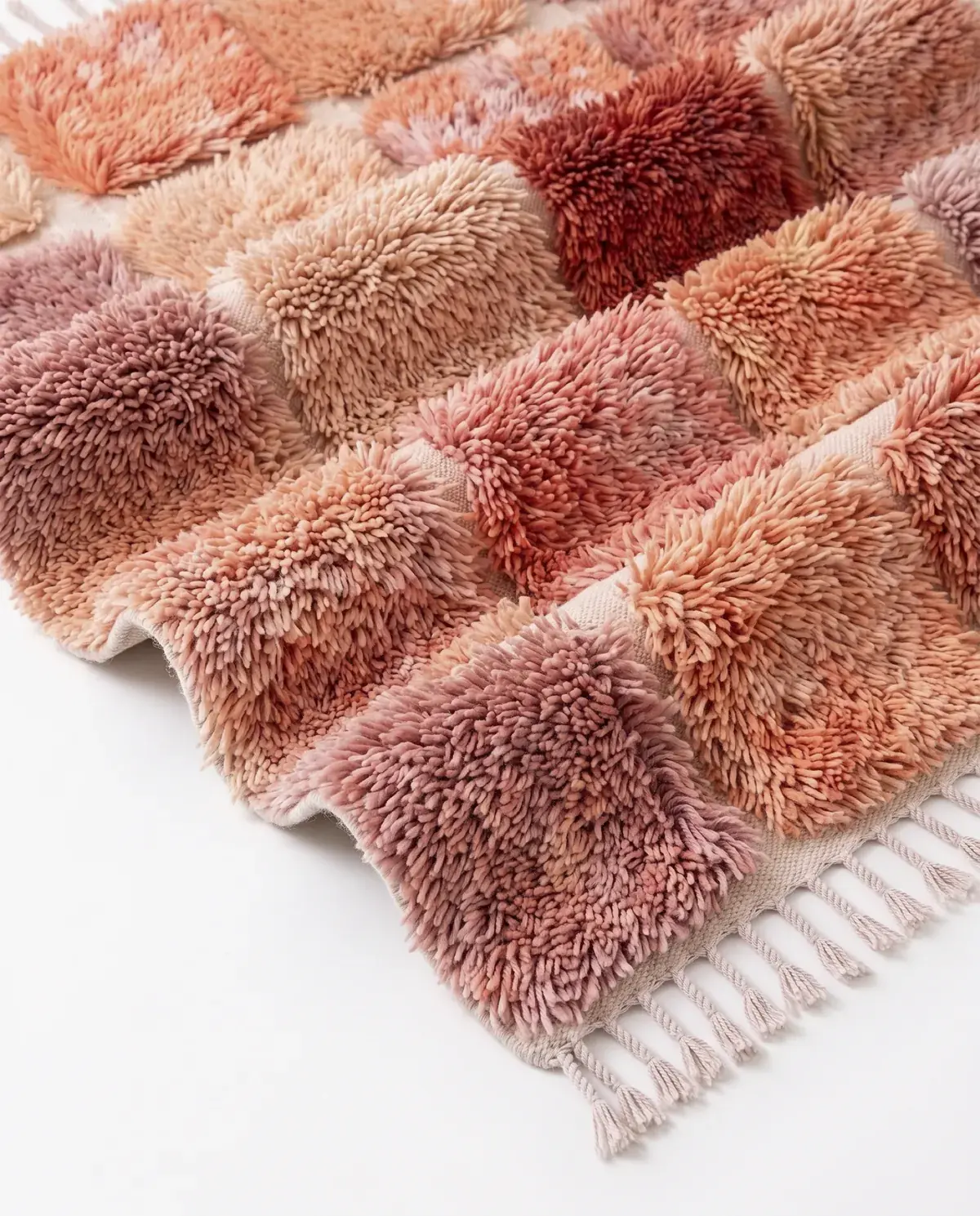
Once the knots make sense, the next question is the wait: what happens between order and door. See the knotting in Beni Mrirt rugs from the Terrain collection.