


Decor styles
Mid-Century Modern Living Room: Why a Beni Ourain Rug Works
Thin lines, thick wool, and a room of teak and legs.
By Zarbish · · 8 min read
In a mid-century modern living room the rug should be quieter than the furniture and softer than the floor: wool, in a low-contrast geometric or a solid period color, sized so the tapered legs stay in view. The classic answer is an ivory Beni Ourain rug with thin dark lines, and every design of ours that suits the period is gathered under the rugs we pick for mid-century rooms. Printed retro motifs are the one thing to skip.
Key takeaways
- A mid-century modern rug should be quieter than the furniture: wool, a low-contrast geometric or a solid period color, sized so the tapered legs stay in view.
- The ivory Beni Ourain rug with thin dark lines has sat beside modern furniture since Le Corbusier set thick Berber rugs next to his pieces.
- In Tizi and Abrid, ivory covers 89 and 92 percent of the photo and the black line 11 and 6, the ratio a teak room wants.
- A Beni Ourain pile is long and open, tufts that part under the hand, and that mass is what balances slim legs.
- Put the period's color, ochre, rust, camel or olive, on the rug only when the upholstery is quiet; one signature color per room is enough.
What kind of rugs go with mid-century modern?
A Moroccan wool rug with a restrained design goes with mid-century modern: a lattice, a single large diamond, stripes, or a solid field in a warm color of the period. It sits quieter than the furniture, because in these rooms the furniture is the event: teak sideboards, walnut tables, molded plywood, tapered legs, leather slung over a thin frame. Three kinds work, and one does not:
- The ivory Beni Ourain rug. A thick, soft ivory ground crossed by thin black or brown lines, the pairing the style is known for and the one we would choose first.
- A solid field in a period color. Ochre, camel, rust, olive or a deep charcoal, with no pattern at all, so a graphic chair or a color-block print takes the attention.
- A bold geometric with open ground. Bands, a grid, a stepped block, at a scale bigger than the details of the furniture, or the two start to argue.
- The one to skip: the printed retro rug. Atomic starbursts and boomerangs look like a costume the moment real mid-century furniture stands on them. The furniture already tells the period.
Why does a Beni Ourain rug suit mid-century furniture?
Because the two are opposites that need each other. The furniture is line and leg, wood and air; the rug is mass, softness and warmth. A room of tapered legs on a bare floor looks unfinished, and a thick ivory rug gives the legs something to stand in. That mass is built into the lineage: a Beni Ourain pile is long and open, tufts that part under the hand, a loose pile made for cold mountain floors, which is why it reads as a cloud beside a slim walnut frame.
The pairing is not new. Moroccan rugs reached Western interiors through modernist architects, and Le Corbusier, working a generation before mid-century modern, is the name usually given for setting thick-piled Berber rugs beside sleek modern furniture (Wikipedia, Moroccan rugs). The rugs were already old, the rooms were new, and the two fit.
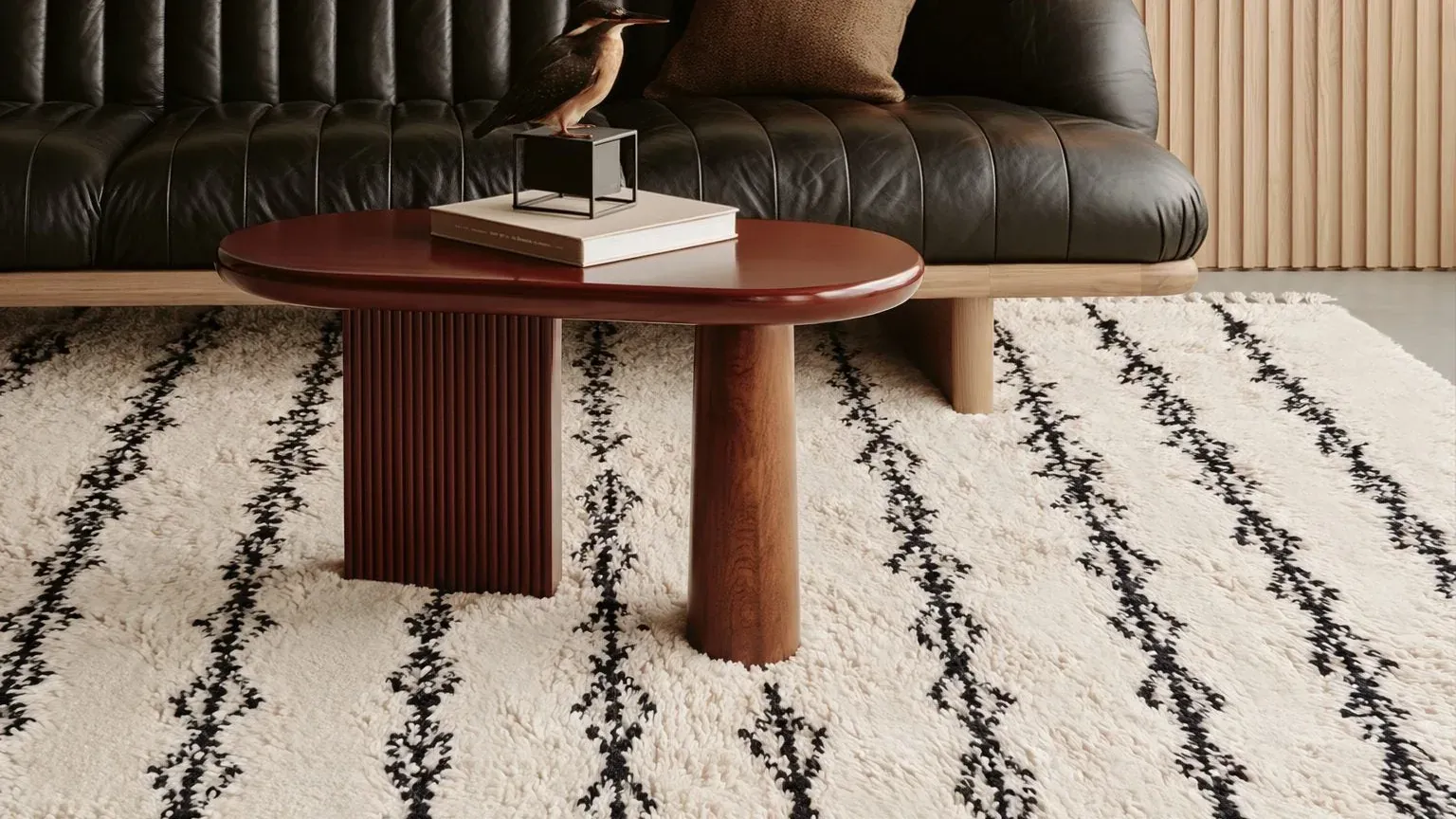
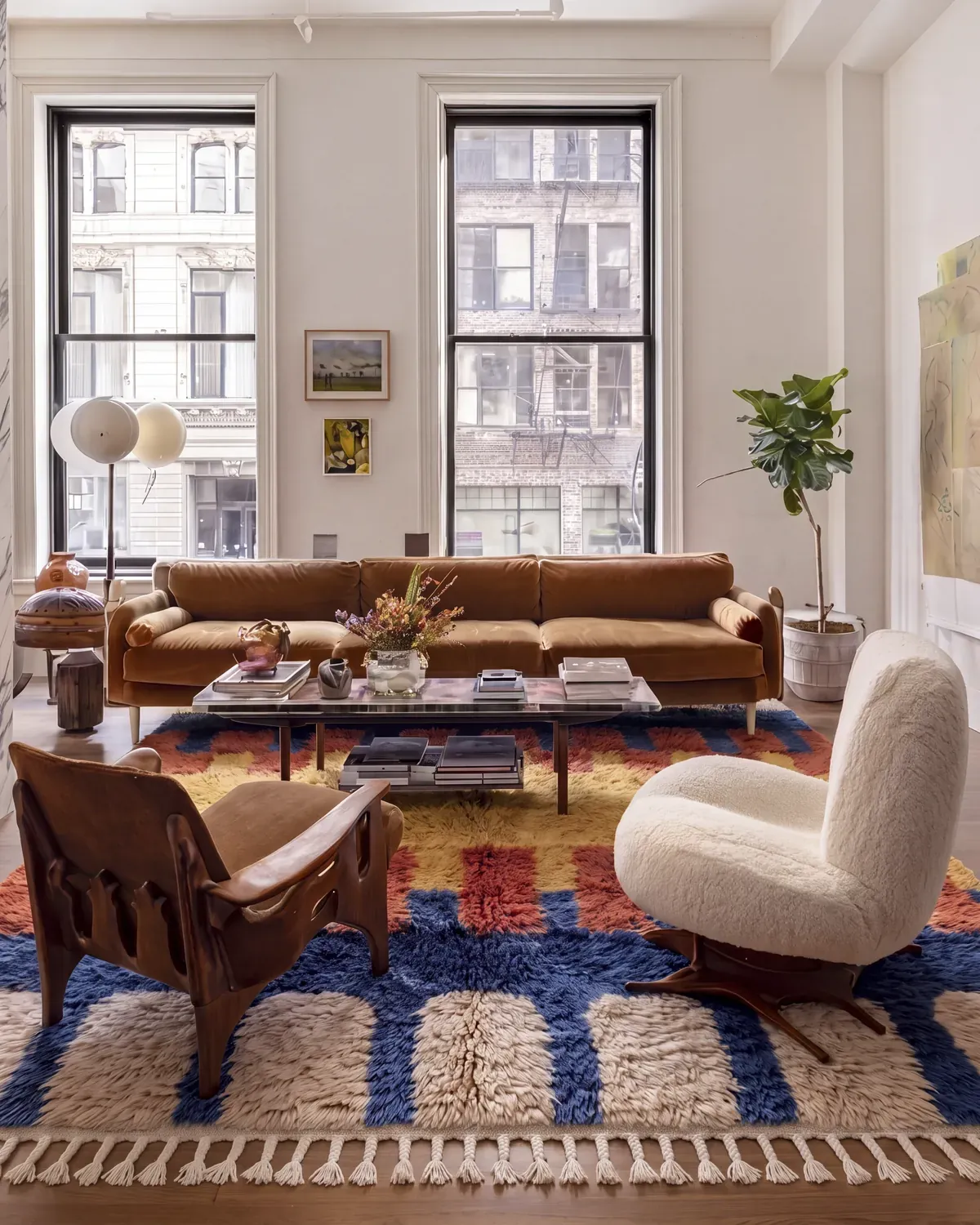
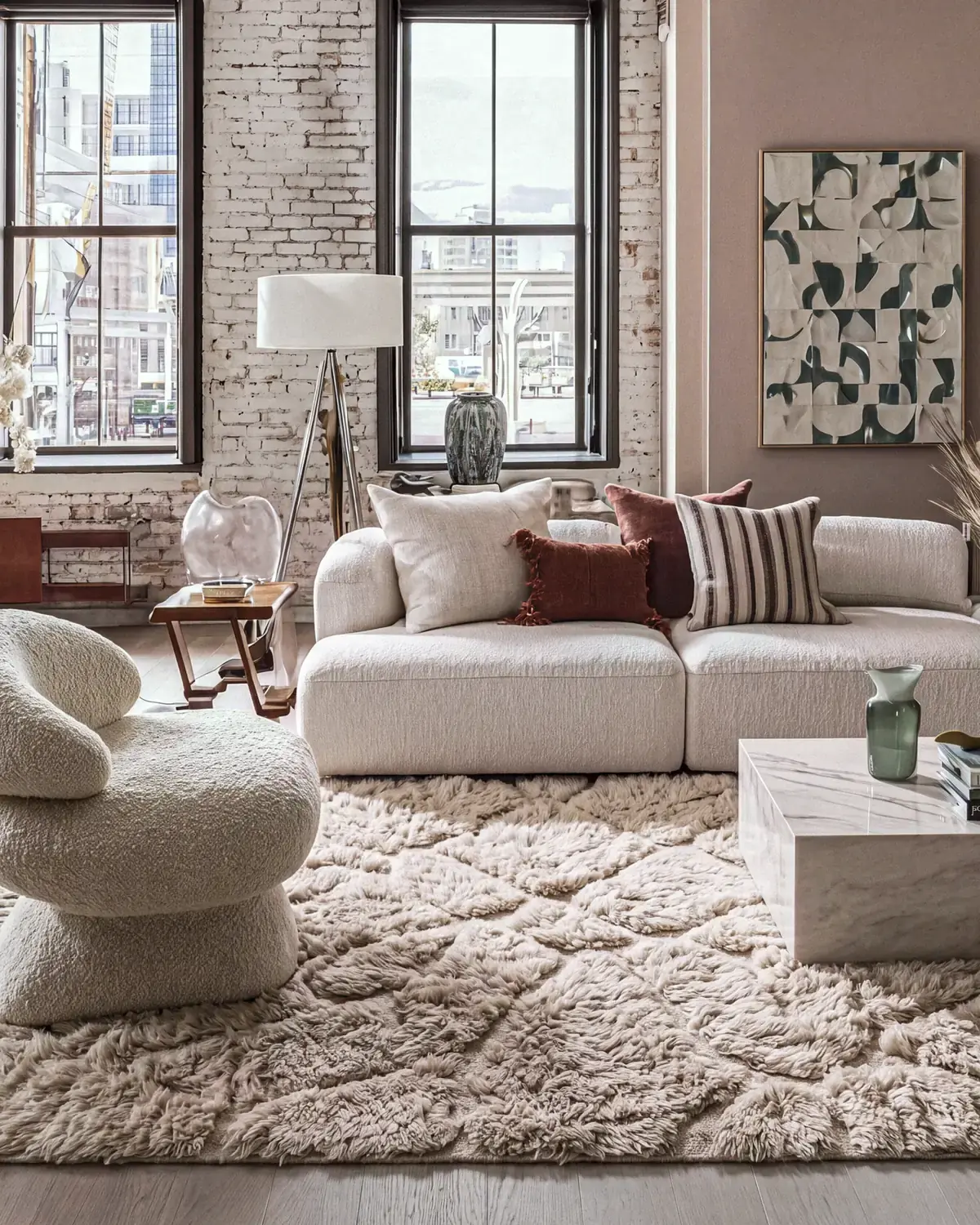
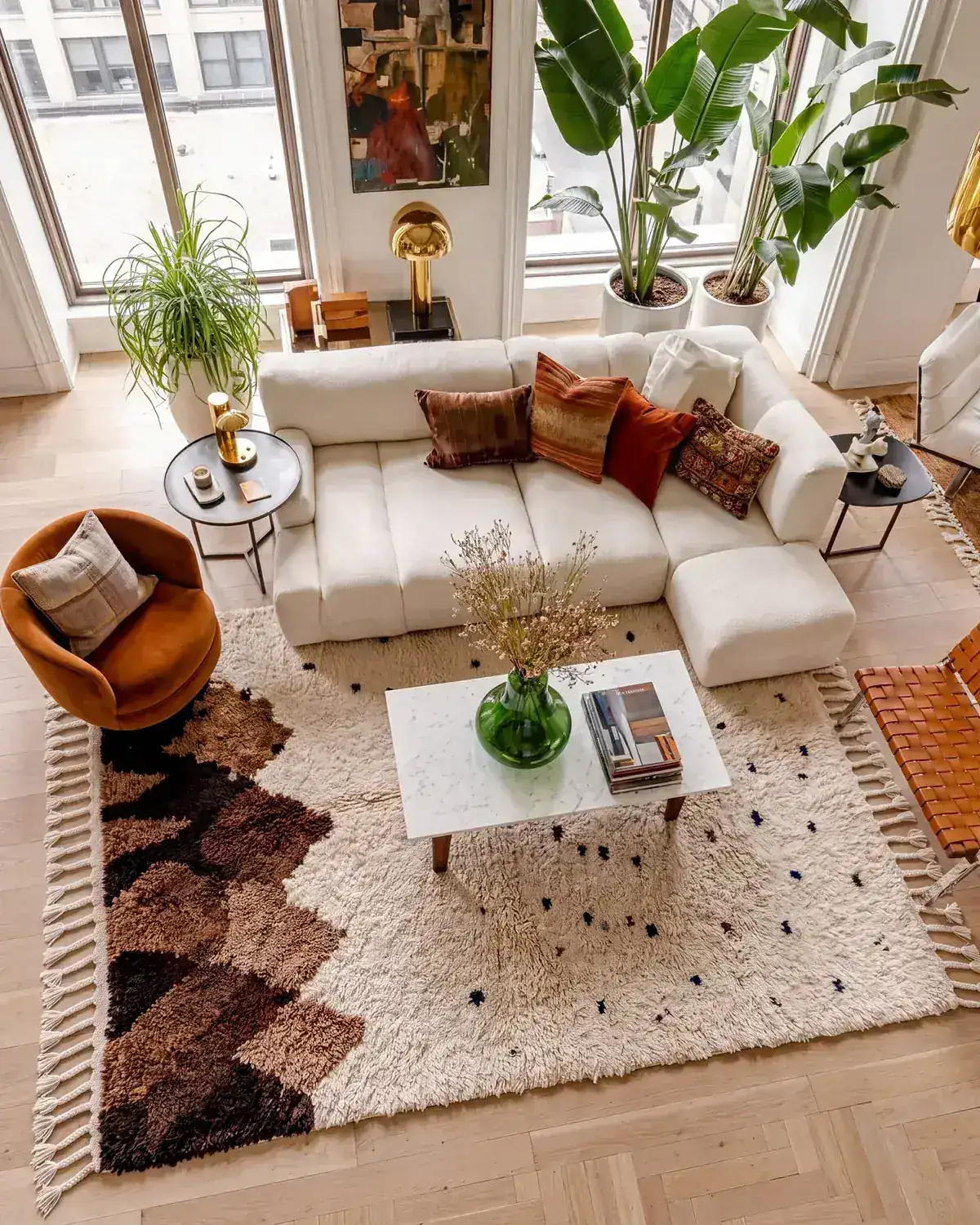
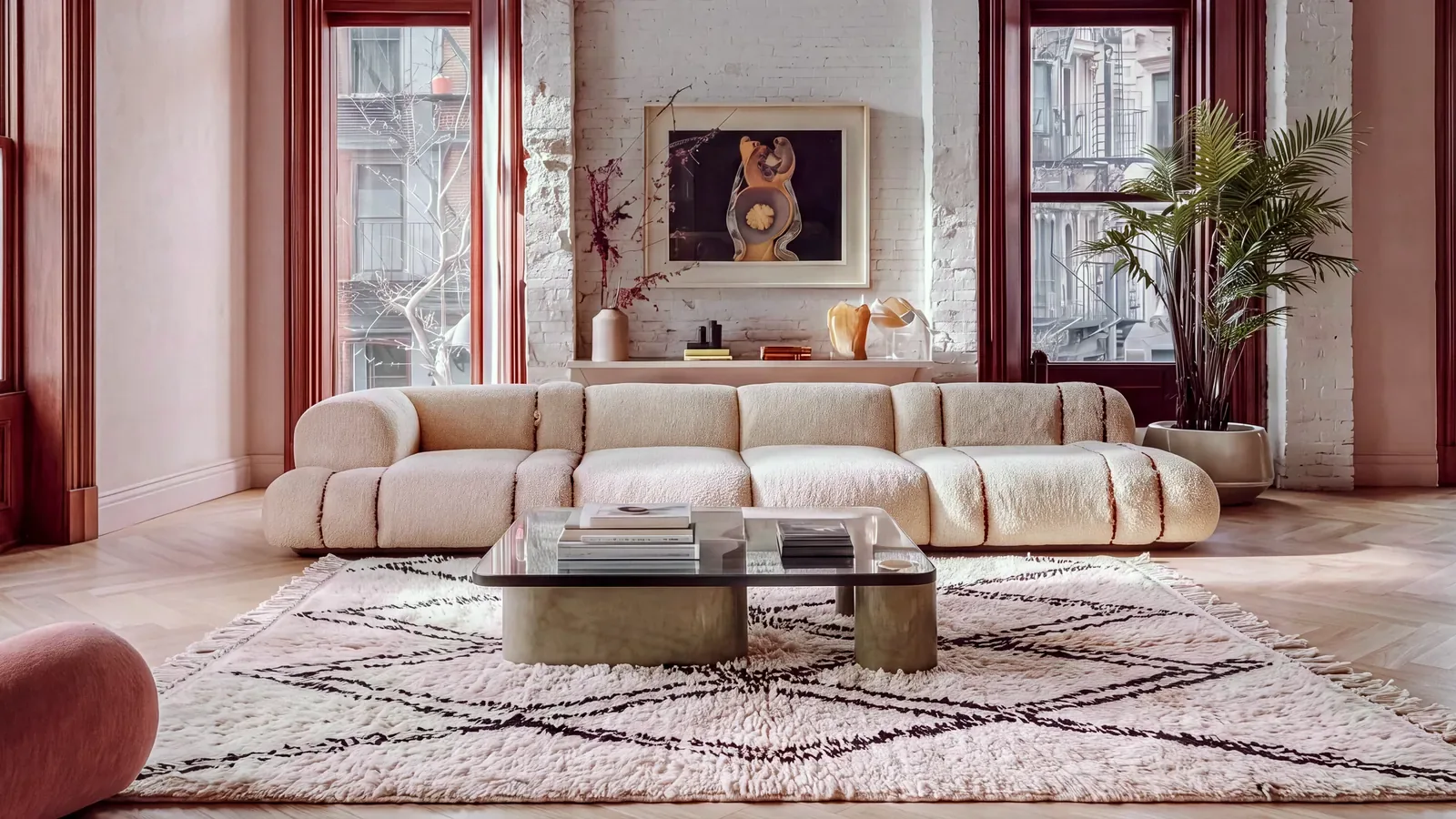
There is a second reason, and it is the one we would build a room on: a line knotted by hand relaxes a room of exact edges. Look at Tizi, on the cover. Its doubled black lines cross slightly off-register, because each one is tied row by row, and beside the edge of a glass table or a teak case that wandering line reads as the one easy thing in the room. Tizi is named for the Amazigh word for a mountain pass; in the loft pictured, a cream channel-tufted sofa, a glass table and tall wood-framed windows leave the floor as the only soft pattern. The lesson is the ratio: mostly open ivory, with a thin dark line the eye follows.
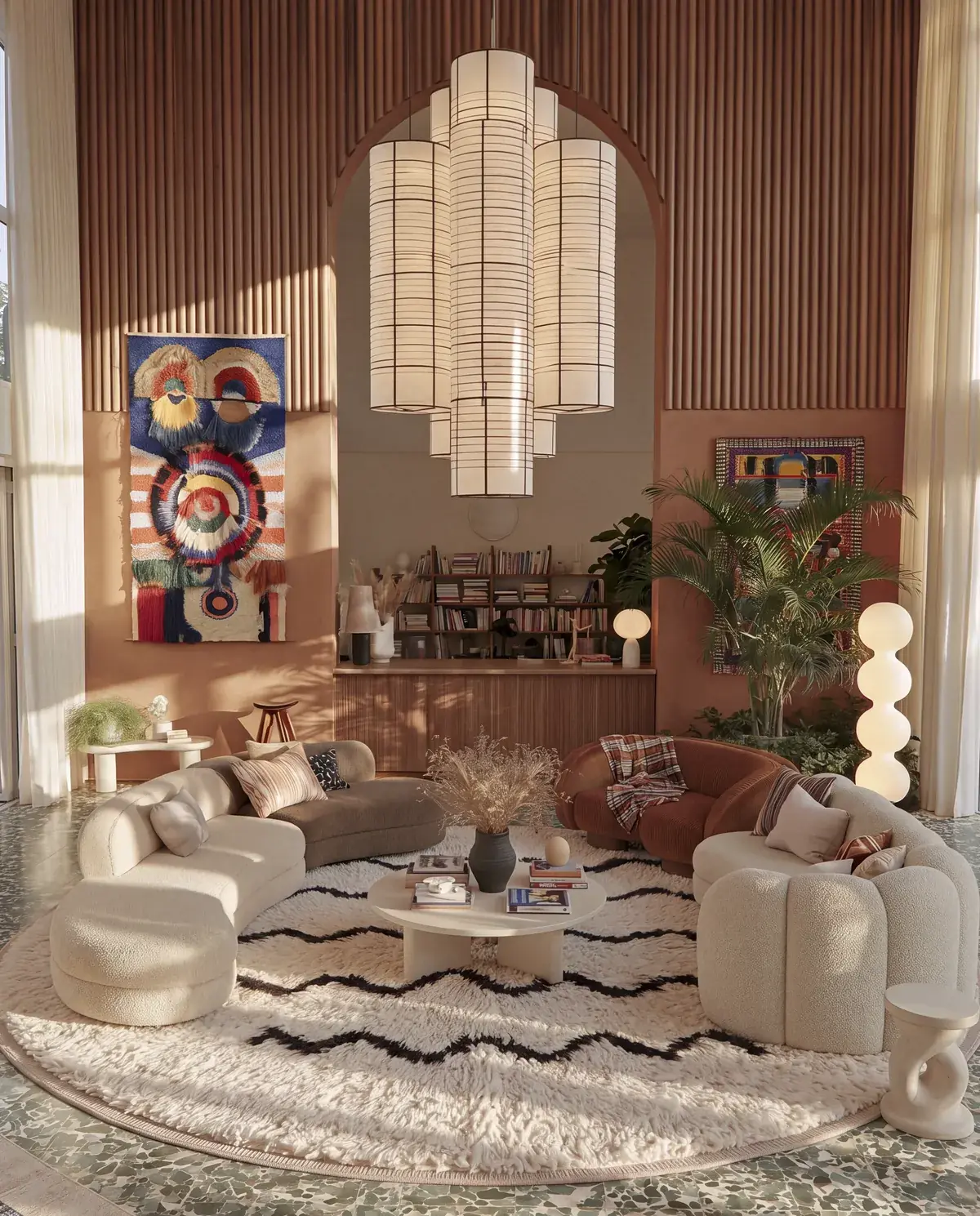
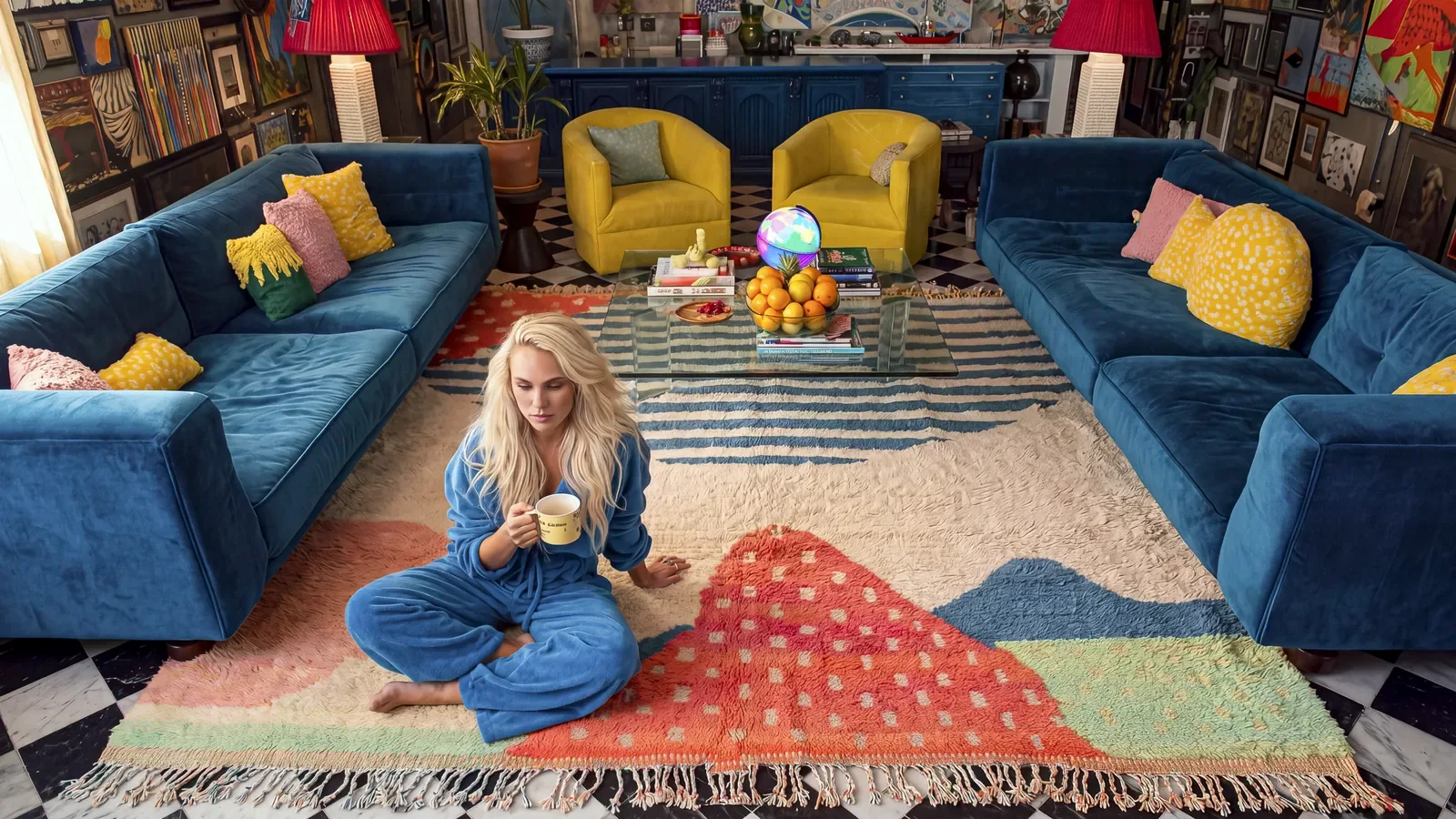
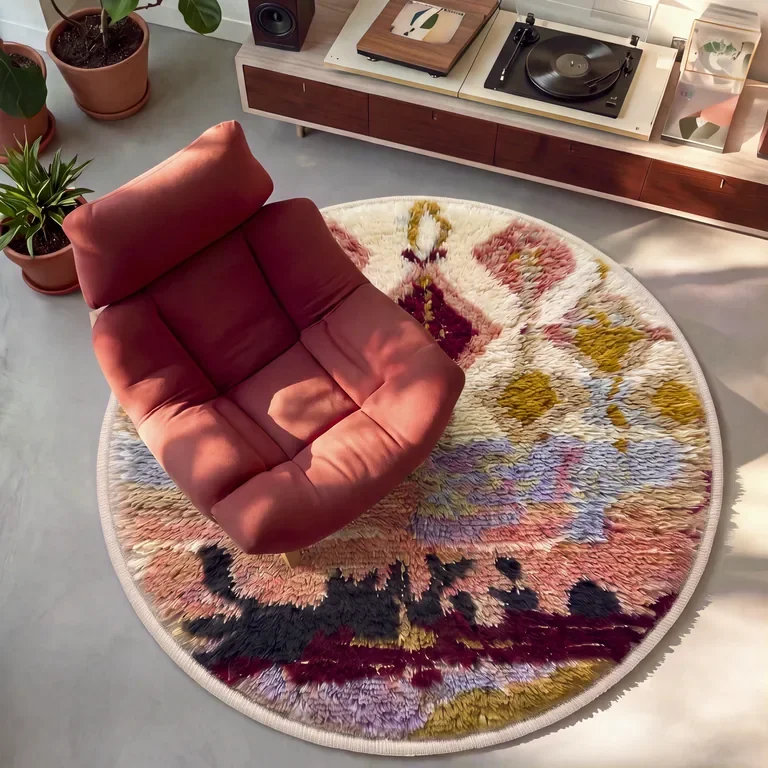
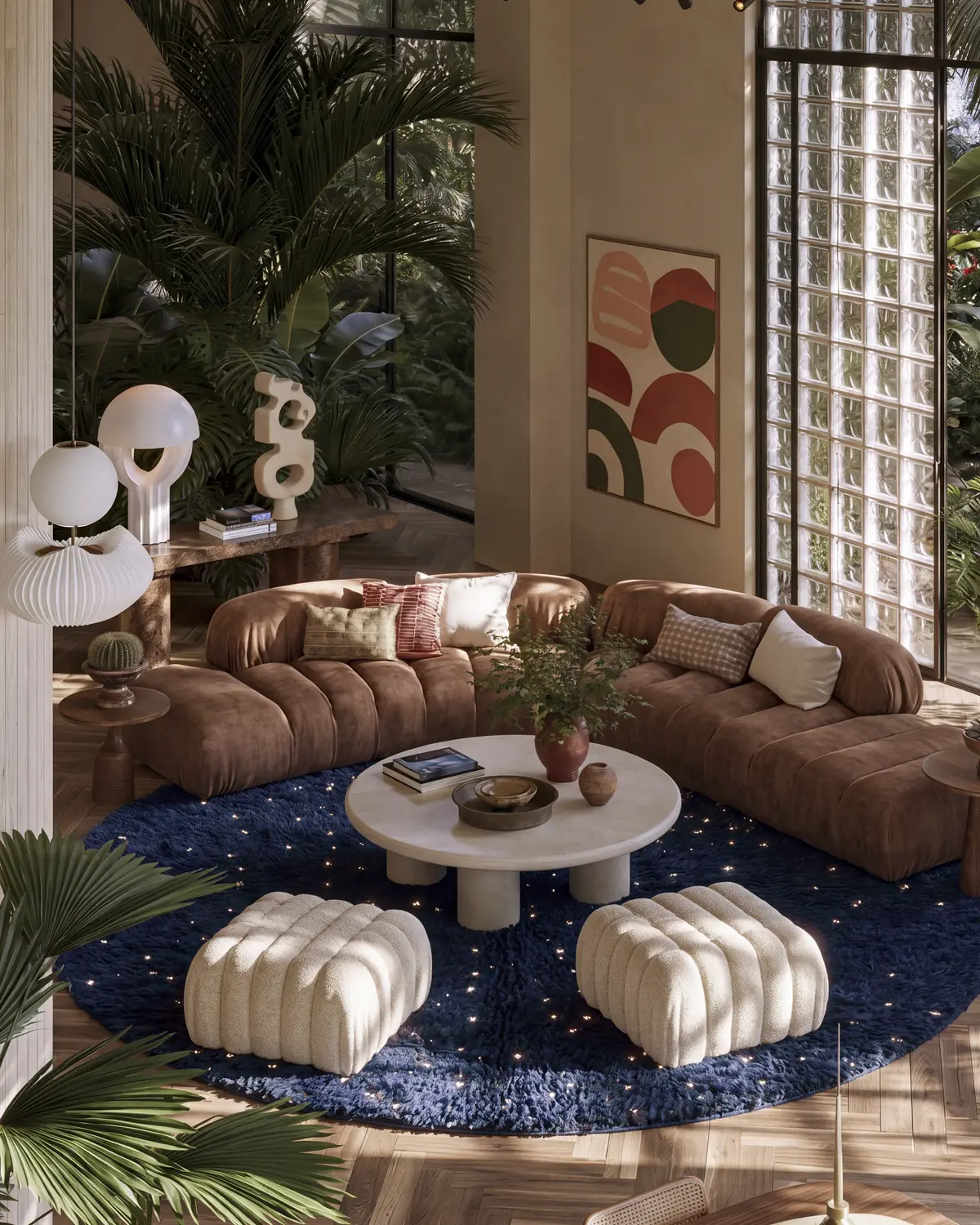
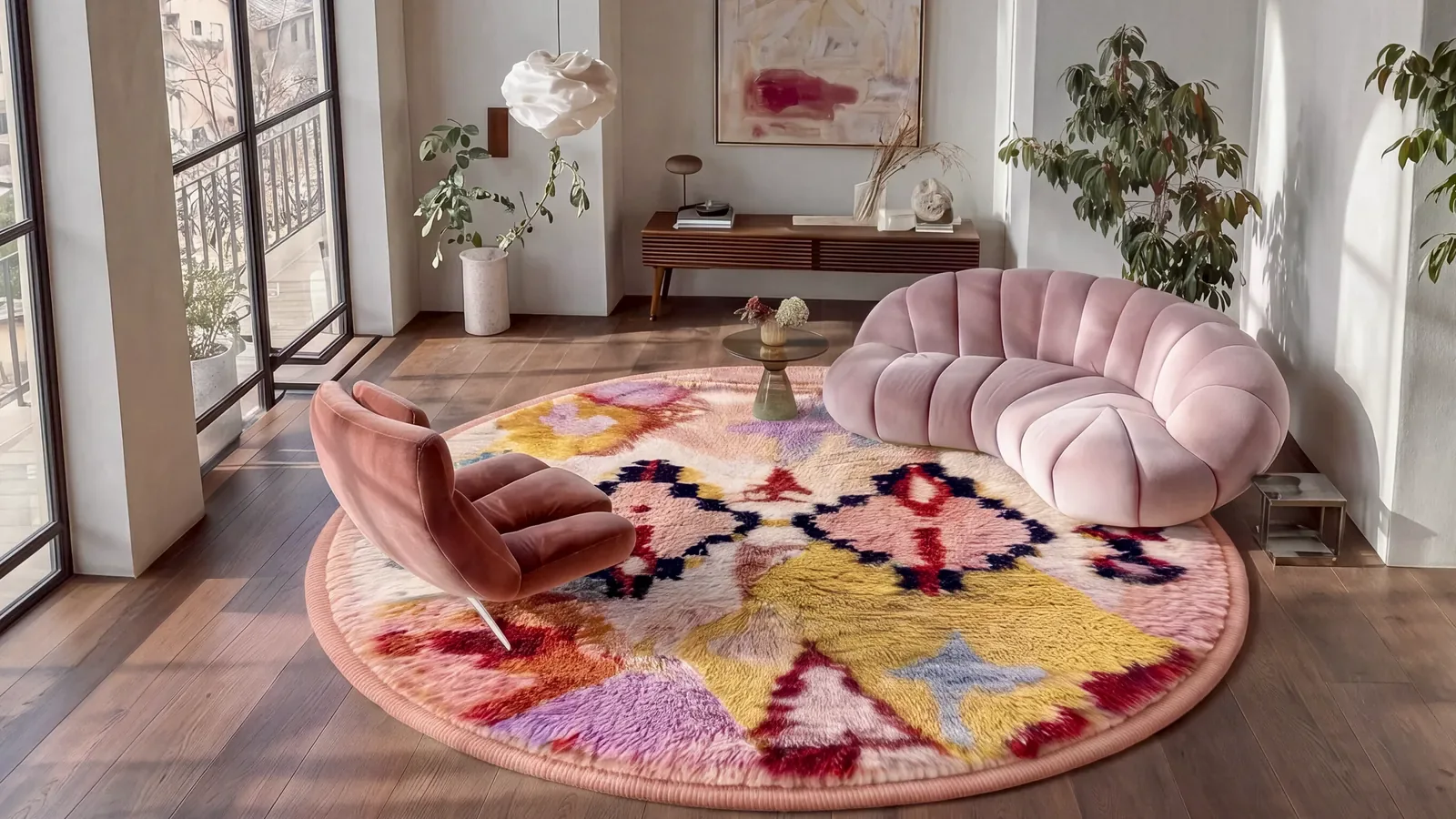
Abrid, the Amazigh word for path, carries the idea in a different direction: jagged black lines travel edge to edge across the ivory round. In the room pictured it sits under two curved cream bouclé sofas and a low round table, with fluted terracotta walls and paper lanterns above: low seats and warm color, the mid-century recipe. The zigzags are the only sharp line in a room of curves, so the rug reads as the one graphic piece, chosen on purpose.
Which colors are mid-century modern?
The colors of mid-century modern are warm and earthy with one strong accent: ochre and mustard, rust and burnt orange, olive and moss, camel and teak brown, soft whites, and a single spike of red, teal or cobalt. Put them on the floor only when the upholstery around the rug is quiet. One signature color per room is the rule we would keep.
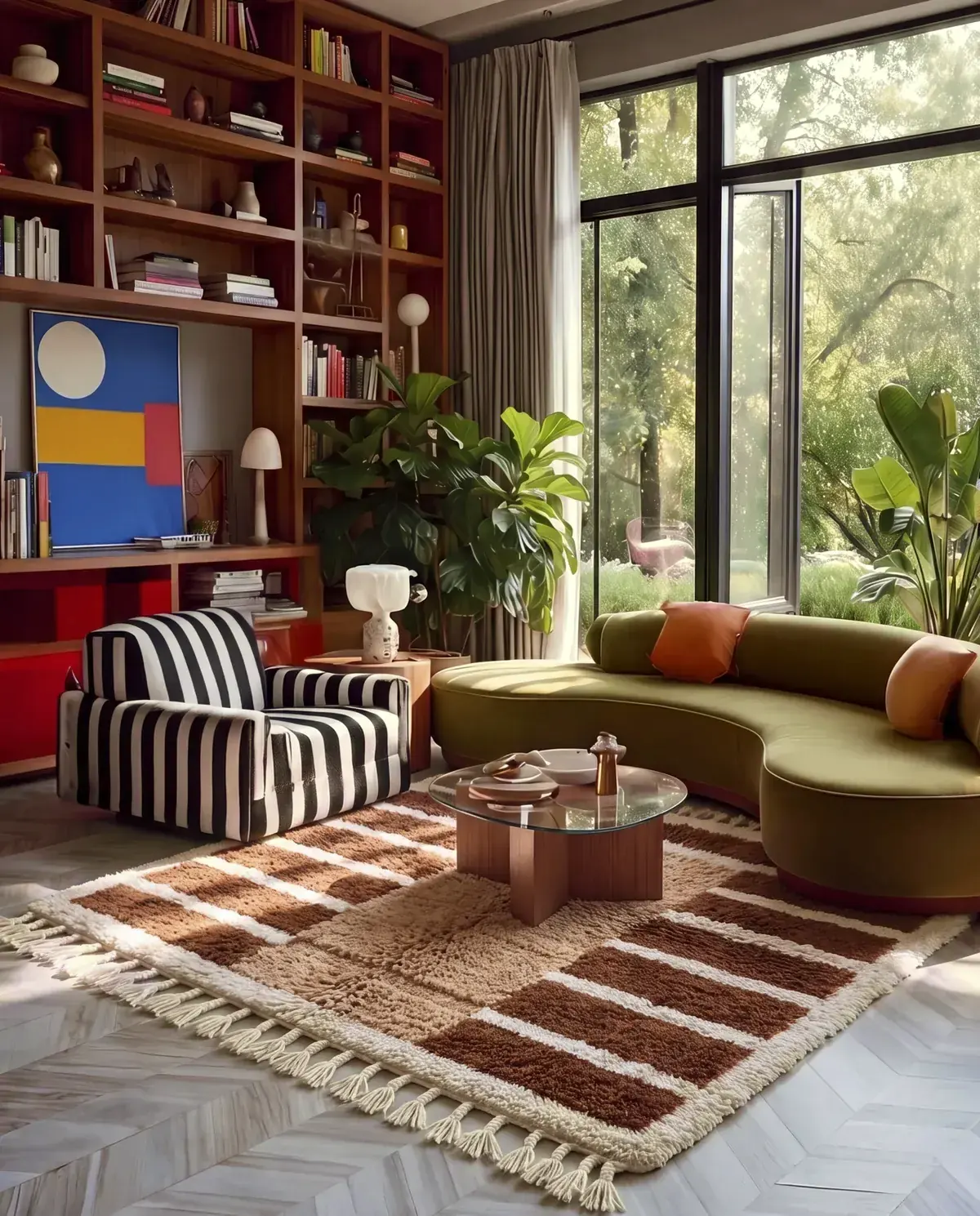
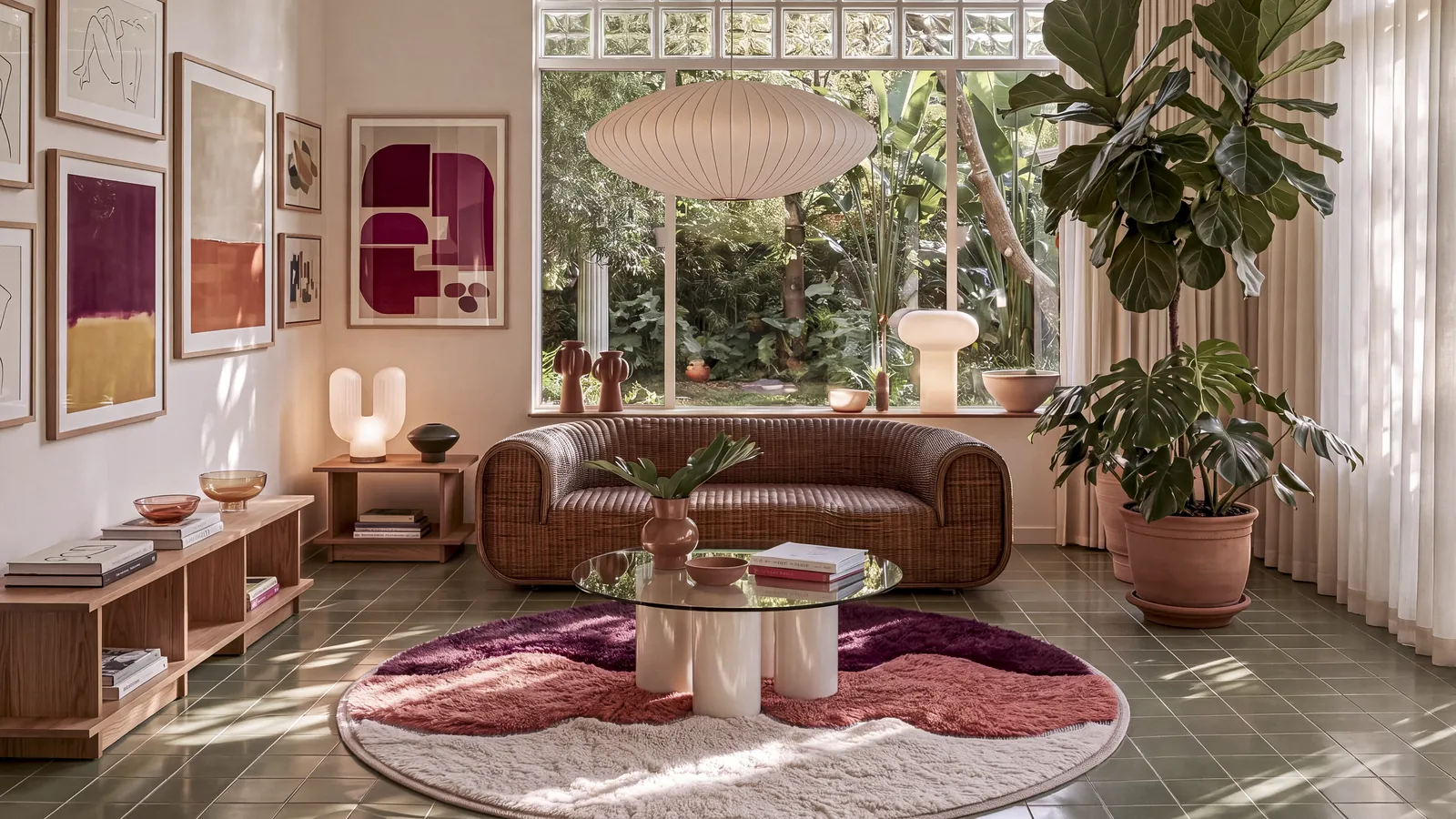
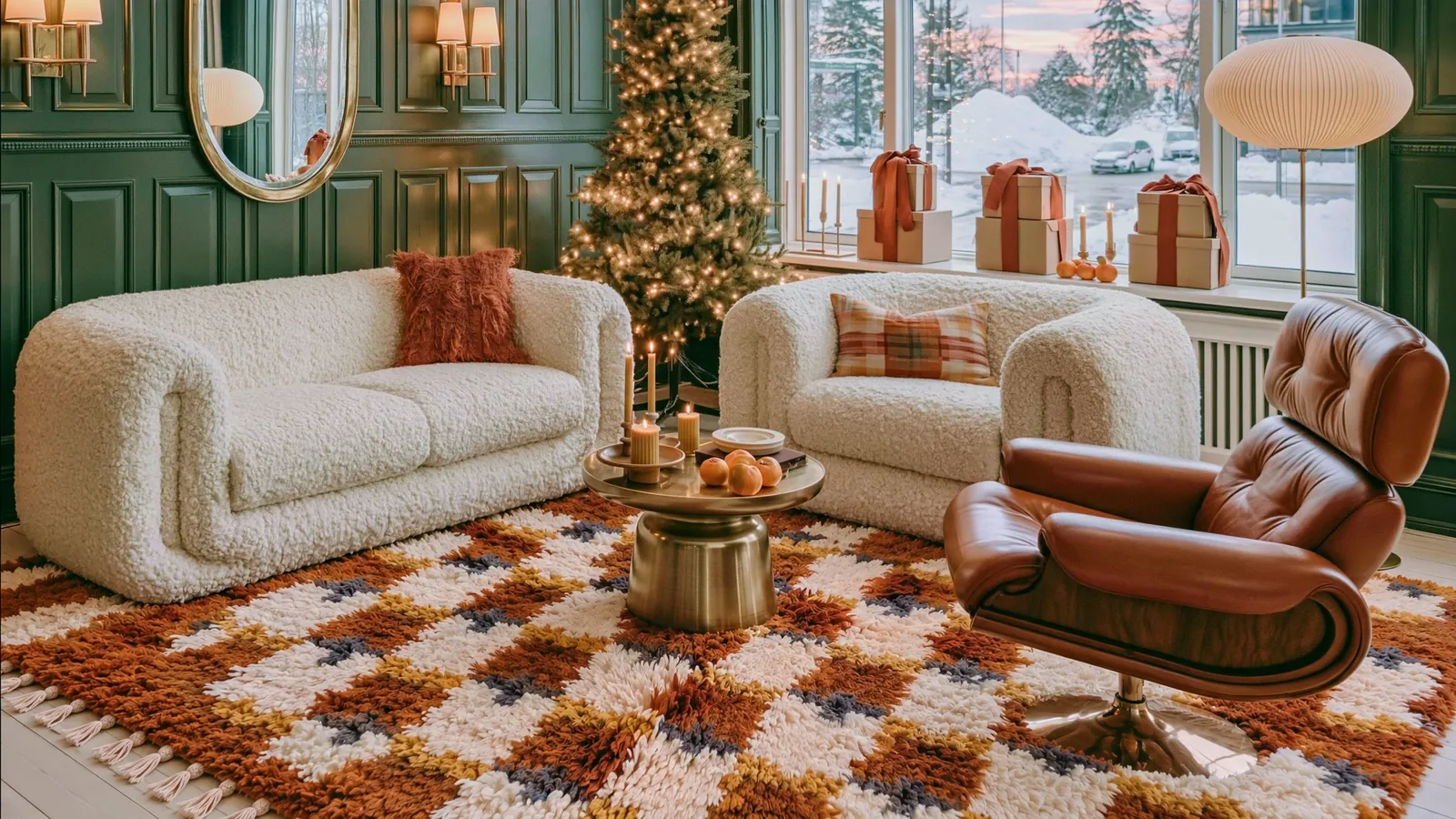
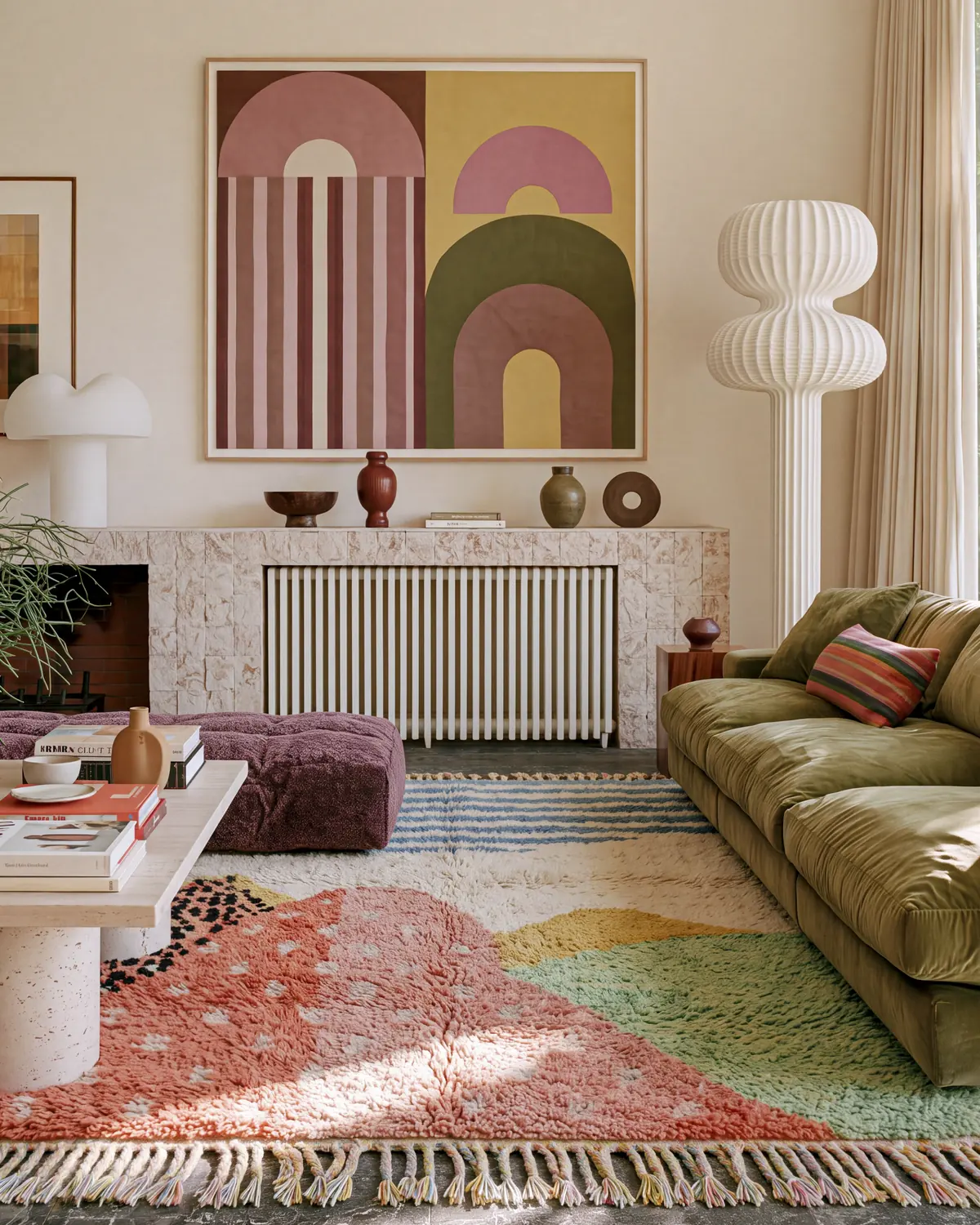
Todra shows the palette carried by a rug. In the room pictured, a black and white striped armchair, an olive curved sofa with rust cushions, walnut shelving and a color-block print in blue, red and yellow all hold strong color or pattern, and the rug keeps to the browns of the wood. It works because it shares the room's warmth without adding a new color. A striped chair on a banded rug sounds wrong; here the stripes run in different directions and at different scales, which keeps them apart.
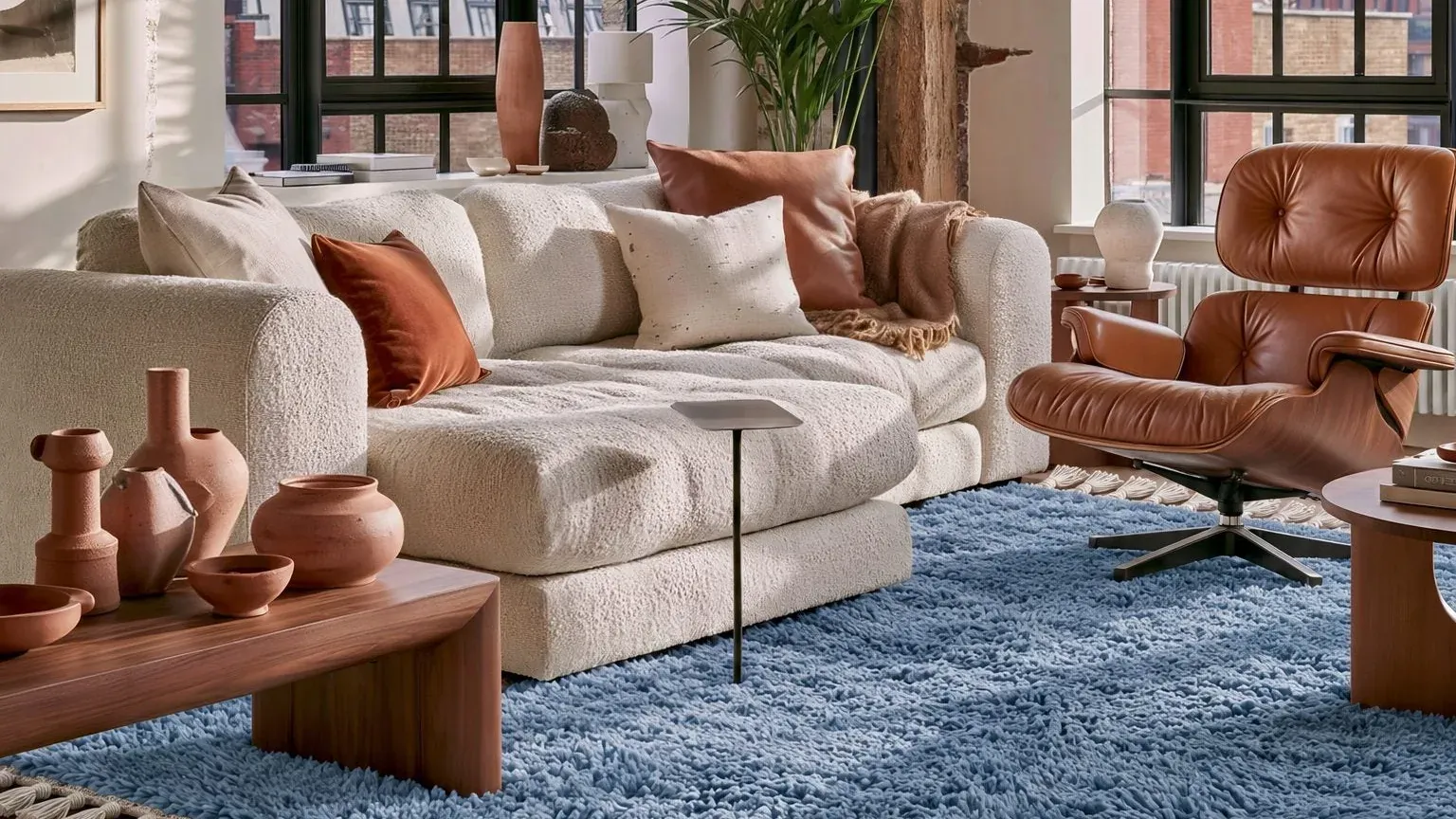
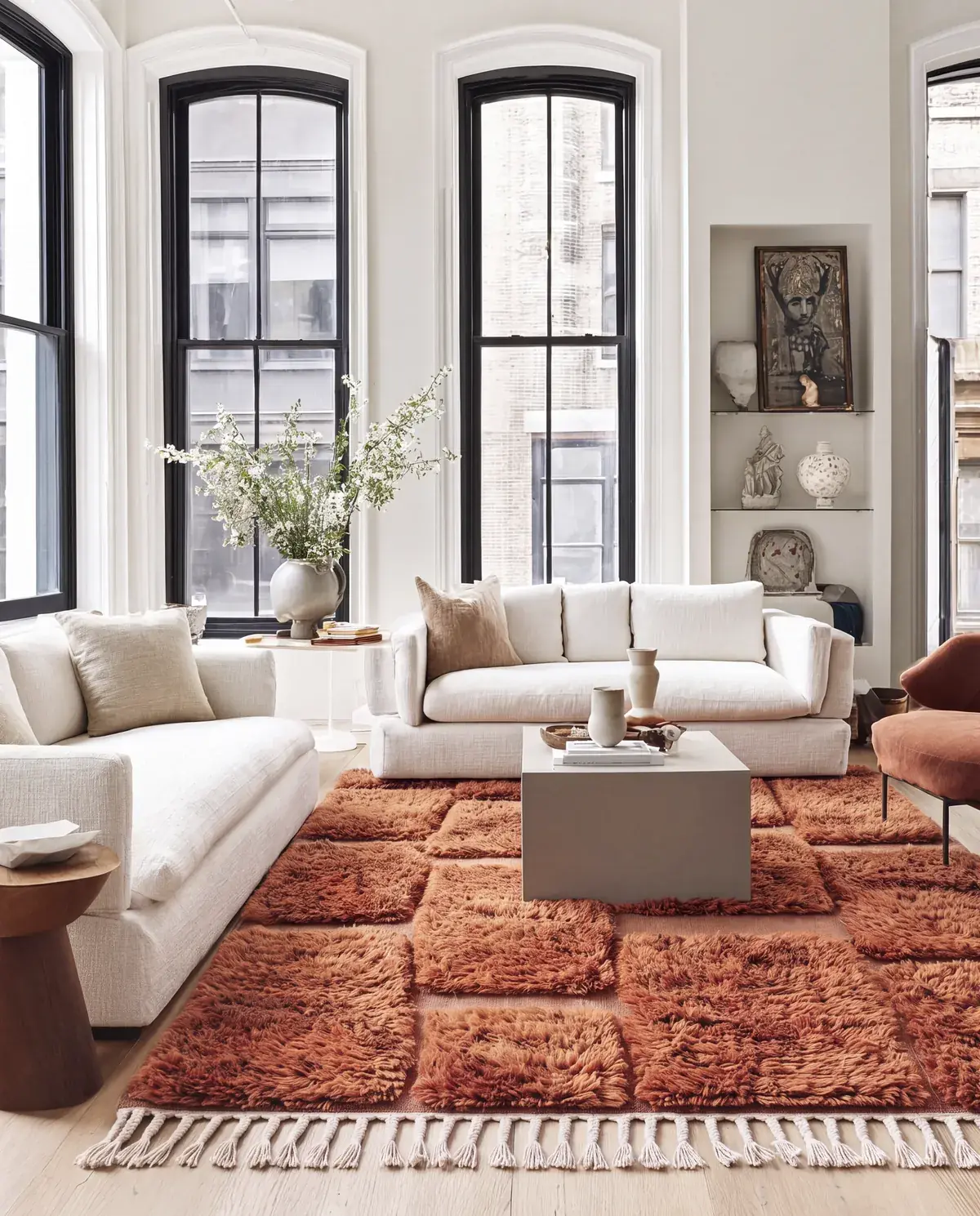
When the seating is white or cream, the rug can carry the color alone. Hamada in burnt orange does that in a bright room with two white sofas, a pale block table and tall black-framed windows. Its raised blocks, staggered like offset brickwork over a lower ground, give the floor a relief a flat color could not. That is a carved Beni Mrirt rug rather than a linear Beni Ourain; the difference in feel is in the Beni Mrirt and Beni Ourain comparison.
The rugs, measured
The numbers below come from each rug's own photo and its catalog record, so they describe the pictured colorway, not the whole design.
| Rug | Collection, lineage | Shape | Colorway | Color share in its photo | Wool and dye | Pile and hand |
|---|---|---|---|---|---|---|
| Tizi | Jibal, Beni Ourain | Classic | Ivory & Black | ivory 89%, black 11% | Undyed natural wool; the black is naturally dyed | Dense, soft pile, the motifs set by height and density |
| Abrid | Jibal, Beni Ourain | Round | Ivory & Black | ivory 92%, black 6%, brown 2% | Undyed natural wool; the black is naturally dyed | Thick, soft wool with the design traced in relief |
| Todra | Jibal, Beni Ourain | Classic | Brown & Camel | brown 63%, ivory 21%, beige 11% | Natural wool, naturally dyed | Soft underfoot, with a dense and even pile |
| Hamada | Terrain, Beni Mrirt | Classic | Burnt Orange | orange 94%, ivory 4%, terracotta 3% | 100% natural wool, naturally dyed | Low, dense ground with plush blocks standing above it |
Tizi and Abrid put the ratio into numbers: ivory at 89 and 92 percent of the photo, black at 11 and 6. That is the proportion a teak room wants, enough dark line to follow and nothing that competes with the wood. Todra flips it, brown at 63 percent with ivory at 21, and is the rug for the room whose chairs are already loud. Hamada's 94 percent orange is one period color and nothing else, which only works with white seating around it.
How to choose a rug for a mid-century living room
Choose it from the legs up.
- Show the legs. The front legs of the sofa and every chair go on the rug. A sofa of 84 to 96 in takes an 8x10 ft; a sofa of 96 to 110 in, or a low sectional, takes a 9x12 ft. Tapered legs lose their point on a rug too small to reach them.
- Set the ground against the wood. Teak and walnut on ivory, cream or camel; pale or painted furniture on charcoal, brown or olive. A clear step, never a match.
- Choose a pattern bigger than the furniture. A lattice or a band wider than the chair's own details reads as a floor. A small repeat under spindly legs looks busy.
- Keep to one loud surface. If the sofa is mustard or the chair is striped, the rug goes quiet: ivory with a line, or a solid. Plain upholstery lets the rug carry the room's one color.
- Dining tables and desks take short pile. Under a table the rug reaches at least 24 in beyond the edge so the chairs stay on it when pulled out; an 8 ft round sits under a 42 to 48 in round table. Short pile there and under a desk chair on casters, so chairs slide and slim legs do not sink.
- In the bedroom, think of the low bed on legs. A queen takes an 8x10 ft with about 30 in showing each side, a king a 9x12 ft, and the rug runs at least 18 in beyond the sides and foot. The mid-century bedroom guide takes the style room by room.
Where to look: the Beni Ourain line and diamond designs are in Jibal, the carved designs in Terrain, and the solid fields in Dune, several of them in period colors.
Vintage or new?
A vintage Moroccan rug is a real choice for a mid-century room, and a good one if you find a piece in the size you need, in sound condition, with its wear honest to its age. The difficulty is the size: old pieces come as they were woven, often long and narrow, and a mid-century living room usually needs a proportion close to 8x10 ft. A new rug knotted to the design in the size the sofa asks for solves that, with the same wool and the same hand.
Not sure which line suits your teak? Send us a photo. Next: what is a Beni Ourain rug, then the Jibal collection.