


Styling
Layering Rugs: How to Layer Two Rugs, and a Rug on Carpet
A flat base, a smaller rug on top, an even band between.
By Zarbish · · 9 min read
To layer rugs, lay a large, flat base sized to the furniture, then a smaller rug on top, usually two sizes down, so an even band of the base shows all round: 12 to 18 in. The base does the size work, the top rug brings the pile, pattern and color, and the band between them is what makes two rugs look intended.
A rug on wall-to-wall carpet follows the same logic, with the carpet as the base, and it has one problem of its own: keeping the rug from creeping.
Key takeaways
- To layer rugs, lay a large flat base sized to the furniture, then a smaller rug on top with an even band of the base, 12 to 18 in, showing all round.
- The flat, quiet rug goes underneath and the pile, pattern or color goes on top; a thick rug stacked on another thick rug rocks underfoot and lifts at the edge.
- For an 18 in band, choose a top rug 3 ft shorter and 3 ft narrower than the base: a 6x9 ft rug on a 9x12 ft base.
- A rug works on wall-to-wall carpet when the carpet is low or loop pile, the rug is short pile with a pattern the carpet does not have, and furniture legs hold it in place.
- Rugs creep on carpet because foot traffic pushes them along the carpet's pile; a sofa or bed standing on the rug stops it.
The rules for layering rugs
The rules for layering rugs come down to six decisions, made in this order:
- Size the base to the furniture. It holds at least the front legs of the sofa and chairs, which in most living rooms means an 8x10 ft or a 9x12 ft. How to size it for your sofa: living room rug size.
- Keep the base flat. Jute, sisal, a flatweave, or a wool rug in short pile, 0.4 in.
- Choose the top rug two sizes down, so 12 to 18 in of base shows on the sides. The size table is below.
- Let one rug lead. Plain base and patterned top, or the other way round; two busy rugs fight.
- Set the top rug square or turn it. Square to the sofa reads calm; turned a few degrees off center reads looser and more collected. Keep the band visible on every side either way.
- Pad the base, not the top. On a hard floor, the pad goes under the base rug.
What size rugs to layer
For an even band of 18 in, choose a top rug 3 ft shorter and 3 ft narrower than the base. For a 12 in band, 2 ft. The top rug usually ends up covering about half to two thirds of the base, which is the proportion that reads as two layers rather than one rug with a frame.
| Base rug | Top rug | Base showing |
|---|---|---|
| 9x12 ft | 6x9 ft | 18 in on every side |
| 8x10 ft | 5x8 ft | 18 in on the sides, 12 in at the ends |
| 10x14 ft | 8x10 ft | 12 in on the sides, 24 in at the ends |
| 8x10 ft | 6 ft round | 12 in at the sides, 24 in at the ends |
| 6x9 ft | 4x6 ft | 12 in on the sides, 18 in at the ends |
A worked example: a 100 in sofa facing two chairs across a coffee table needs a base of about 9x12 ft so every front leg lands on it. Lay a 6x9 ft patterned Moroccan rug on top, centered on the coffee table, and 18 in of the base shows on all four sides.
Which rug goes on top?
The flat, quiet rug goes underneath and the rug with pile, pattern or color goes on top. The reason is physical before it is visual: a pile rug laid on a flat base sits level, while a flat rug laid on a pile rug wrinkles, and a thick rug stacked on another thick rug rocks underfoot and lifts at the edge.
That makes a hand-knotted wool rug a natural top layer. A dense wool pile, short at 0.4 in or medium at 0.8 in, sits flat on jute and gives the layers the difference in texture that makes them work: rough under soft, matte under the sheen of wool. Shag, 1.2 in, works as a top layer too, in a bedroom or a quiet corner where nobody drags a chair across it.
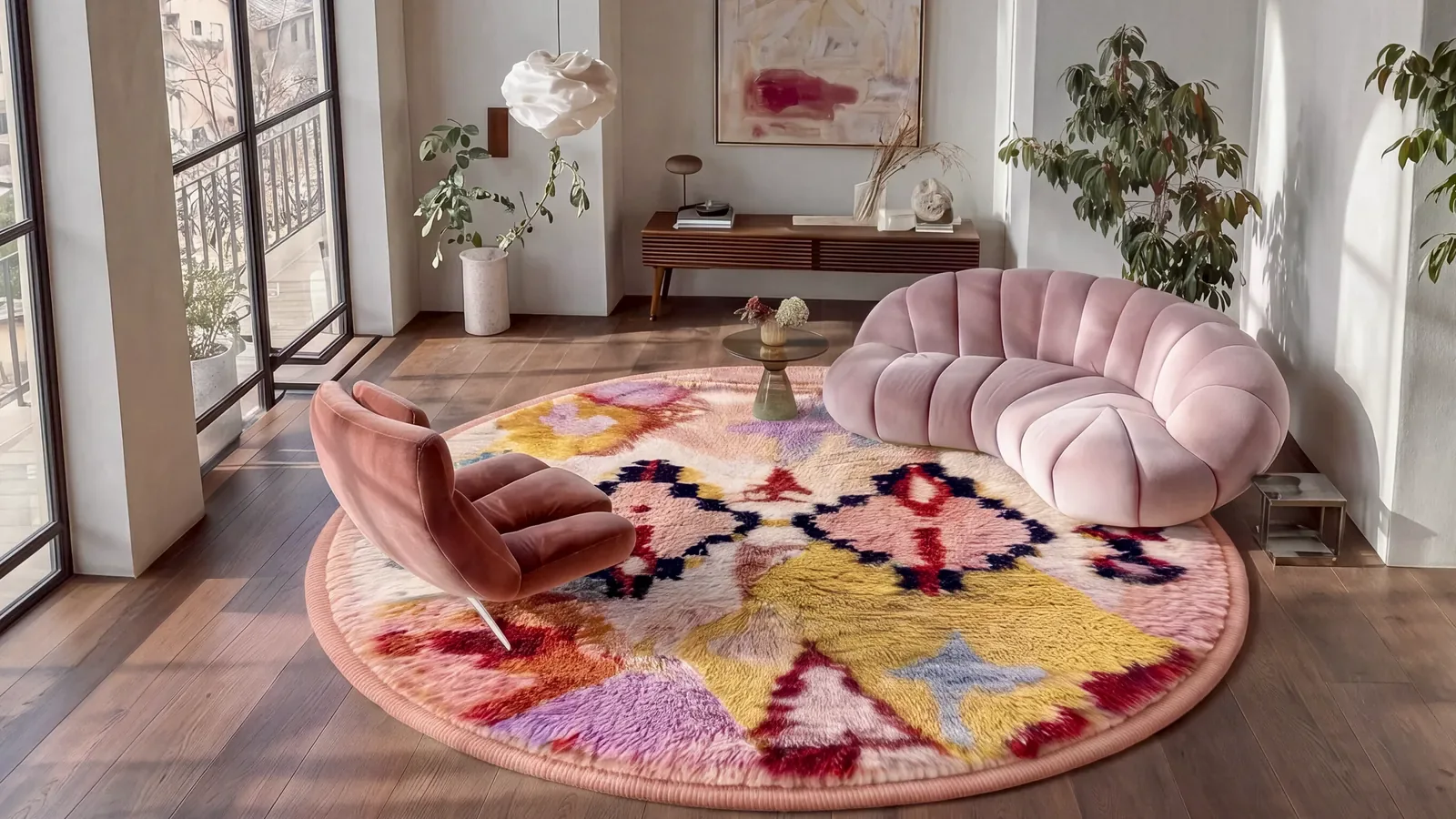
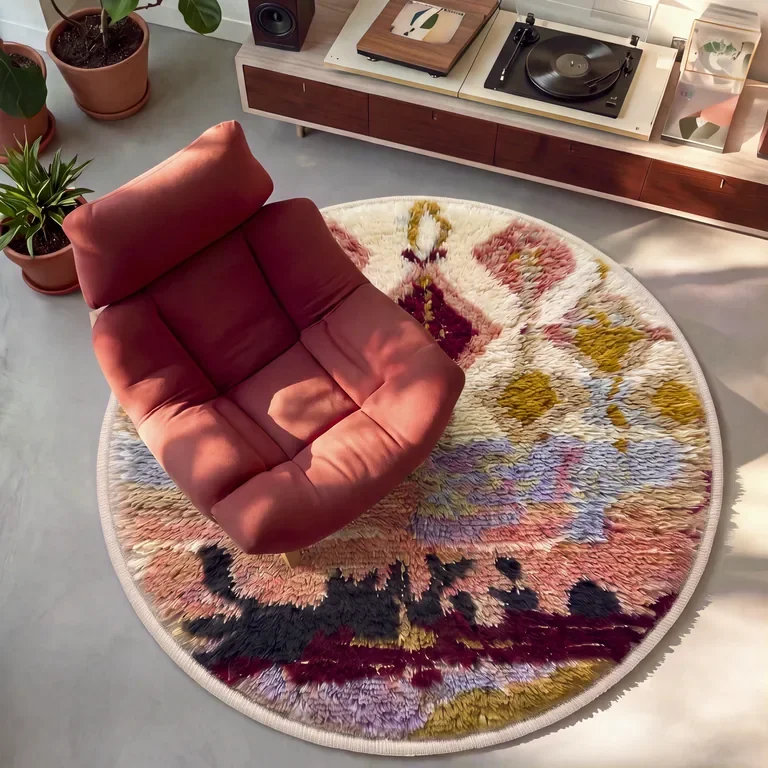
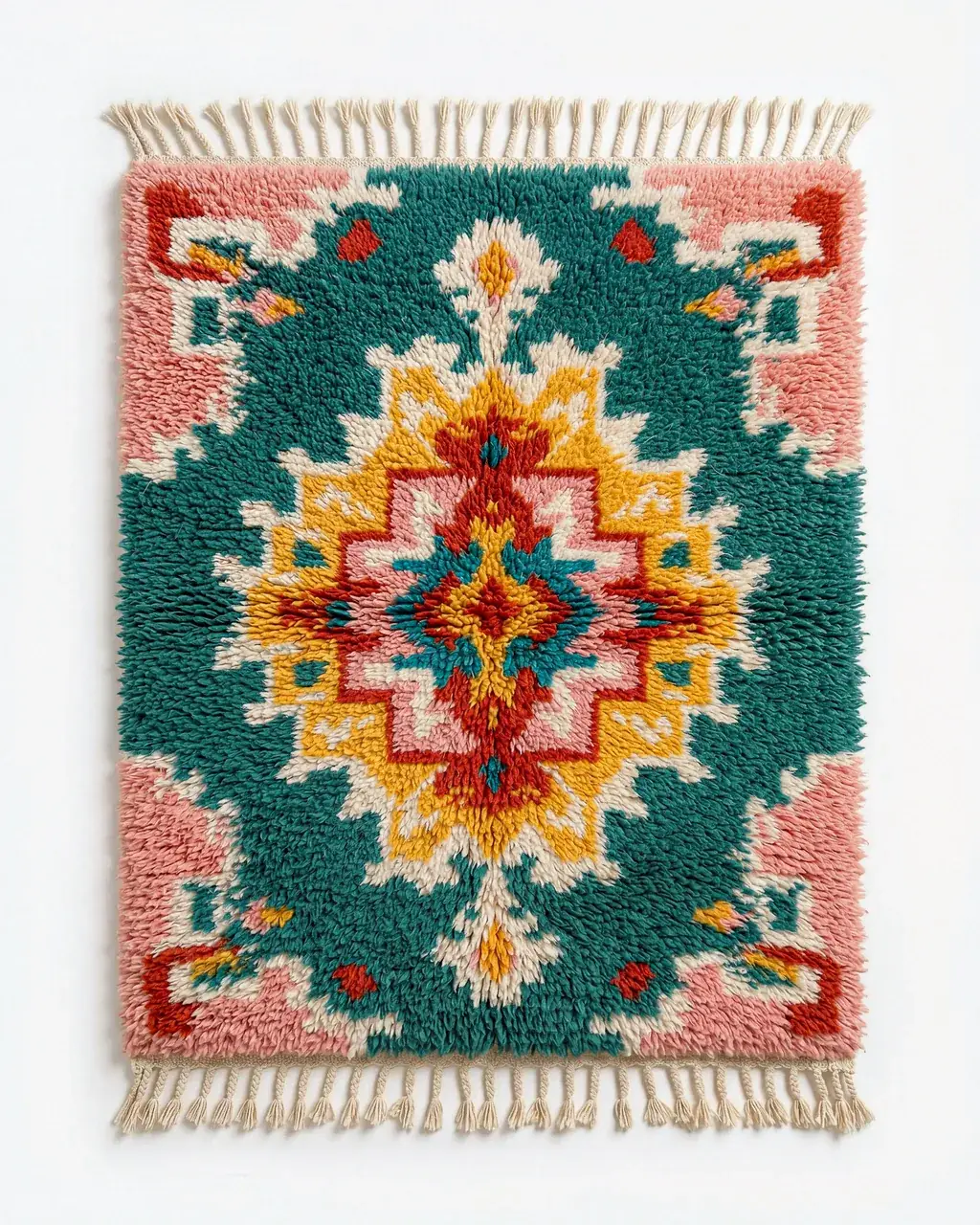
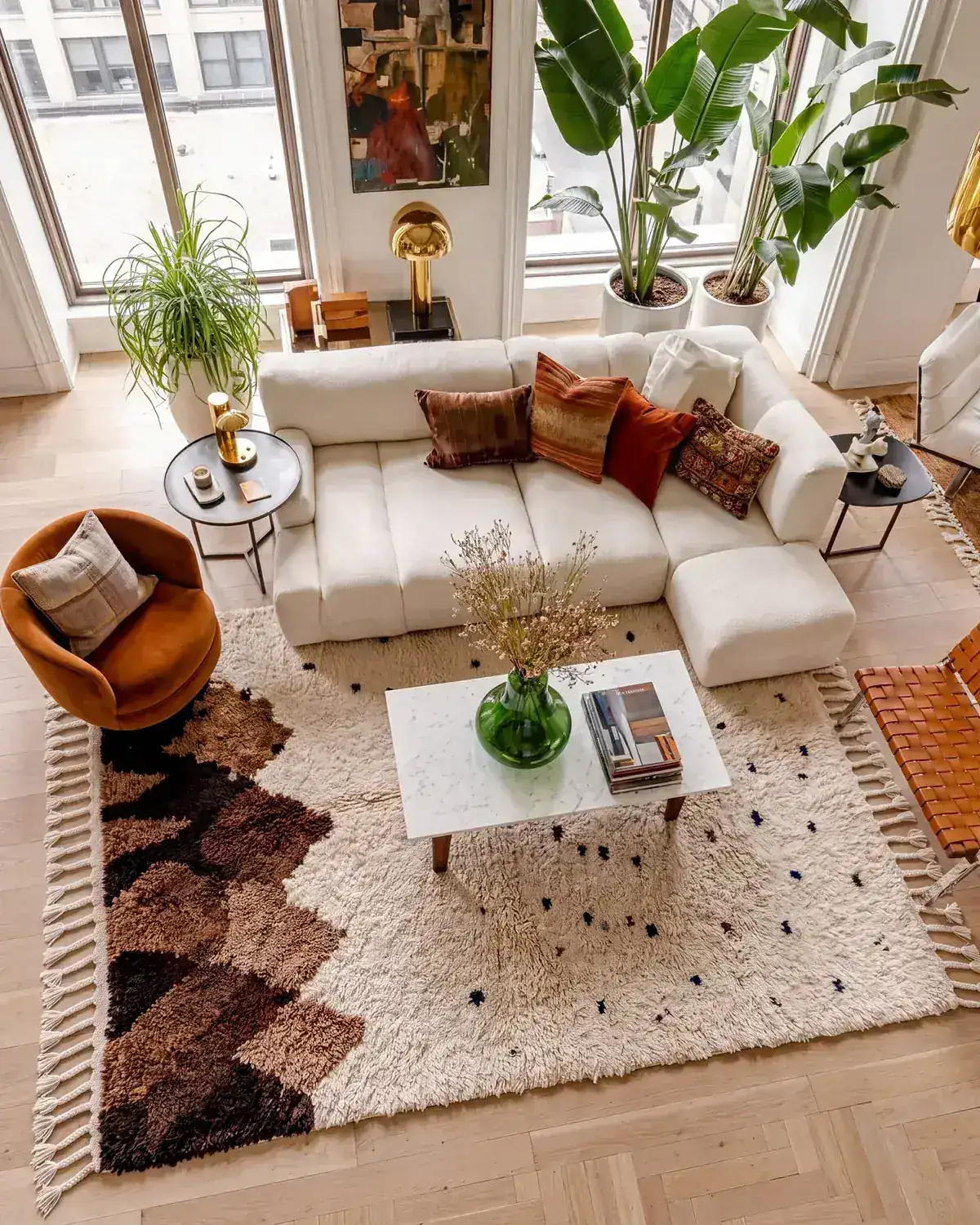
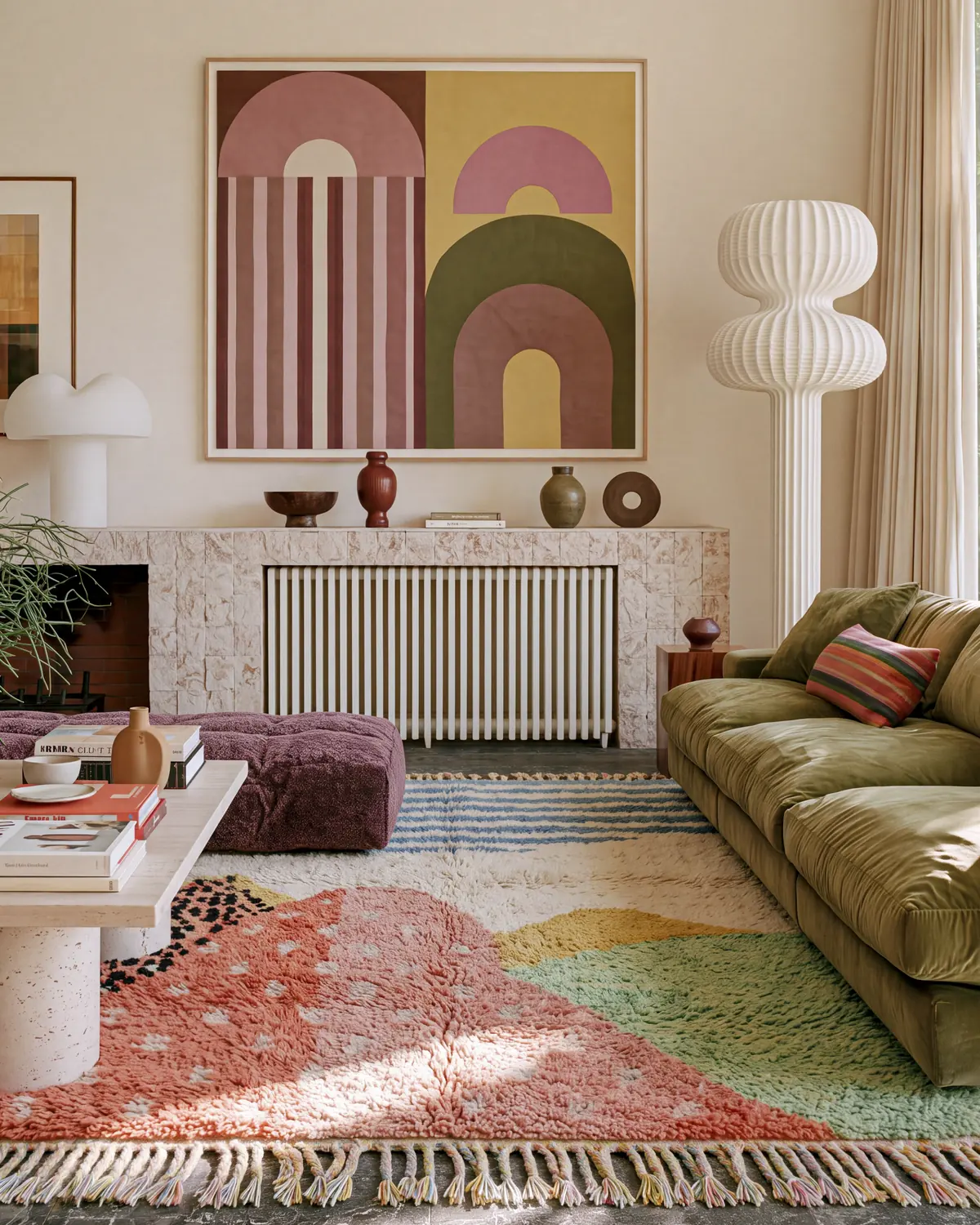
Nouar is the kind of rug that belongs on top: loose painterly diamonds in mustard, rust, lavender and pink on an ivory ground, with two peach-pink diamonds outlined in black and mustard dots across the center. On its own, as in the room above, it sits on bare wood. Laid over a larger jute base, it would keep its color and gain a frame. Nouar lives in the Bloom collection, where color leads; for pattern built from tiles and florals, see Mozaik.
Good pairings for layered rugs
| Base | Top | Why it works |
|---|---|---|
| Natural jute or sisal | A colorful wool rug, such as a Boujaad | Rough and flat under soft and bright; the jute's tan warms every color |
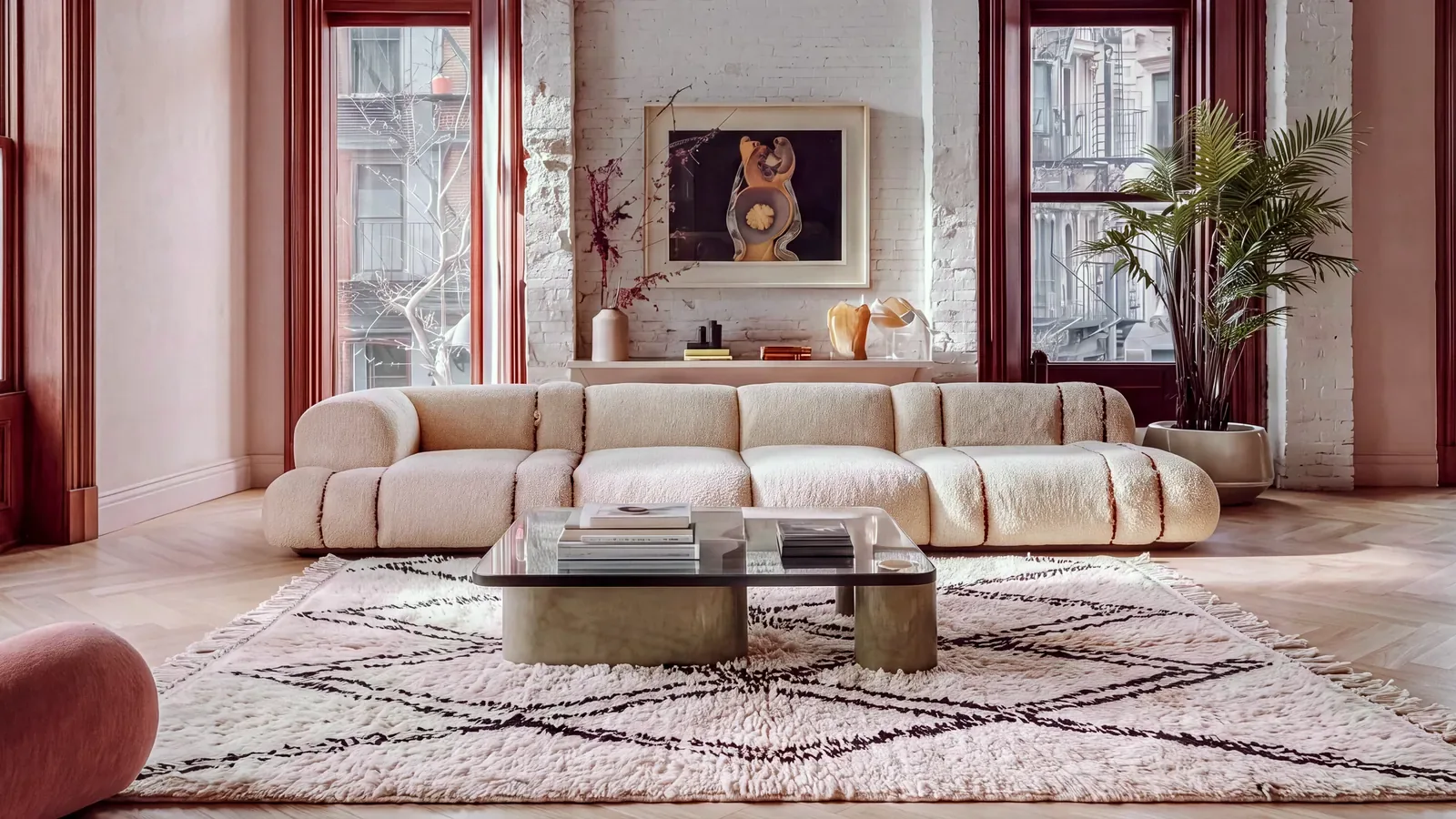
| Ivory or oatmeal flatweave | A graphic black and ivory Beni Ourain rug | One undertone, two textures; the pattern leads |
| A plain, short-pile wool rug | A round rug, off center, in a reading corner | The round shape does the contrast, so the colors can stay close |
| Jute in a bedroom, under the bed | A smaller patterned rug at the foot of the bed | The base carries the bed; the top rug is where your feet land |
| Striped flatweave | A solid, deep-colored wool rug | Pattern below, calm above: the reverse of the usual order |
How to coordinate two rugs in one room
Coordinate two layered rugs by letting one lead and giving them one thing in common. The lead is the rug with the pattern or the color; the other stays plain or natural. The thing in common is a color or an undertone: a warm jute under a rug with rust and ochre, a cool gray flatweave under a rug with blue and ivory. Change the texture rather than the palette. Two rugs with busy patterns at the same scale fight, and two rugs in the same texture merge into one. More on reading a rug's palette: decorating around a colorful rug.
Layering a round rug over a rectangle
A round rug over a rectangular base is the easiest layered look to get right, because the corners of the base always show. Center it under a round coffee table, or set it off center in a reading corner with a chair on it. A 6 ft round on an 8x10 ft base leaves 12 in of base at the sides and 24 in at the ends; a 5 ft round leaves 18 in at the sides. More on when a round rug is the right shape: when to use a round rug.
Can you put a rug on carpet?
You can put a rug on carpet, and it often looks deliberate: a rug defines a seating area in a carpeted living room, brings pattern and color to plain wall-to-wall carpet, protects carpet in a rented home, or covers a mark you cannot get out. It works when three things are true:
- The carpet is low pile or loop. A short, tight carpet, including loop-pile Berber carpet, is a firm floor for a rug. Plush and shag carpet are not: a rug sinks, wrinkles and never lies flat. What Berber carpet is, and how it differs from a Berber rug: Berber carpet or Berber rug.
- The rug is short pile. 0.4 in is the best choice on carpet, medium 0.8 in the most. A thick rug on carpet feels spongy and trips feet at the edge.
- The rug contrasts with the carpet. Pattern on a plain carpet, or a clearly different color and texture. A beige rug on beige carpet reads as a mistake; a patterned wool rug on the same carpet reads as a choice.
Does a rug on carpet look bad?
A rug on carpet looks bad in three situations: when it is too small, floating in the middle of the room with no furniture on it; when it matches the carpet so closely it looks like a stain; and when a patterned rug lies on a patterned carpet. Size it like any living room rug, with at least the front legs of the seating on it, and it looks planned.
How to keep a rug from moving on carpet
Rugs creep on carpet because every step pushes the rug a fraction along the carpet's pile, and the pushes add up. Two fixes, in order of how much they help:
- Put furniture on it. The front legs of the sofa and chairs, or the bed, hold a rug in place better than anything else. This is one more reason to buy the rug large enough.
- Skip the tape. Double-sided carpet tape leaves residue on the carpet and on the back of the rug.
Vacuum the carpet under the rug when you rotate the rug, twice a year; care for the rug itself is in the care guide.
Is layering rugs still in style?
Layering rugs is still in style, and designers expect it to stay. In Veranda's April 2026 round-up of rug trends, designer Amy Aidinis Hirsch called layering one of the most underused tools, and Homes & Gardens put layering rugs on rugs on its list of 2026 rug trends in January. Our view is simpler: layering lasts because it is a solution before it is a look. It makes a small rug work in a big room, gets you a large rug for less, and adds texture to a room that has none.
Layering mistakes to avoid
- Two thick rugs. Pile on pile rocks and trips. Keep the base flat.
- Two sizes too close. A band of 3 in looks like an accident. Aim for 12 to 18 in.
- A base that is too small. The base is the rug that has to fit the furniture. A small base with a smaller rug on top makes two small rugs.
- Two loud patterns. One leads. If both rugs are patterned, make the base a fine, low-contrast pattern such as a narrow stripe.
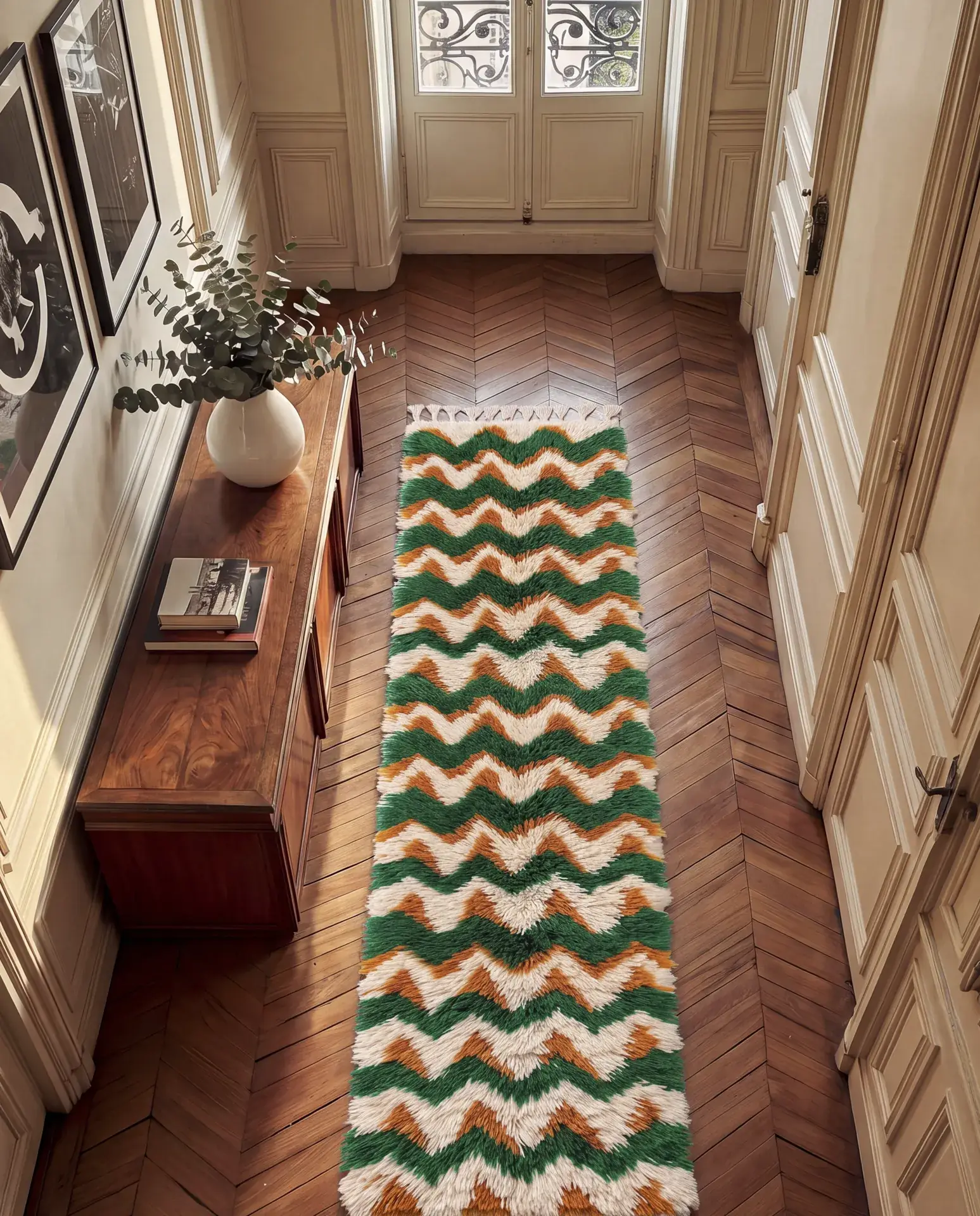
- Tassels in a walkway. Tassels are about 4 in long; on a top rug that sits across a path, choose a rug without them.
Choosing a top rug
A top rug for layering is usually a 5x8 ft, a 6x9 ft or a round, in short or medium pile, with the pattern or the color the room is missing.
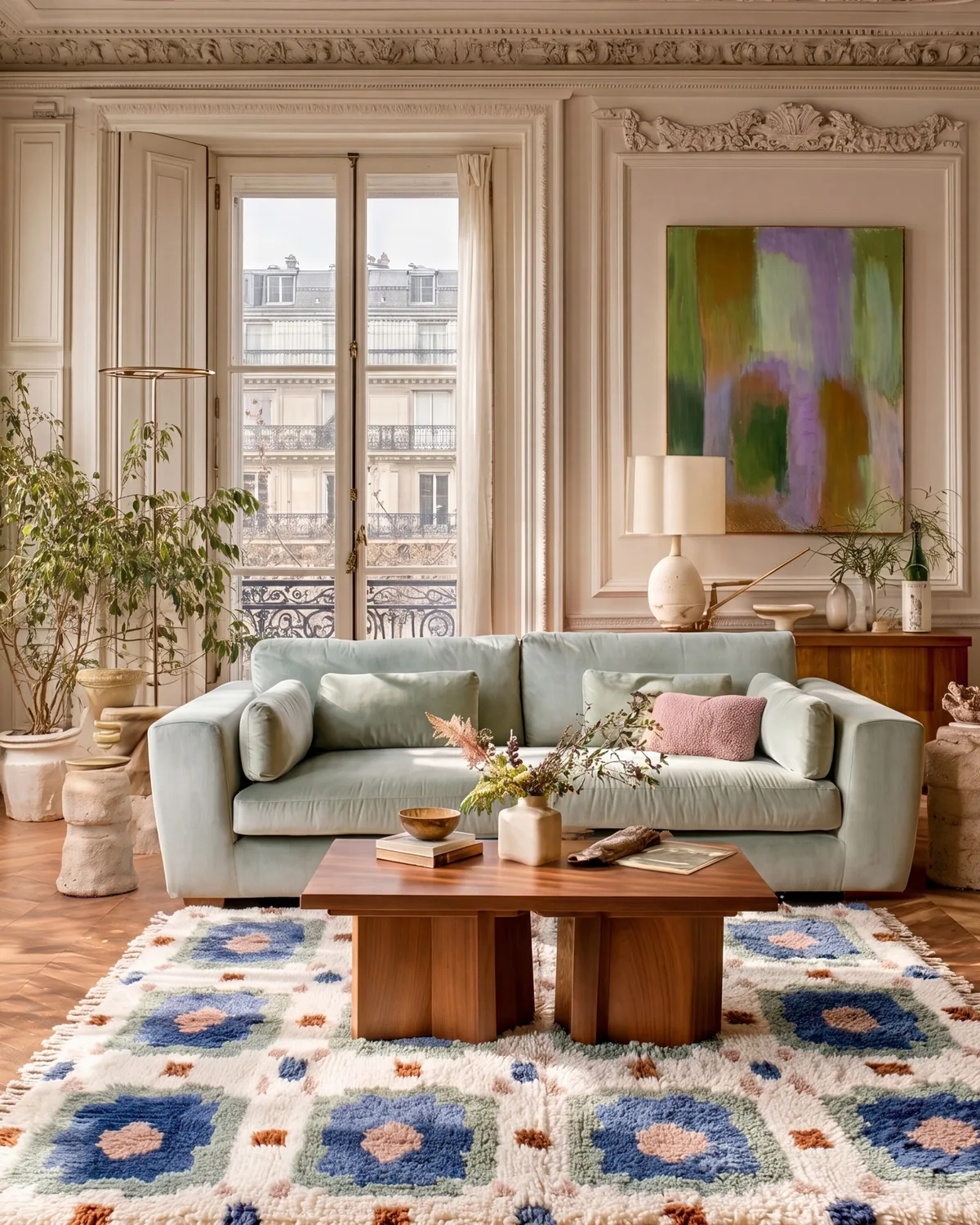
Three designs that layer well, in three different ways: Nouar, color on ivory, above; Lazward, cobalt and ochre blossoms on a blush and ivory checker from Mozaik; and Darja as a round, a bold shape for a corner. All the rounds are in round rugs.
Unsure how a top rug will sit on your jute or your carpet? Send a photo of the floor. Next: living room rug size, then bedroom rugs.