


Living rooms
Rug in Front of a Fireplace: Size, Distance and Wool
The hearth sets the distance; the seating sets the size.
By Zarbish · · 9 min read
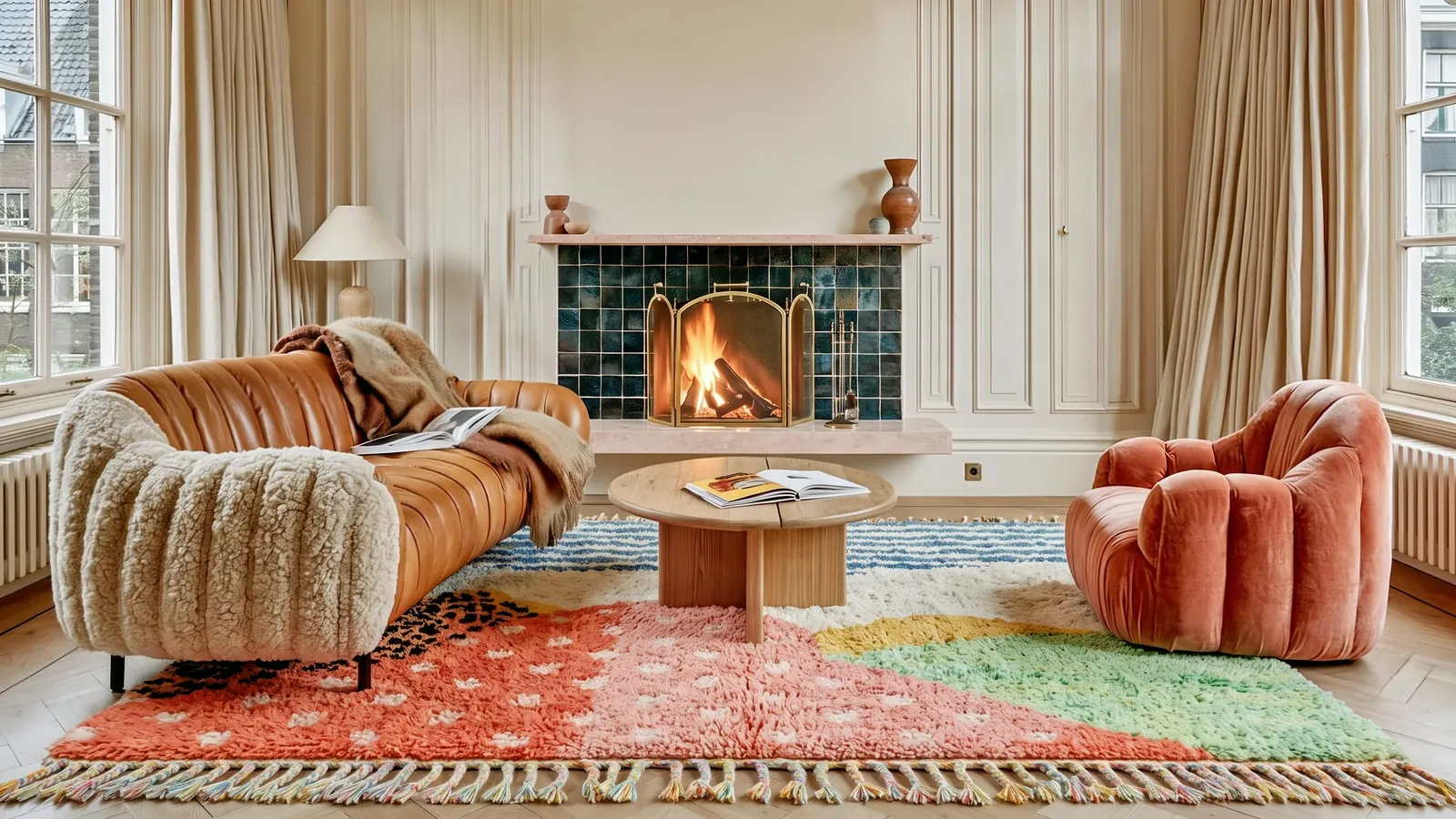
A rug in front of a fireplace sits beyond the hearth, never on it, with a lane of 4 to 6 in of bare floor between the stone and the rug's front edge. Its size comes from the seating that faces the fire, not from the fireplace: front legs of the sofa and chairs on the rug, which for most living room rugs means 8x10 ft or 9x12 ft. In wool, which chars rather than melts if a spark reaches it.
Key takeaways
- A rug sits beyond the hearth, never on it: the US residential code gives the hearth at least 16 in in front of the opening and 8 in each side, more for a large fireplace.
- Leave a lane of 4 to 6 in of bare floor between the hearth and the rug's front edge, so the rug never rides up onto the stone.
- Size the rug to the seating that faces the fire, not to the fireplace: front legs of the sofa and chairs on the rug, usually 8x10 ft or 9x12 ft.
- Wool is hard to ignite, chars instead of melting and puts itself out when the flame is gone, which is why it is the classic fireside fiber; it is still not a hearth mat.
- Ash and soot show least on a mid-tone pattern; the pile for a room people cross with logs is short or medium.
How far does a rug need to be from a fireplace?
A rug needs to be clear of the hearth extension, the band of stone, brick or tile on the floor in front of the opening. In the United States the residential code sets that band at a minimum of 16 in in front of the fireplace opening and 8 in beyond each side; when the opening is 6 sq ft (0.56 m²) or larger, it grows to 20 in in front and 12 in each side. The exact text is section R1001.10 of the International Residential Code. The hearth is the fireplace's own answer to the question: a surface that cannot burn, sized so a rolling ember lands on it.
The rug starts after that band. Leave a lane of bare floor, 4 to 6 in, between the stone and the rug's edge: the rug never rides up onto the hearth, the vacuum can turn in it, and the line between stone and wool reads as intended rather than as a rug that did not quite fit. On a raised hearth the same lane keeps the edge from being kicked every time someone tends the fire.
What kind of fire you have changes how much that matters:
- An open log fire throws sparks. The hearth takes them, a fire screen stops the rest, and the usual fire-safety advice holds: nothing that can burn within 3 ft of the opening while the fire is lit. Furniture and throws, not just the rug.
- A fireplace with glass doors or a gas insert throws nothing. The hearth is still required, and the rug still sits beyond it, but the risk to the rug is heat and dryness, not embers.
- A wood stove has its own clearances from the manufacturer, usually measured from the stove body to anything that can burn, and they are larger than a fireplace's. Follow the plate on the stove.
What goes on the floor in front of a fireplace?
The floor in front of a fireplace holds three things in order: the hearth, sometimes a hearth mat, then the rug. The hearth is built in. A hearth mat is a small fire-resistant rectangle or half-round, fiberglass or dense wool felt, laid on the hearth's front edge or just past it to catch the ember that bounces; it is a safety item for people who burn logs with the screen open, and it is what the shops mean by a fireplace rug. The living room rug is the third thing, and it starts where the seating starts.
Most rooms with glass doors or a gas fire skip the mat. A room with an open fire and small children or a dog that sleeps by the hearth is the room that wants one. If two rugs both pass the hearth rules, weighing two rugs against the room picks the one that holds the seating.
What size rug for a fireplace seating area?
The rug is sized to the furniture that faces the fire, not to the fireplace. Put the front legs of the sofa and the chairs on the rug, center the rug on the chimney breast, and set its front edge parallel to the hearth with the lane in front of it. A rug that only fills the space between the sofa and the fire reads as a mat; a rug that runs under the whole seating group makes the fire the end of the room rather than a thing in the corner.
| Seating that faces the fire | Rug that holds it | Where the front edge goes |
|---|---|---|
| Sofa and two chairs, coffee table between | 8x10 ft | 4 to 6 in past the hearth, the sofa's front legs on the rug |
| Sectional or two sofas facing each other | 9x12 ft | the long side parallel to the hearth, every front leg on |
| Two chairs and a side table, nothing else | 6 ft or 7 ft round | centered on the opening, the chairs' front legs on the rug |
| A small room, loveseat and one chair | 6x9 ft | centered on the hearth; the loveseat may sit fully on it |
The living room sizes behind this table, the 18 in to the walls and the front-legs rule, are worked through in is my rug too small, and the chart is in the size guide. The round-rug version, two chairs turned to the fire with a round between them, is the layout where a round rug earns its place.
To check a size before you order, use the hearth as your ruler:
- Measure the hearth's depth from the fireplace wall to its front edge, and add 4 to 6 in. That is where the rug begins.
- Measure from that line to the back legs of the sofa facing the fire, and add 12 in or more so the sofa is not sitting on the rug's edge. That is the rug's depth.
- Measure the width of the seating group, chair to chair, and add 6 to 12 in each side. That is the rug's width.
- Tape the rectangle on the floor and live with it through one evening by the fire. Chairs get pulled toward the fire in winter; the tape shows whether they leave the rug.
- Round up to the nearest standard size, or note the exact rectangle.
What kind of rug to put in front of a fireplace?
Put a wool rug with short or medium pile in front of a fireplace. Wool because of what it does when a spark lands on it, covered below; a pile of 0.4 in or 0.8 in because the strip between sofa and hearth is crossed every time someone adds a log, and a shorter pile takes that traffic and lets ash lift out with the vacuum. A shag by the fire looks the part in a photograph and holds ash in a room that is used; the full trade-off is in low pile vs high pile rugs.
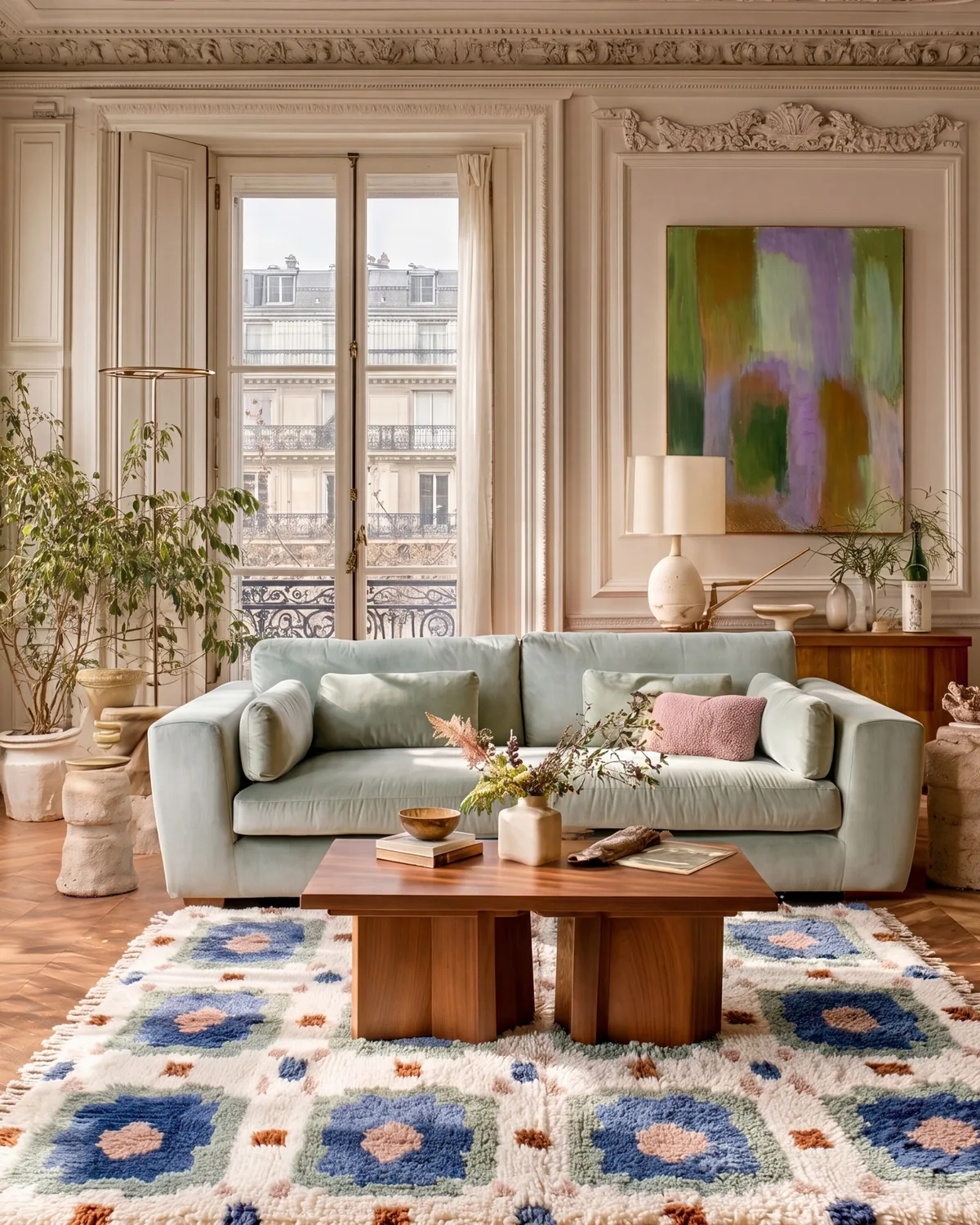
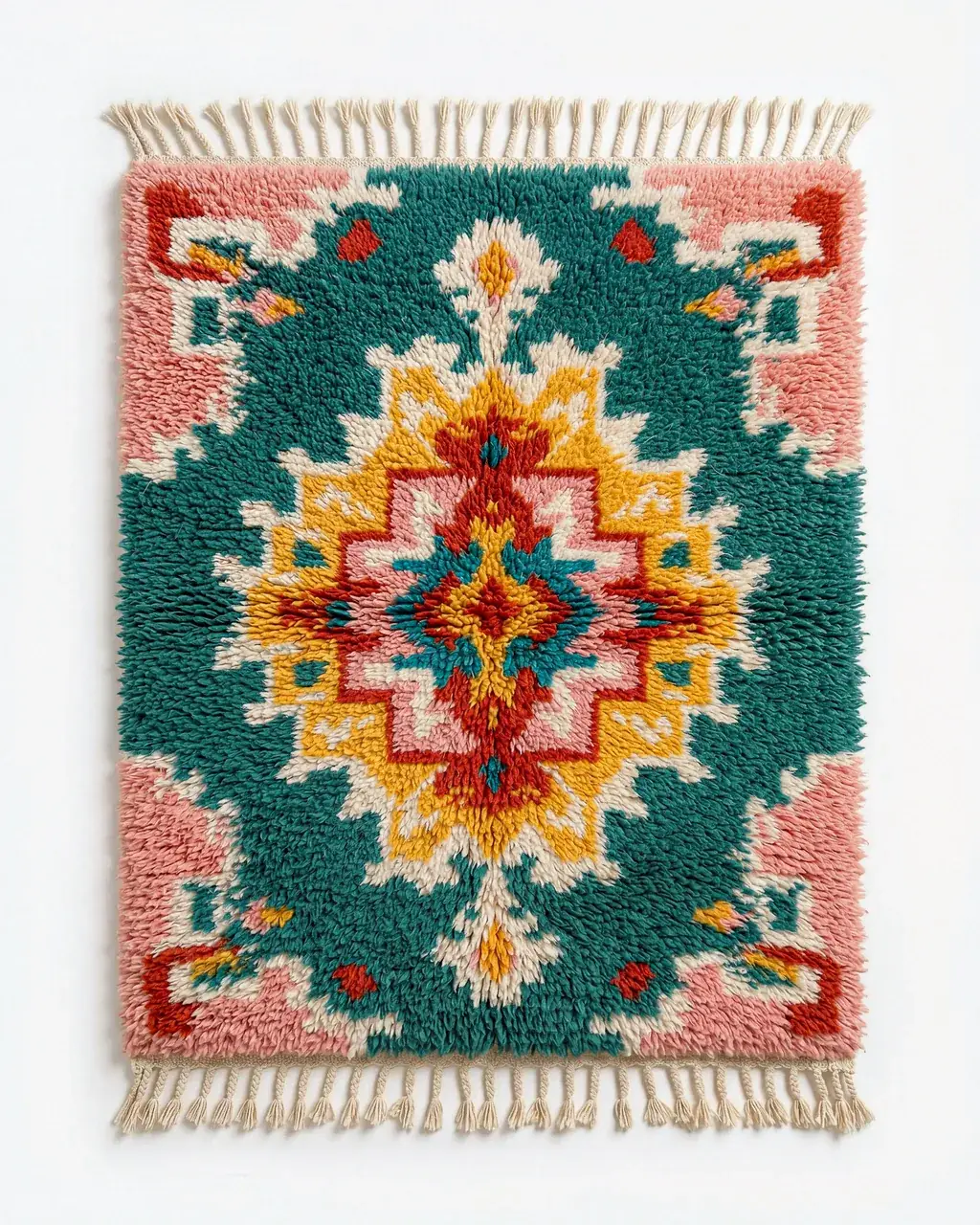
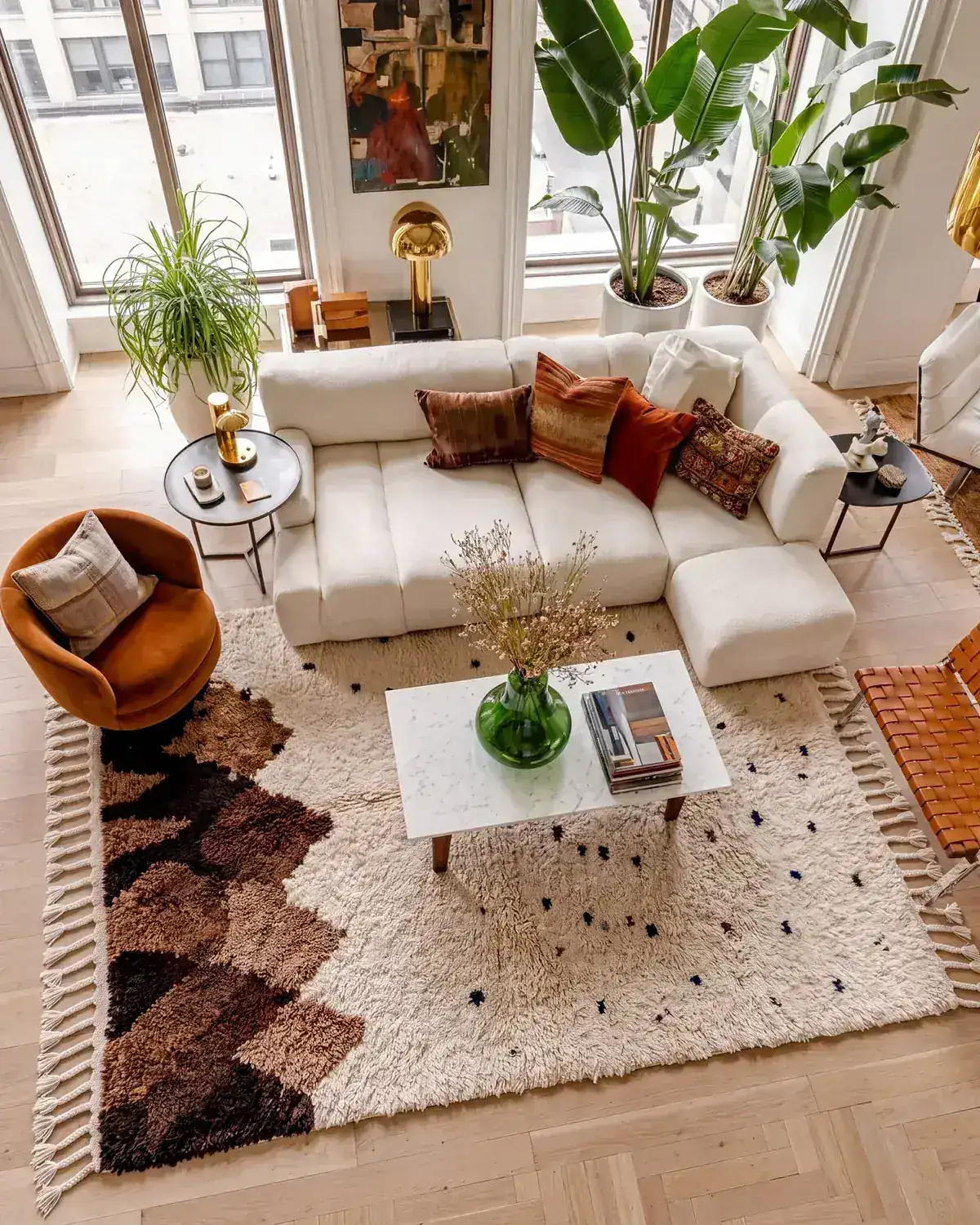
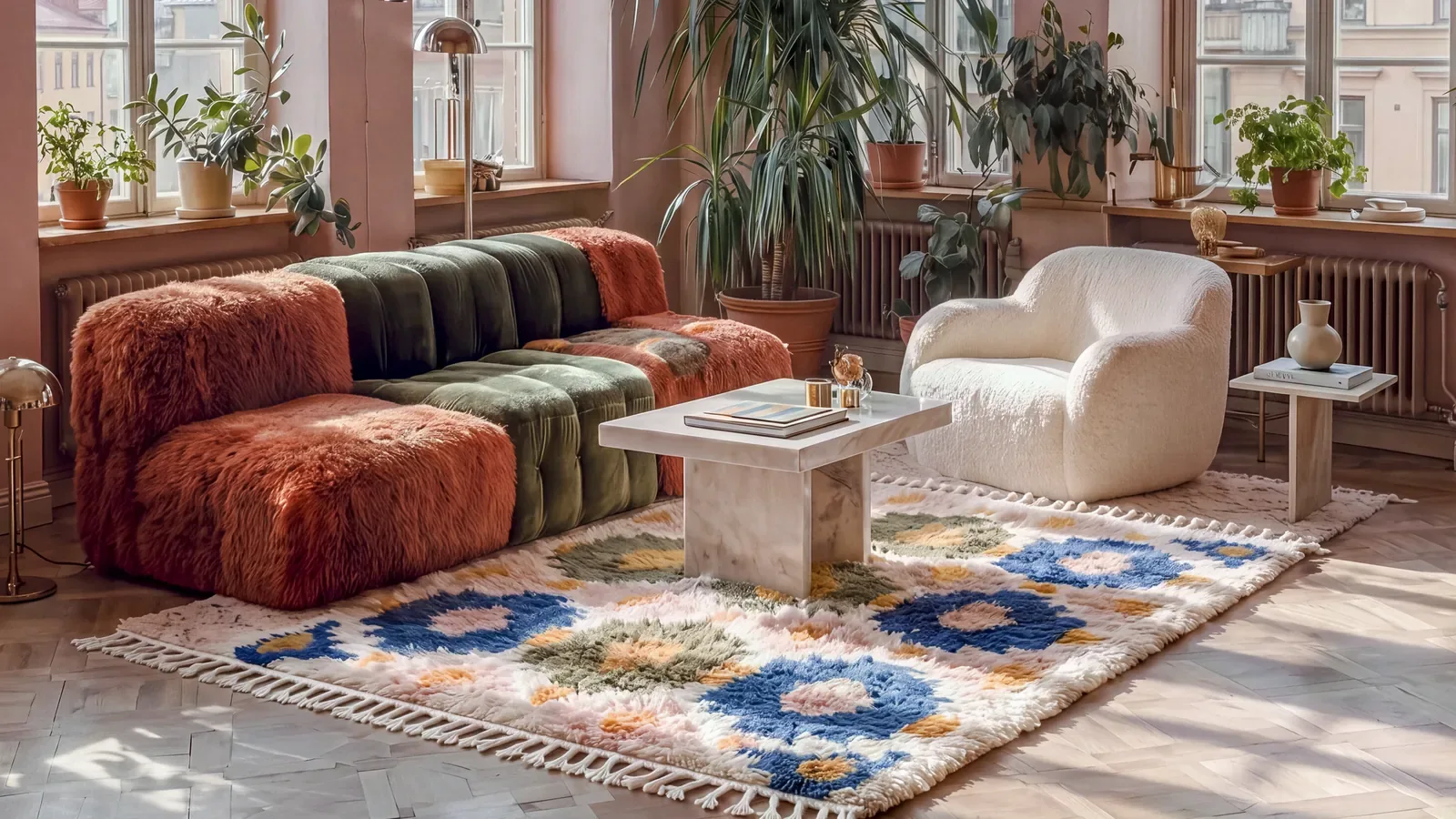
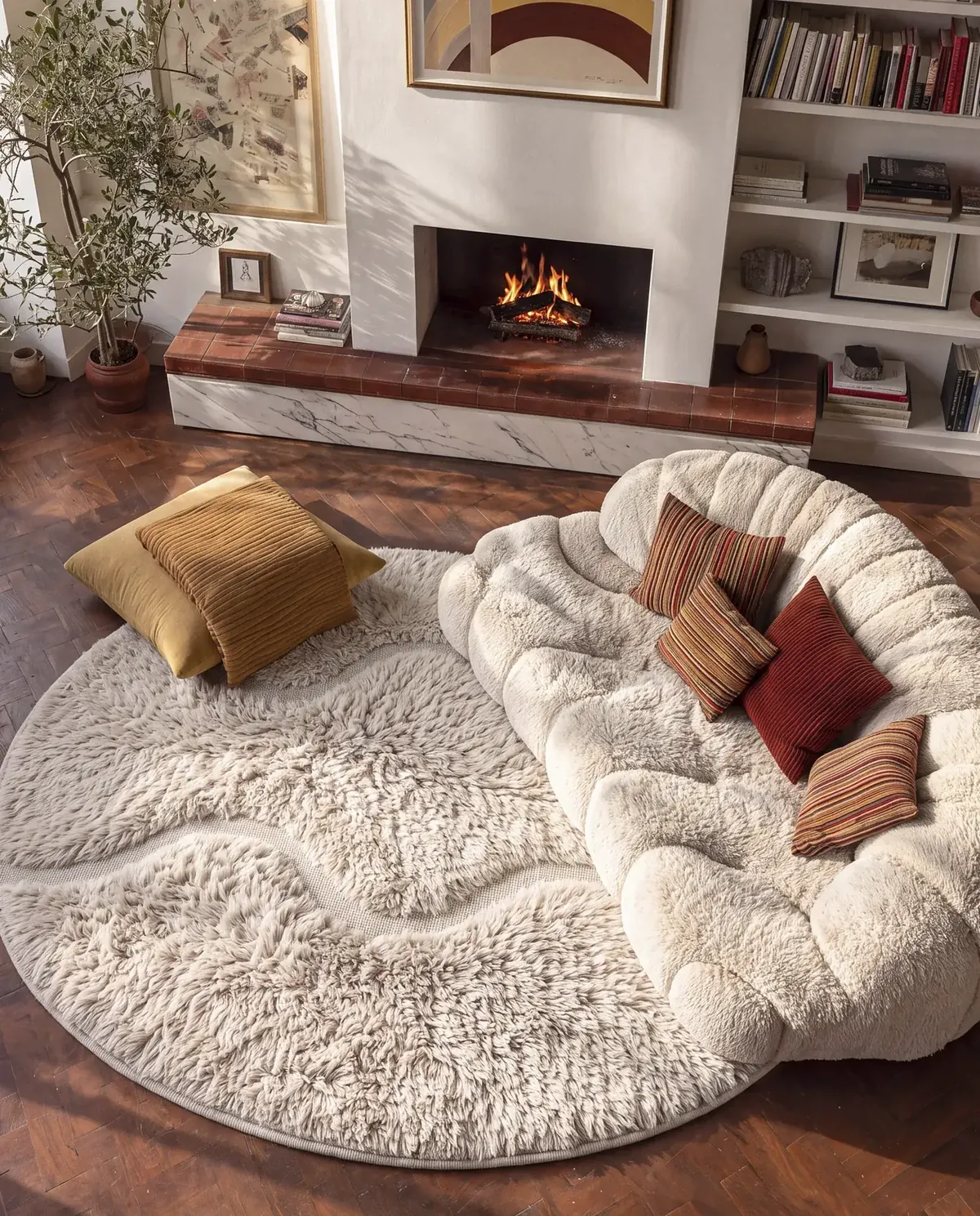
Color is about ash. A fireside rug gets a fine grey dust every winter, and it shows most on a pure ivory field and on a flat dark one. A mid-tone pattern hides it between vacuums. Undyed ivory still works beside a fire when the rug has relief over it, as Draa does below; a plain cream shag in the firing line is the one to avoid.
Synthetic fibers are the ones to keep away from an open fire. Polypropylene and polyester melt at a few hundred degrees and a spark leaves a hard, shiny crater that does not vacuum out. Jute and sisal burn readily. Cotton flatweaves burn too, though they are easy to move.
Is a wool rug safe near a fireplace?
Wool is the safest common rug fiber near a fire, for reasons that are chemistry rather than marketing. Wool needs a far higher temperature to ignite than cotton or synthetics, it holds moisture inside the fiber, and its high nitrogen content means it chars and forms an insulating crust rather than melting or flaming up. Take the flame away and wool puts itself out. The Woolmark Company's fact sheet on wool and fire sets out the numbers, and it is why wool is specified for aircraft seats and hotel carpets.
What that means by your fire: an ember that lands on a wool rug singes a small dark spot and goes out, where on a synthetic it melts a hole. It does not mean a wool rug is a hearth mat or that a rug can sit on the hearth. The screen, the hearth and the manufacturer's clearances come first; the fiber is the backup. Trim a singed spot with small scissors and it disappears into the pile.
Our rugs are 100% wool through, the pile and the foundation threads it is knotted around, so there is no synthetic backing under the wool to behave differently. A wool rug's other strengths and its few weak points are set out in wool rug pros and cons.
Rug in front of a fireplace: three layouts
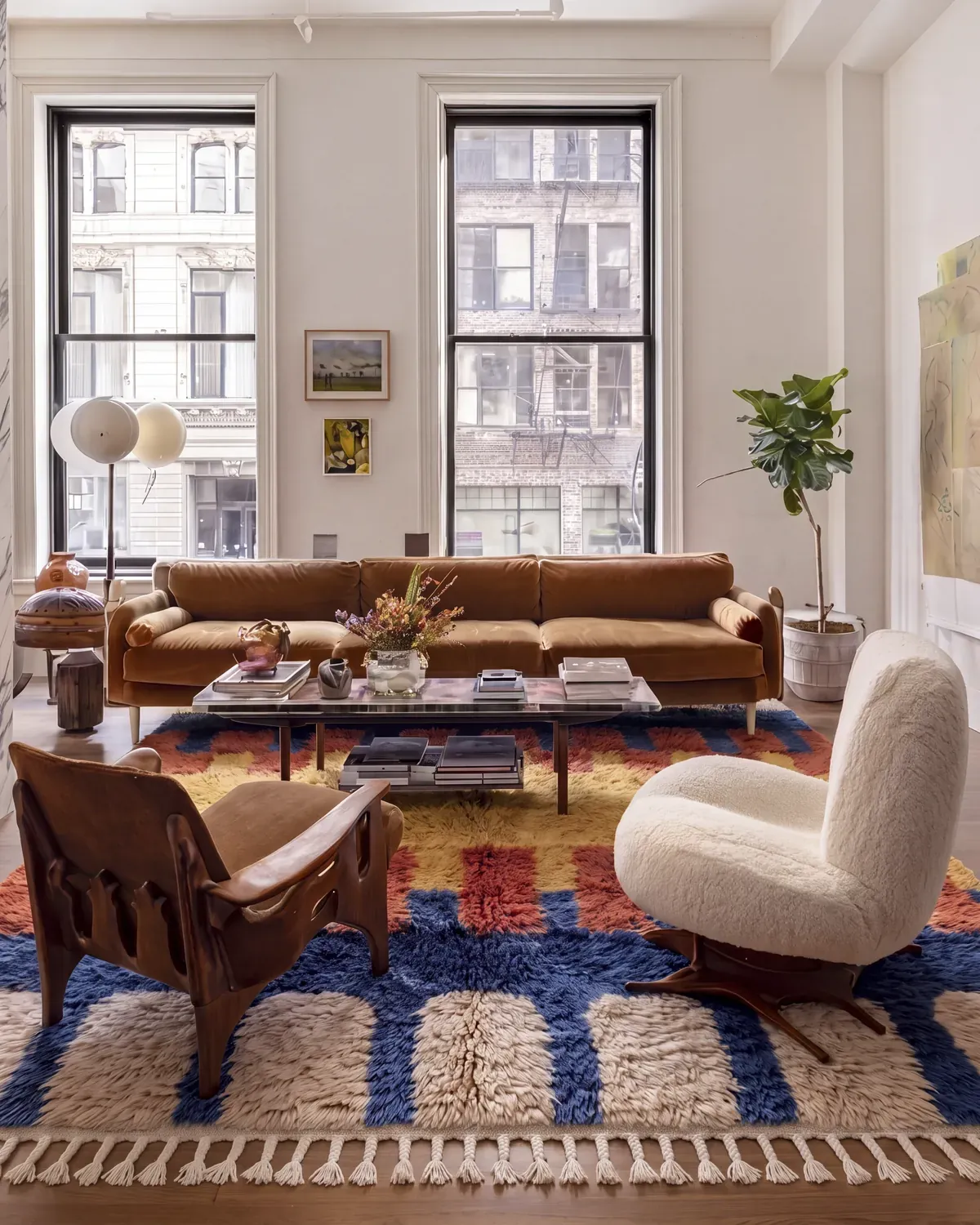
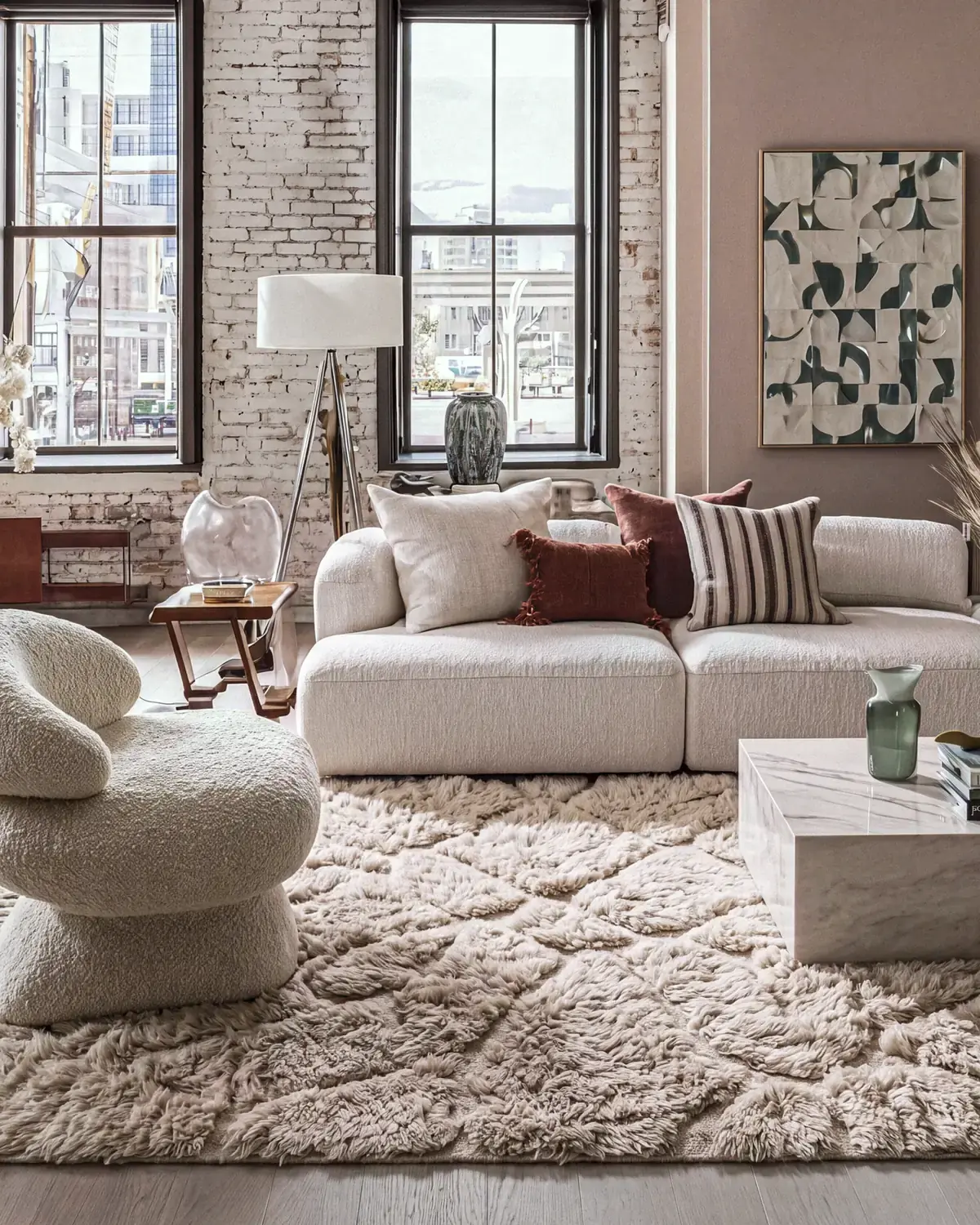
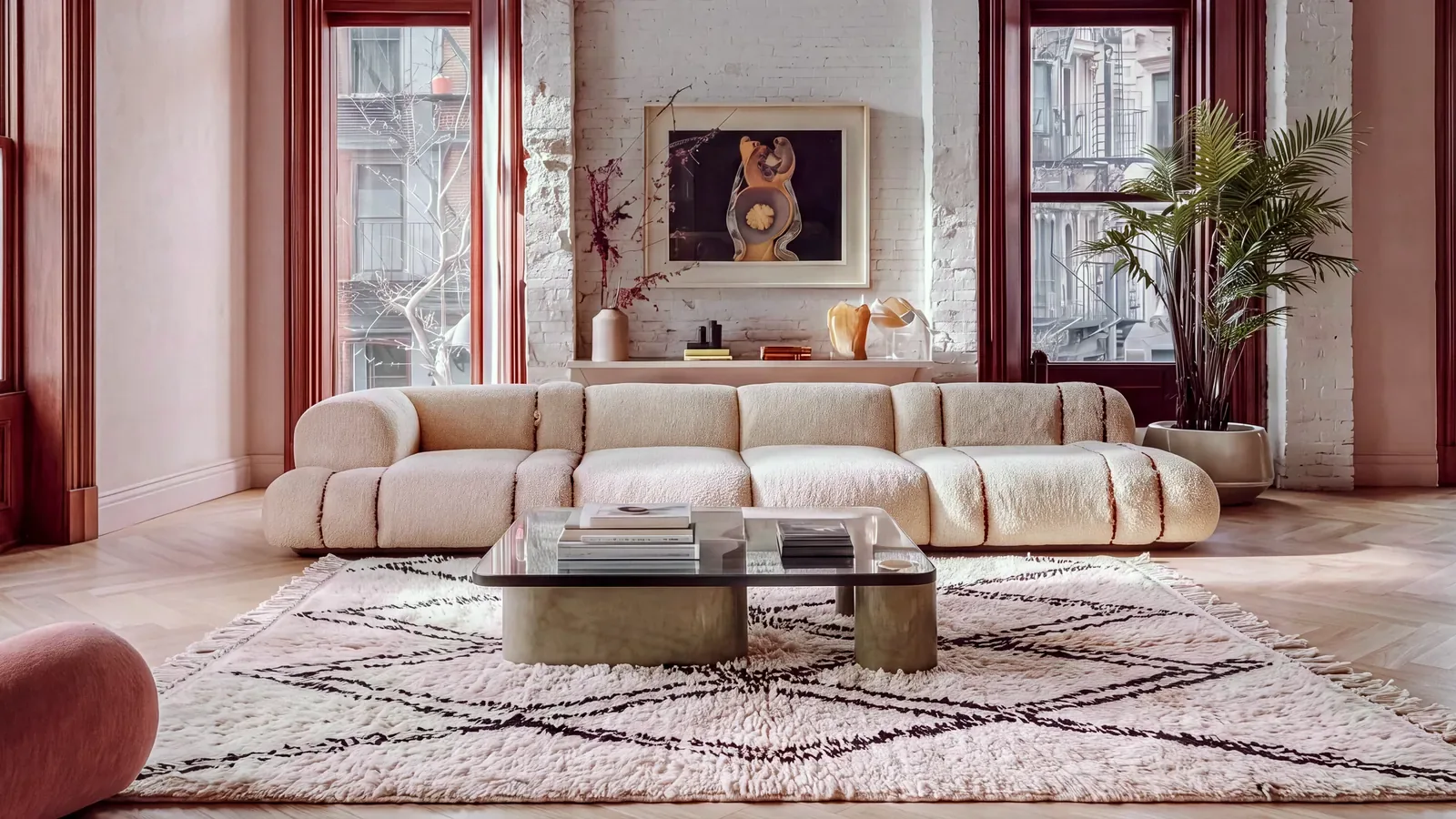
Centered on the chimney breast. The sofa faces the fire across a coffee table, a chair each side, and the rug is set on the center line of the fireplace with its front edge parallel to the hearth. Tafsut, at the top of this page, does this with the sofa's front legs on the rug and the armchair fully on it, so the whole group reads as one. Most living rooms with a fireplace on the long wall want exactly this.
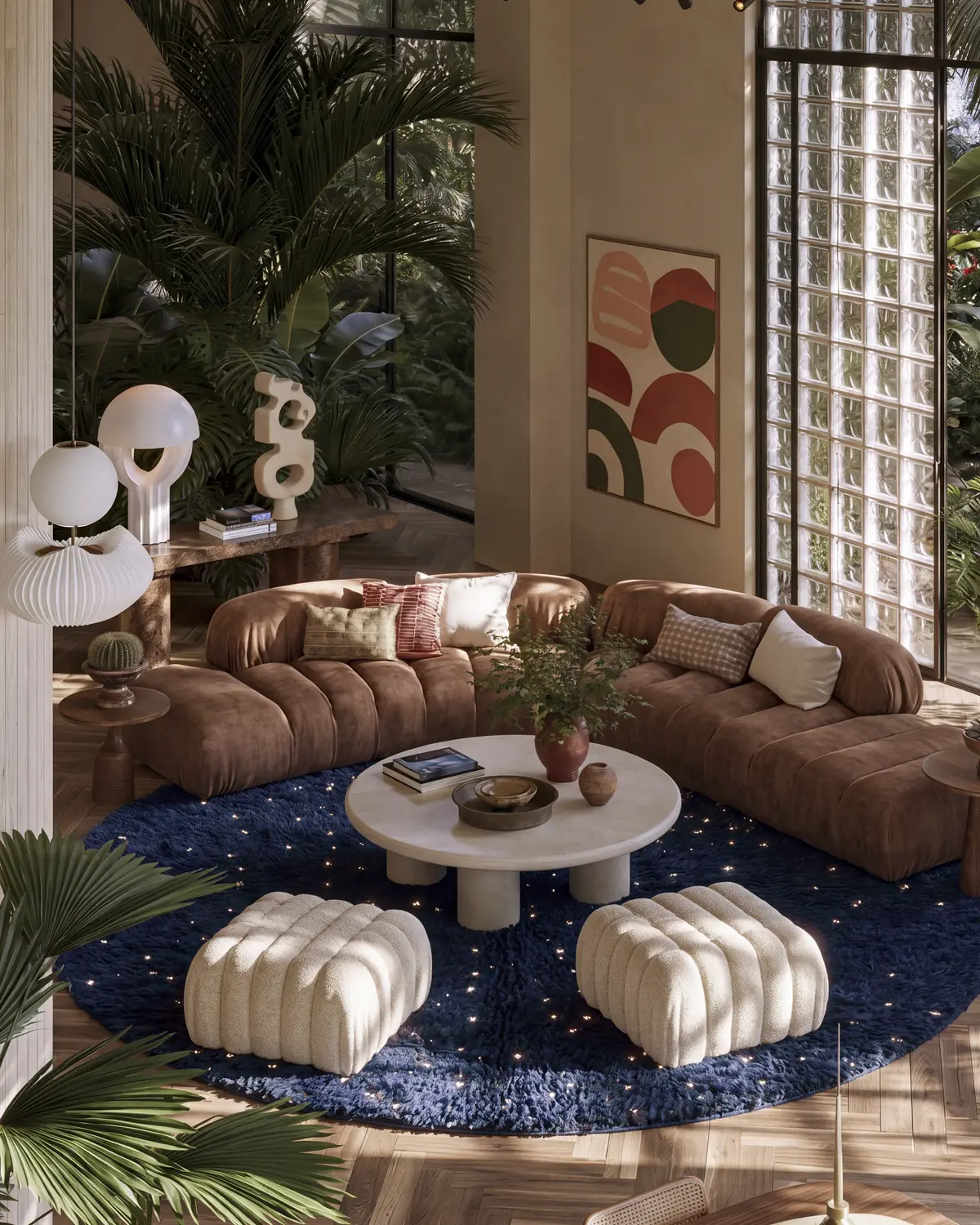
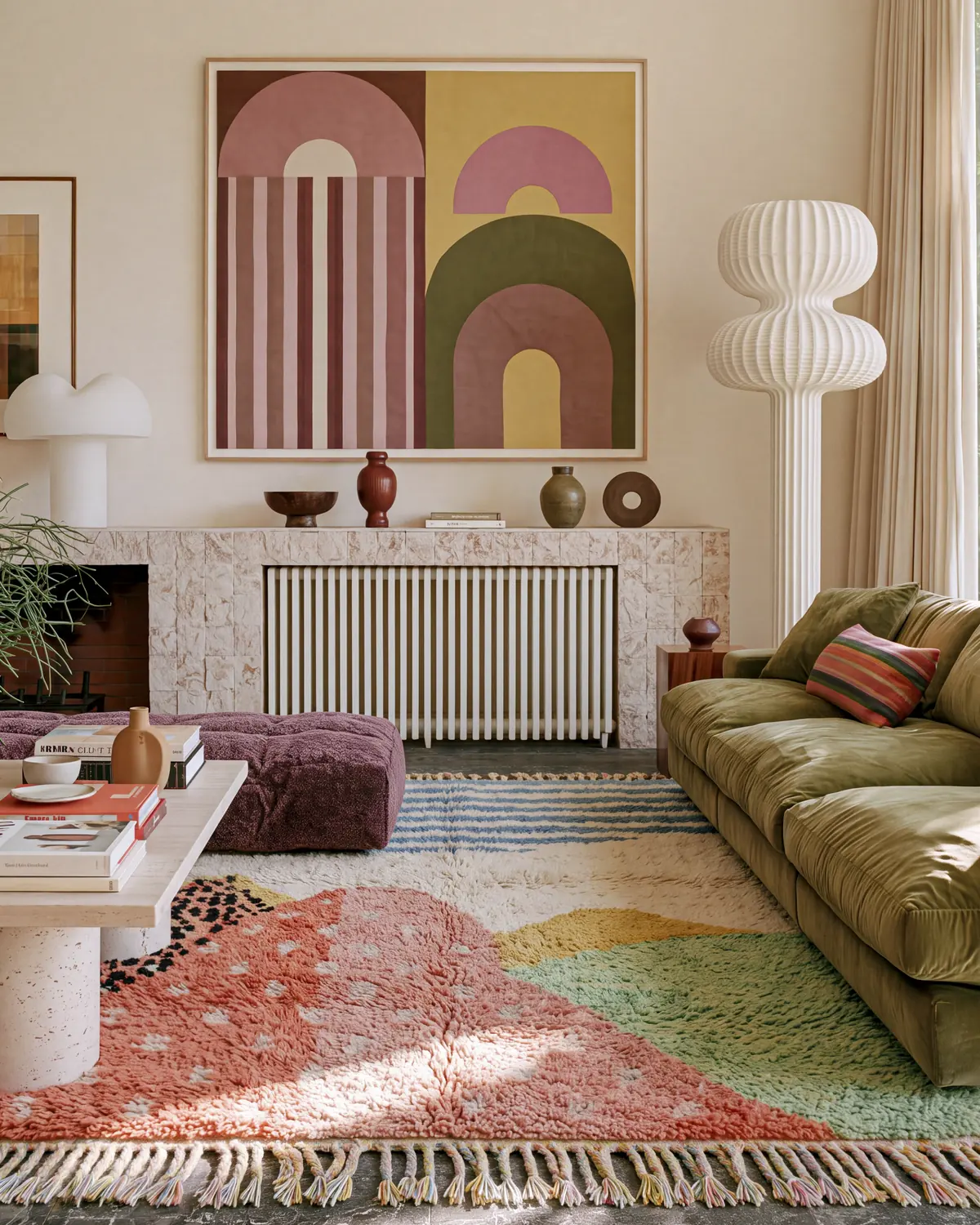
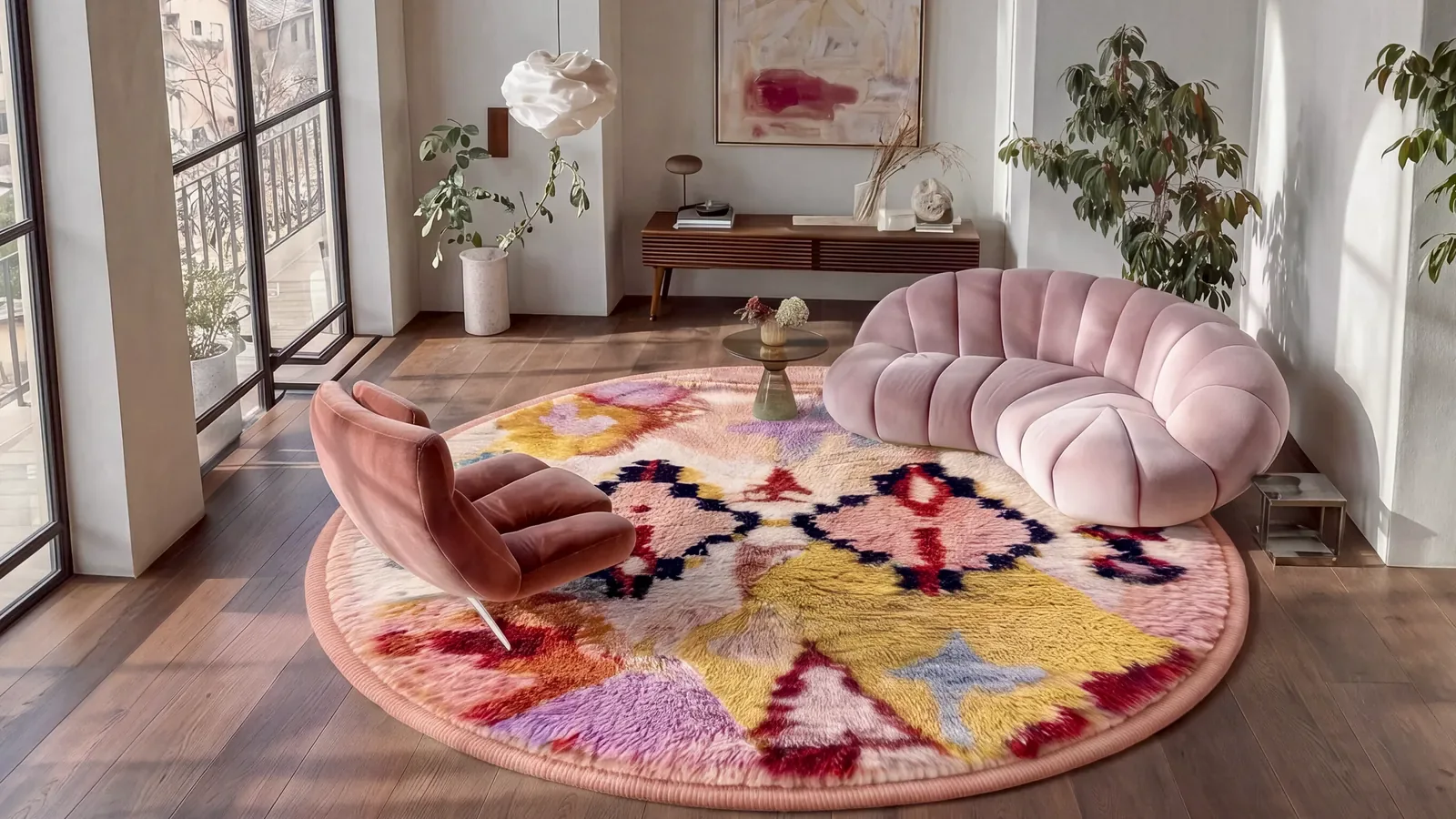
Two chairs and a round. For a fireplace used as a reading corner rather than the center of the room, turn two armchairs toward the fire with a round rug between them and a small table in the middle. Kerkour, below, shows the round before the fire with a sofa along one side; as a reading corner it gives up the sofa and keeps two chairs.
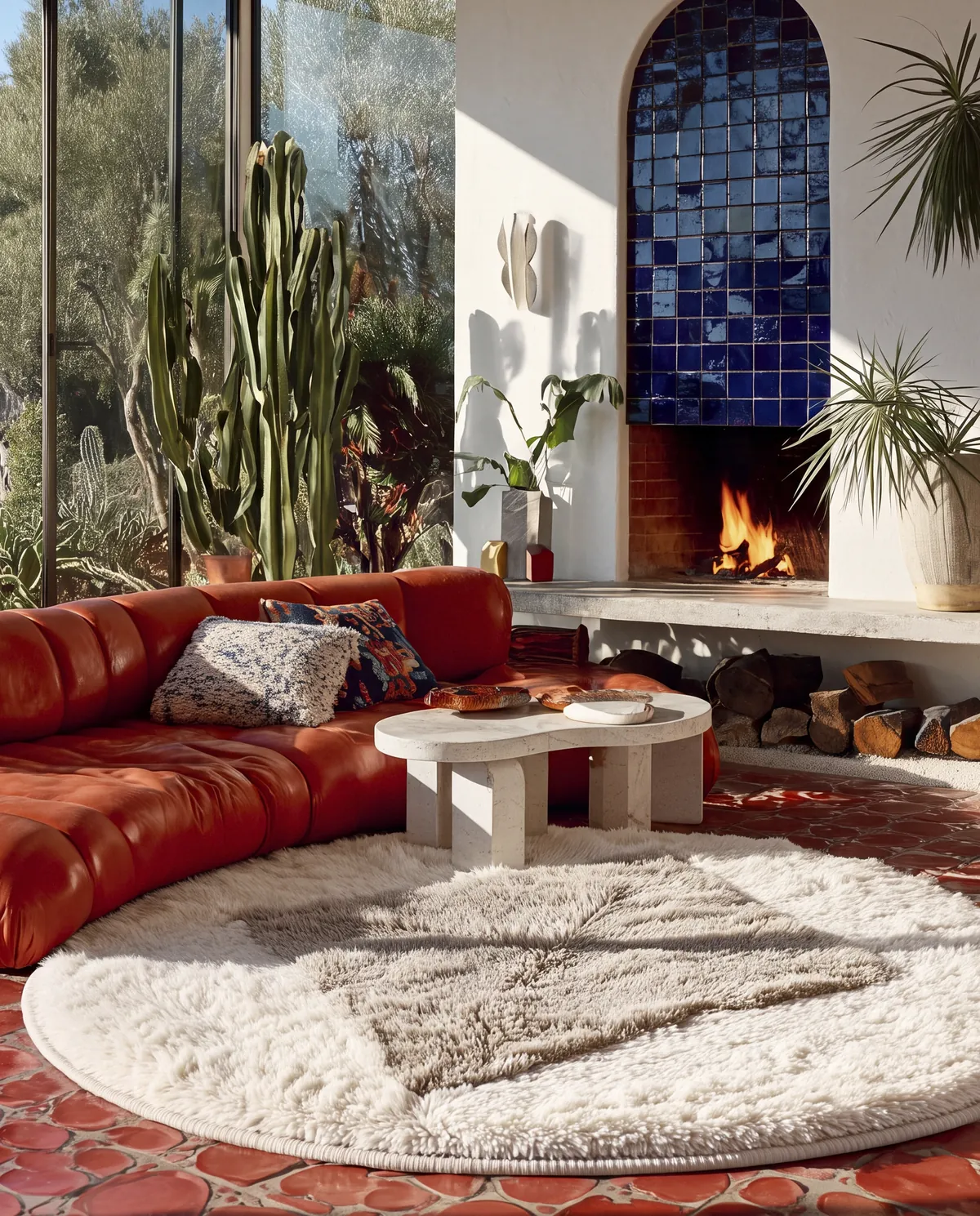
The fireplace in the corner. When the fireplace sits across a corner, forget centering on it. Center the rug on the seating group and let the fire sit at one corner of the rug, with the lane in front of the hearth still there. A corner fire with a 9x12 ft rug squared to the room's walls, not to the hearth, is the version that looks planned.
The ash that a winter leaves in the pile comes out with a suction-only vacuum, and a spot of soot is lifted dry before any water touches it; the steps are in the care guide.
A hearth that is off-center, or a seating group that needs a size the chart does not list? Send us a photo. Next: living room rug sizes in full, then the round rugs for a two-chair corner by the fire.