



Color guide
What Colors Go With a Terracotta Rug, Rust or Burnt Orange?
Clay, iron or ember: three warm reds and what they need.
By Zarbish · · 8 min read
Terracotta is a soft clay red-orange, rust is deeper and browner, and burnt orange is orange darkened with brown. All three are warm earth tones that read almost as a neutral beside wood and cream. Pair them with cream, sage or olive, cobalt or navy, blush and walnut, and keep one cool color in the room.
Key takeaways
- Terracotta is a soft clay red-orange, rust is deeper and browner, and burnt orange is orange darkened with brown; all three are warm earth tones that read as a neutral in a room of wood and cream.
- Terracotta and rust go best with cream, sage and olive, cobalt and navy, blush, ochre, walnut, rattan and brass.
- Blue is terracotta's opposite on the color wheel, so a single blue chair or cushion makes a terracotta rug look richer.
- An earth tone living room stays light when the rug is the warmest surface, the walls stay cream or white, and one cool color, blue or green, breaks up the browns.
- A terracotta rug costs what any rug of its size and construction costs; a hand-knotted wool one in natural dyes keeps its color through years of daily use if it is rotated out of constant sun.
Terracotta, rust or burnt orange: what is the difference?
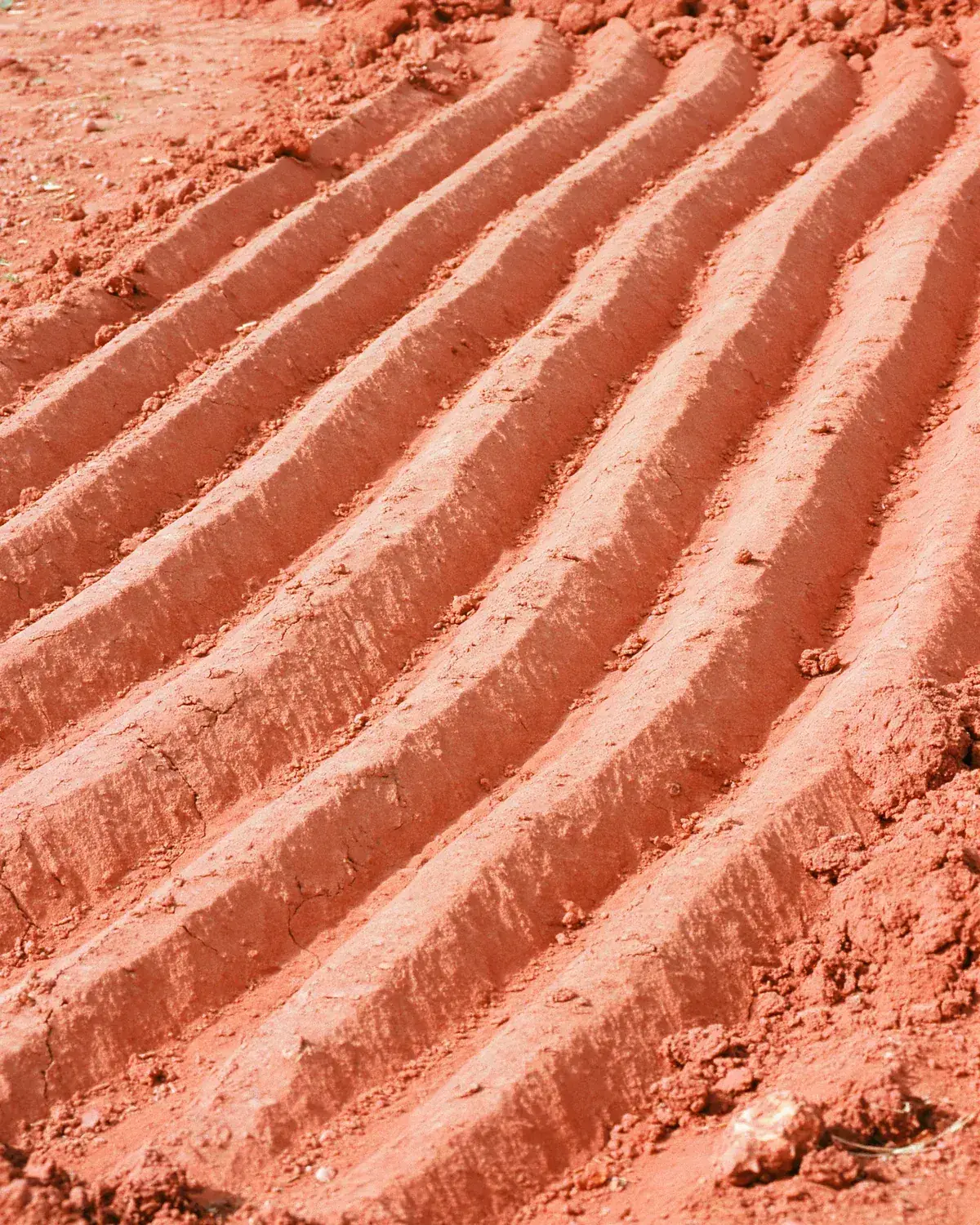
Terracotta, rust and burnt orange are all warm reds and oranges softened with brown or pink, and they differ in depth and lean. Terracotta is the lightest and pinkest, the color of fired clay pots. Rust is deeper and browner, the color of oxidized iron. Burnt orange is the most orange of the three, orange darkened toward brown.
| Shade | Reads as | Depth | Best light | Best partners | Our rug |
|---|---|---|---|---|---|
| Terracotta | Clay, soft red-orange, can lean pink | Light to mid | Any; warms a north room | Cream, cobalt, sage, blush | Tabia in terracotta, Tigmi |
| Rust | Iron, red-brown | Mid to deep | Bright rooms | Ivory, cognac, olive, navy | Tamment |
| Burnt orange | Ember, orange-brown | Mid | Bright rooms, white walls | White, black, walnut, olive | Hamada |
| Terracotta in a pattern | Clay on ivory | Light | Any | Ivory, boucle, pale wood | Ouzoud |
Which to choose: terracotta if you want warmth without weight, or your room faces north; rust if the room is bright and you want depth; burnt orange if you want the most energy from a warm color and have white walls to hold it. A terracotta on an ivory ground is the gentlest entry, and the one for a small room.
Colors that go with terracotta
Terracotta goes with cream and ivory, sage and olive green, cobalt and navy blue, blush and ochre, and with walnut, oak, rattan and brass. Each partner does something different. Cream keeps a terracotta room light. Green makes it earthy, like clay and leaves. Blue sits opposite terracotta on the color wheel, so a single blue chair makes both colors look richer. Blush softens it. The way to place those partners, each repeated twice with the big surfaces kept quiet, is the three-color method for a bold rug.
What colors go with rust?
Rust goes with cream, camel and cognac, olive and forest green, navy and slate blue, and blush. Rust is deeper than terracotta, so it wants a lighter room: white or cream walls, pale wood, and at least one cool color to stop a rust room from turning heavy.
What does not go with terracotta or rust
- Cold gray. Gray upholstery beside terracotta makes both look tired; if the sofa is gray, choose a terracotta pattern on ivory and warm the room with wood.
- Too many oranges at one strength. A rust sofa, rust curtains and a rust rug at the same depth turn the room into one block. Tone on tone works only with a clear step, as in the Tigmi room below.
- Brown on brown on brown. Terracotta, a brown leather sofa, dark wood and brown walls together close a room in. Add cream and one cool color.
How to build an earth tone living room that stays light
An earth tone living room works when the rug is the warmest surface, the walls stay light, and one cool color breaks up the browns. Earth tones are clay, rust, ochre, olive, sand, camel and brown; used all at once and all at the same depth, they make a room feel heavy. Used in layers, they make it the warmest room in the house.
- Let the rug carry the warmth. Terracotta, rust or burnt orange on the floor, the largest warm surface in the room.
- Keep the walls light. Cream, warm white or plaster. Dark earth-toned walls belong in a room with a lot of daylight.
- Add one cool color. Cobalt, navy, sage or olive, on a chair, a table or plants.
- Layer natural materials. Wood, leather, rattan, travertine, linen, clay pots.
- Repeat the rug's warm color once, higher up. A cushion, a print or a vase, so the warmth reaches eye level.
Five rooms, five warm earth tones
Each room below takes a different shade and follows at least three of those steps.
Terracotta on ivory, the gentle entry
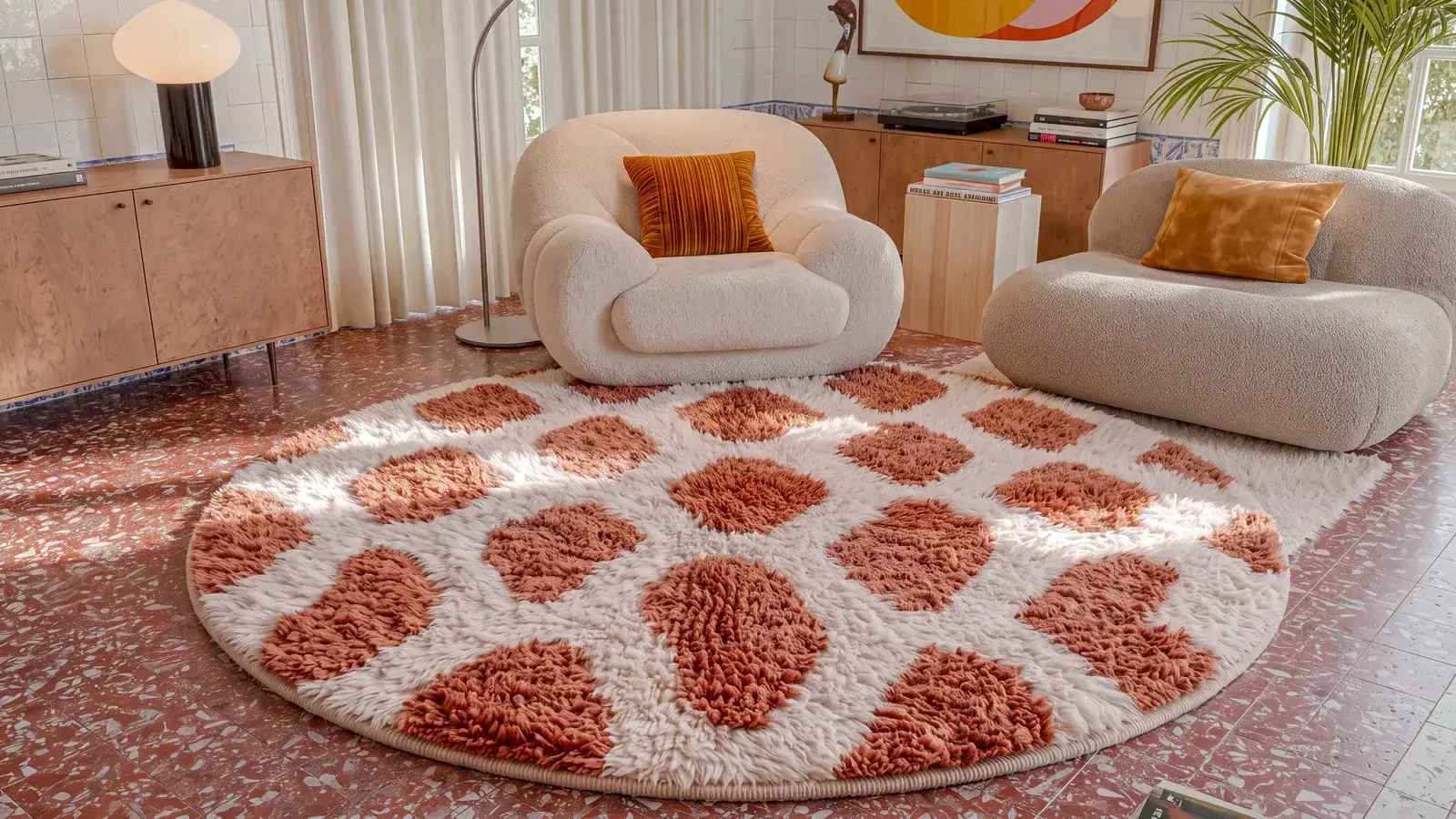
Ouzoud sets coral-terracotta pebbles in offset rows inside an ivory network; the round version reads slightly more coral than the rectangle, and it is redesigned for the circle. In the room at the top of this page, it sits between two ivory boucle lounge chairs with burnt orange and ochre velvet cushions, on a red terrazzo floor, with a pale wood sideboard, a record player and a palm by white curtains. The ivory in the rug and the boucle keep a room with a red floor from feeling hot. This is the way into terracotta for anyone unsure about it.
A solid terracotta with cobalt blue
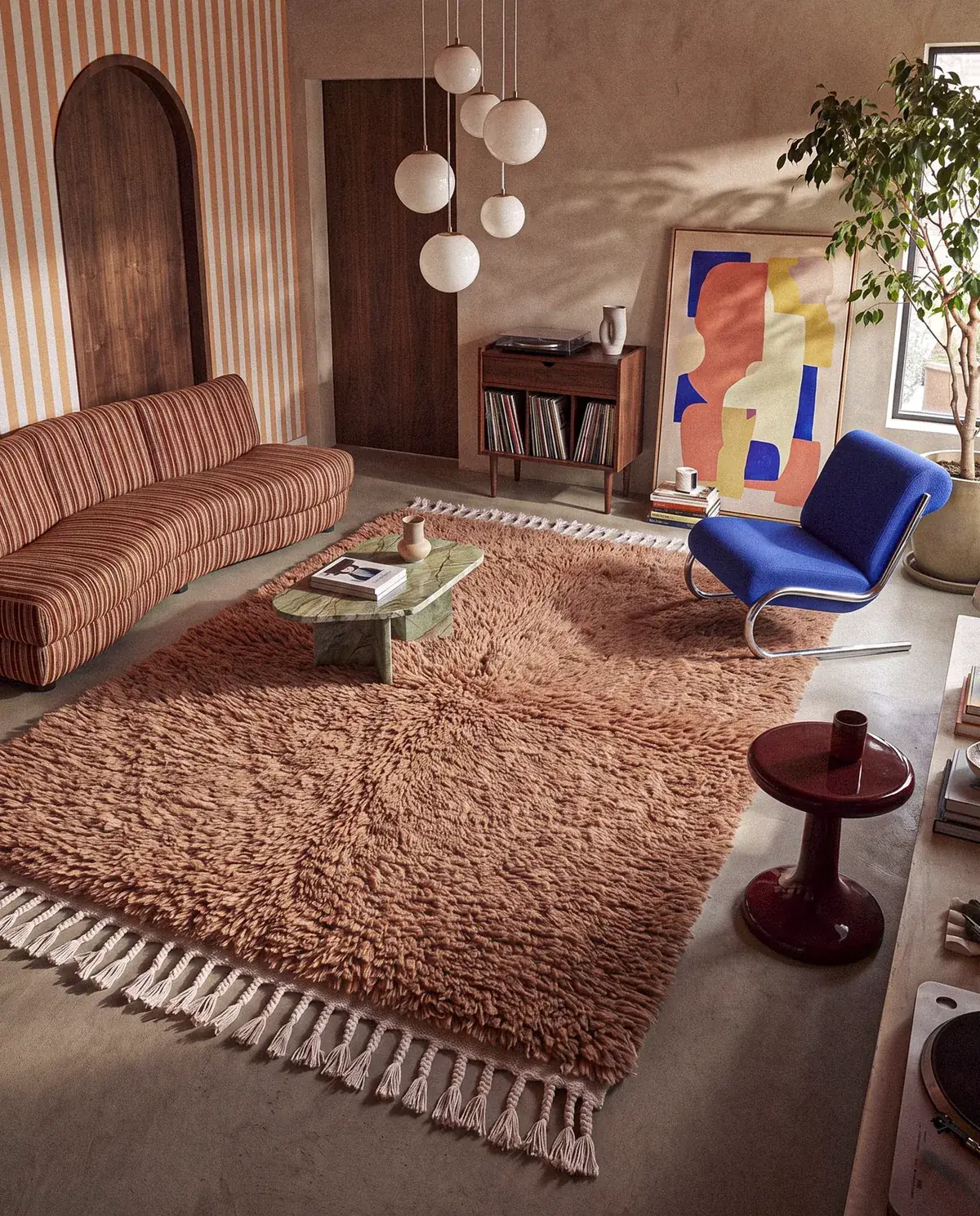
Tabia is named for the rammed-earth walls of Marrakech, and its wool is a light, pink-leaning clay, one warm color edge to edge. In the room pictured, a curved sofa striped in rust and cream sits on it with a green marble table, a cobalt blue chrome chair, an oxblood side table and a record shelf, under a cluster of globe pendants, with an arched walnut door and a striped wall behind. The cobalt chair is the one cool note and the whole room turns on it: take it away and the room is all warm, add it and the terracotta looks deeper. Our solid terracotta and other single-color rugs sit in Dune.
Burnt orange relief with white sofas
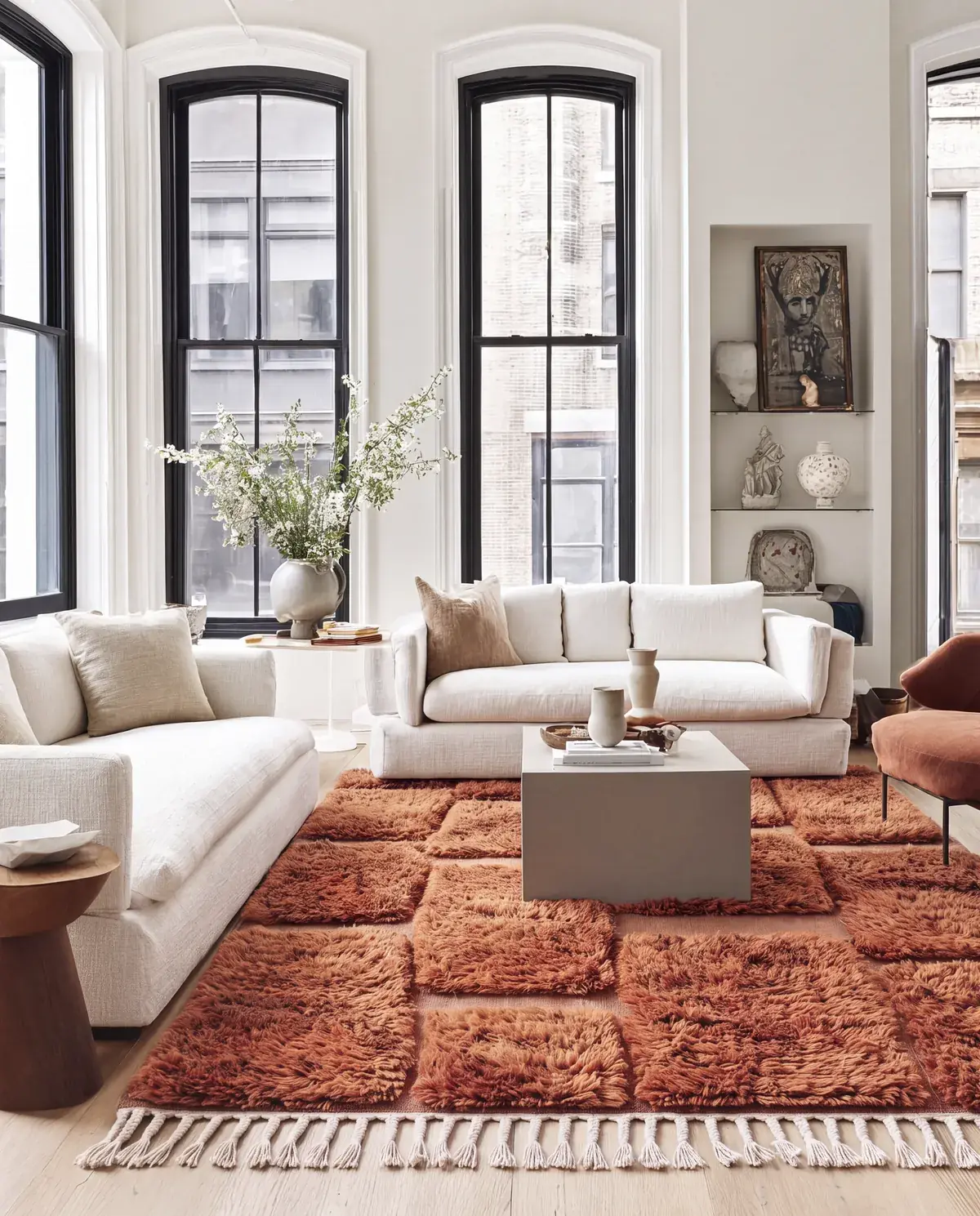
Hamada is named for the sun-baked stony plateau east of the dunes. Raised burnt orange blocks, staggered like brickwork, rise above a slightly duller orange ground. In the room pictured, two white sofas face each other across it around a pale stone block table, under tall black-framed arched windows and niche shelves of ceramics. White is burnt orange's best friend: it gives the strongest warm color in this post a clean frame, and the black window frames sharpen it. The relief makes the orange move with the light, lighter on the blocks and deeper in the channels. More sculpted rugs sit in Terrain, our Beni Mrirt rugs.
Rust and ivory in an earth tone living room
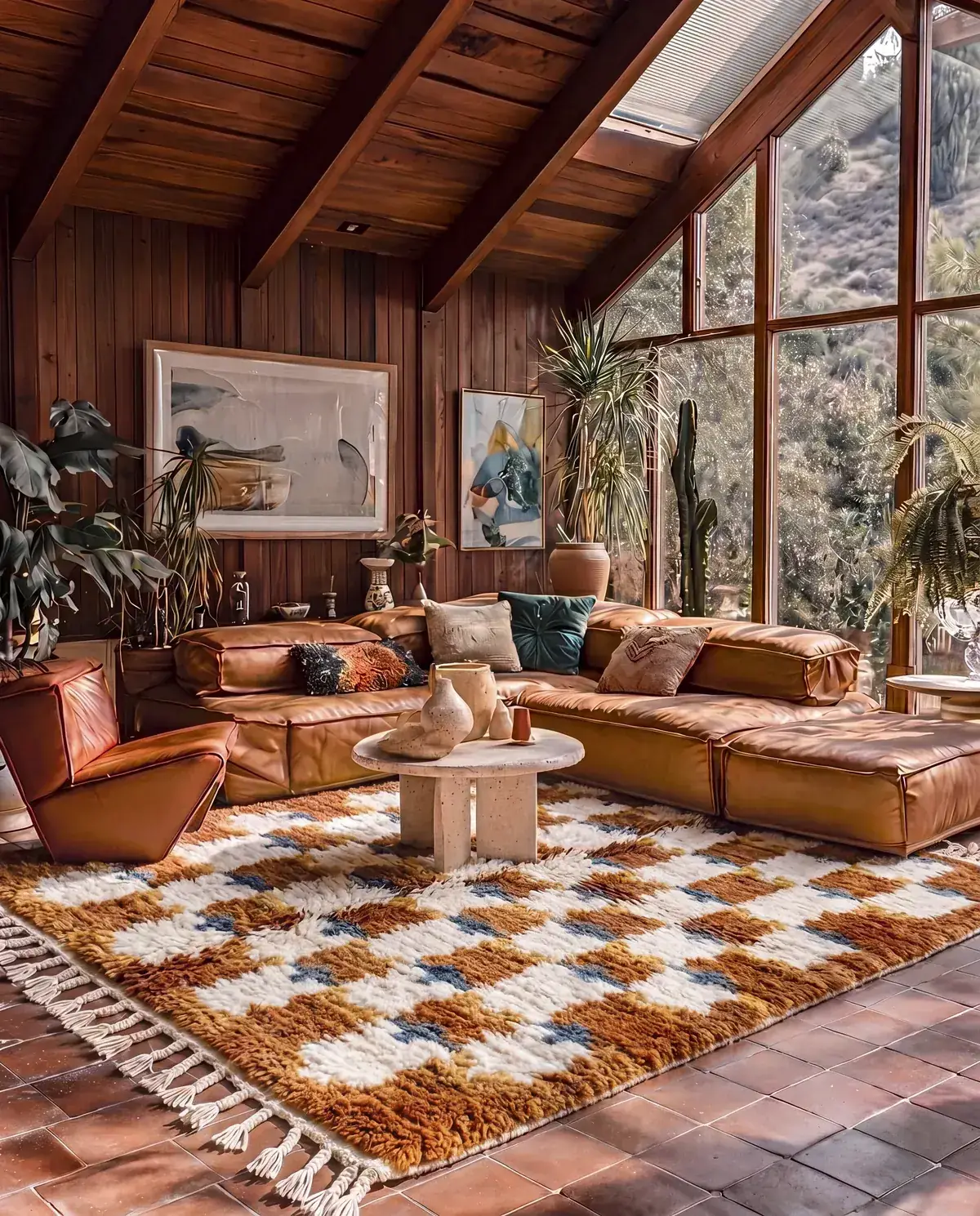
Tamment means honey in Amazigh: rounded ivory blocks sit in a rust grid, each edged in mustard, with small slate-blue marks where the blocks meet. In the room pictured, a cognac leather sectional and a leather lounge chair sit on it over terracotta tile, under a beamed wood ceiling, with cacti, a palm and a glass wall onto dry hills. It is the earth tone living room at full strength, every surface warm, and it works because the rug brings the ivory the room lacks and the slate-blue marks bring the one cool note. Grids and checks like this one live in Dama.
Tone on tone: terracotta under a rust velvet loveseat
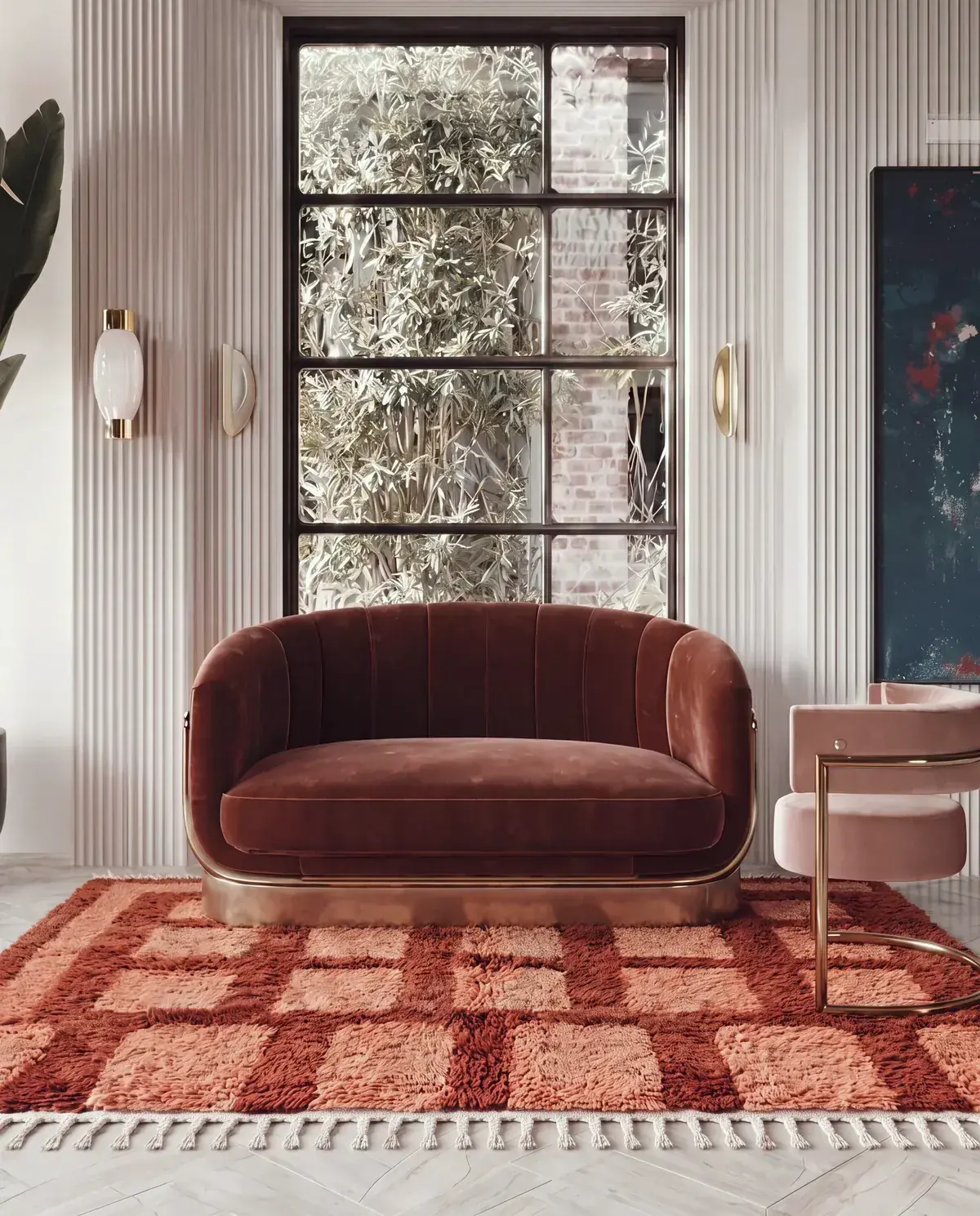
Tigmi means house in Amazigh. Peach squares sit in a terracotta windowpane grid lined in deeper rust, under a header band that repeats the grid in miniature. In the room pictured, a rust velvet loveseat on a brass base and a blush chair sit on it before fluted pale walls, brass sconces and a tall window of leaves. This is terracotta with rust done right: the sofa is a clear step deeper than the rug, the peach in the rug is lighter than both, and the pale walls hold the whole warm group. Rust on terracotta fails only when the two sit at the same depth.
Terracotta rug with your sofa
A terracotta or rust rug suits cream, white, olive, cognac and blue sofas best. A gray sofa needs the warm rug more than any other, but choose terracotta on ivory rather than a solid rust, so the gray does not look dull beside it. A rust sofa takes a terracotta rug a clear step lighter, as in the Tigmi room. Sofa by sofa, with more rooms: what color rug goes with your couch. For olive or forest green beside terracotta, see sage, olive and forest greens.
Is terracotta outdated?
No. Terracotta is the color of fired clay and has been part of houses for as long as there have been tiles and pots. It had a strong moment in the 1970s and has another now, which is why people ask. In natural wool, beside wood and cream, it reads as a material rather than a trend, and material colors date slowly. What does date quickly is a bright, flat synthetic orange; a terracotta wool pile moves with the light, brighter on the tips and deeper in the shadows between them, which no print copies.
Are terracotta rugs expensive, and how long do they last?
A terracotta rug costs what any rug of its size and construction costs; the color does not change the price. What changes the price is how it is made: a printed or tufted rug is cheaper, a hand-knotted wool rug costs more and lasts far longer. Ours are hand-knotted in wool; what you pay for is in are Moroccan rugs worth it.
A dense hand-knotted wool rug is built for years of daily use, and its color lasts with it when two things hold. The dye has to be fixed: ours are natural dyes, set so the color does not transfer or shift with use, and the workshop wash checks each color against the final design before the rug ships. And the sun has to be managed: constant direct sun fades any natural fiber, so rotate the rug twice a year and keep it out of a spot that gets sun all day (care guide).
Every warm rug across our collections sits in two places: terracotta and rust rugs and orange rugs.
Torn between clay and iron? Send a photo of the room. Next: what color rug goes with your couch, then every orange Moroccan rug.
For the people who make rooms worth sharing: Zarbish Creators


